+0.95%
+1.73%
-15.99%
+0.86%
+1.60%
+2.42%
The Australian Securities and Investments Commission (ASIC) believes that cryptocurrency regulation should align with existing financial laws, treating crypto as a technology performing the same functions as traditional financial infrastructure.
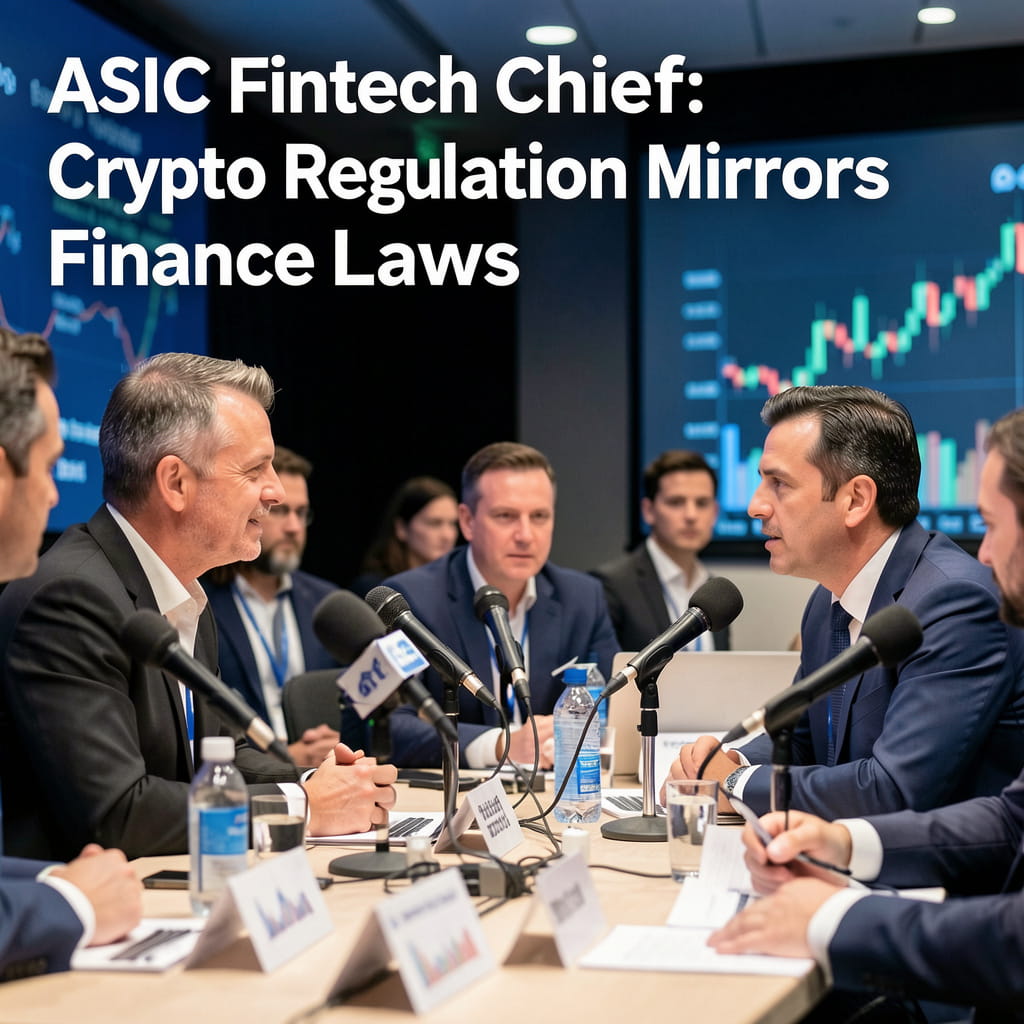
ASIC’s head of fintech, Rhys Bollen, presented this view at the Melbourne Money & Finance Conference on . Bollen argued against creating separate asset classes for crypto when crafting legislation, advocating for regulation based on “economic substance rather than technological form”.
Rhys Bollen, ASIC’s head of fintech, stated that tokenized securities should be subject to securities laws, and stablecoins should trigger payment services legislation. He also noted that other aspects of crypto might fall under consumer protection laws. This approach contrasts with crypto-specific regulatory frameworks like the CLARITY Act in the US and the Markets in Crypto-Assets Regulation in Europe.
Bollen explained that the three primary financial functions — capital allocation, payments, and risk management — have evolved alongside technological advancements. He asserted that distributed ledger technologies, including blockchain, should not be treated differently. According to Bollen, Digital assets largely represent new technological instances of longstanding financial activities. While the mechanisms of issuance, transfer and record-keeping have changed, the underlying economic functions served
.
Australia is already implementing this approach with the Digital Asset Framework bill, which seeks to amend parts of the Corporations Act. Bollen stated that The Bill does not abandon the existing financial services framework. Instead, it introduces tailored amendments that integrate digital asset platforms into the established regulatory architecture
.
ASIC Information Sheet 225 provides guidance to the Australian crypto market, stating that existing definitions of “financial product” and “financial service” under the Corporations Act can apply to digital assets. ASIC’s guidance rejects the idea of digital assets as a separate regulatory asset class, confirming that a digital asset may fall within the regulatory perimeter if it functions as a security, derivative, managed investment scheme interest, or non-cash payment facility.
Bollen said that focusing on “economic characteristics rather than technological labels” would enable regulators to provide clearer rules to market participants and reduce “opportunities for regulatory arbitrage”. ASIC Information Sheet 225 focuses on regulating intermediaries rather than tokens, as Bollen noted that most consumer harm in the digital asset industry has come from crypto platforms offering custody, trading, lending, or yield services.
The specific details of how decentralized offerings will be regulated remain unclear, though Bollen suggested focusing on practical control and benefit rather than formal claims of decentralization.
Further legislative developments and regulatory guidance are expected in Australia as the country continues to integrate digital assets into its existing financial framework. This approach could influence other jurisdictions grappling with crypto regulation, potentially leading to more convergence between traditional finance laws and crypto-asset oversight.
Follow Hashlytics on Bluesky, LinkedIn , Telegram and X to Get Instant Updates