What Each Database Server Enables
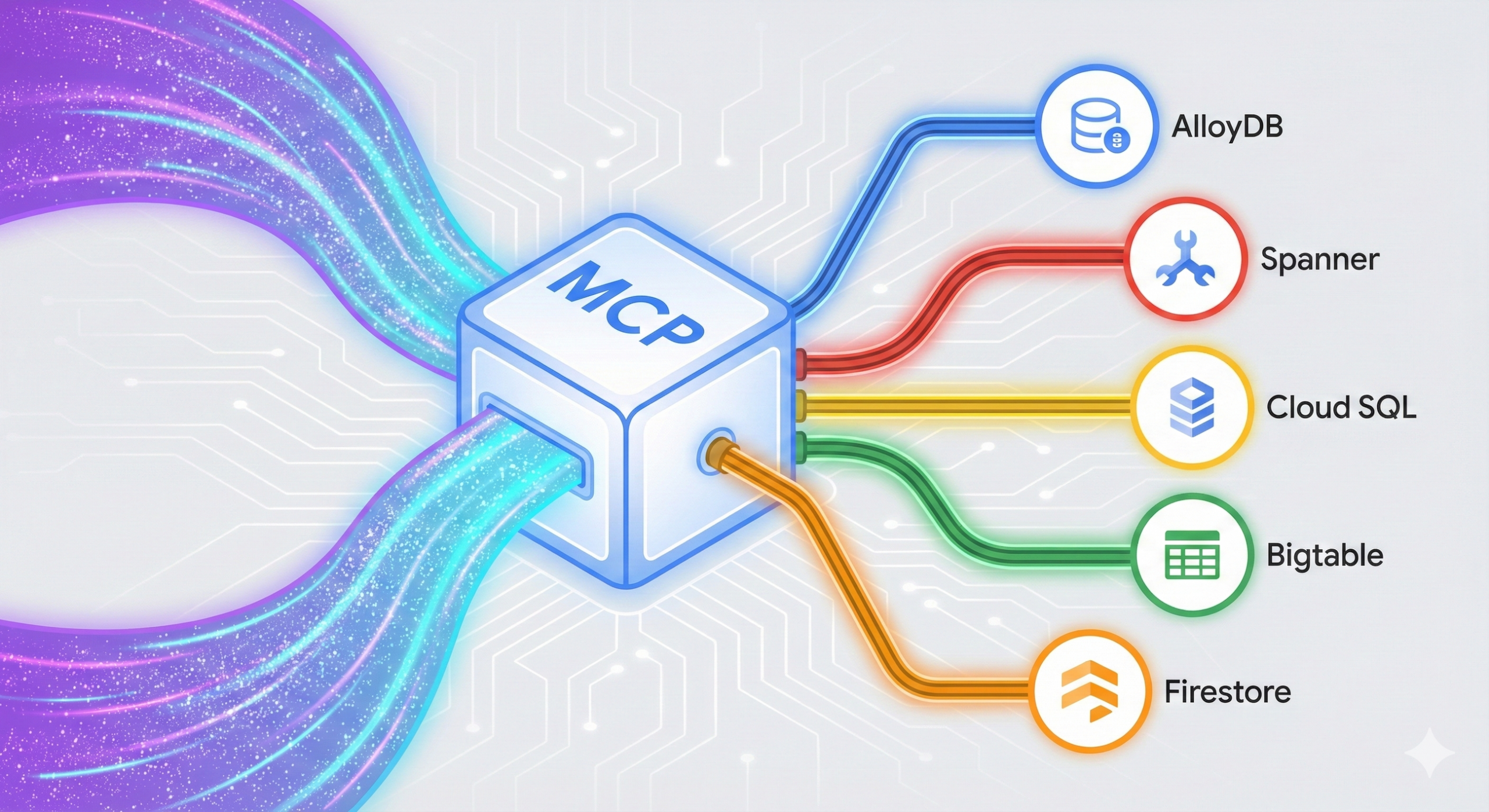
AlloyDB for PostgreSQL supports schema creation, query diagnostics, and vector similarity search for AI-powered retrieval applications. The MCP server exposes these capabilities through conversational interfaces, allowing agents to troubleshoot slow queries or build semantic search features without writing SQL.
Spanner adds MCP support for both SQL and GQL (graph query language) through Spanner Graph, enabling agents to detect fraud patterns or generate recommendations by modeling relationships like social networks and transaction chains directly in queries.
Cloud SQL extends MCP access across PostgreSQL, MySQL, and SQL Server fleets. Database administrators can use natural language to provision instances, optimize queries, and migrate data from local storage through agents like Gemini CLI.
Bigtable MCP servers target operational automation for time-series data and high-throughput workloads in customer support, CRM, HR systems, supply chain, and logistics applications.
Firestore enables agents to sync with live document collections for mobile and web applications, checking user session states or order statuses through conversational prompts.
Developer Knowledge MCP server connects IDEs to Google’s official documentation, allowing agents to answer technical questions and troubleshoot code by referencing current platform guides in real time.
Authentication and Audit Architecture
The implementation uses Identity and Access Management (IAM) for authentication rather than shared database credentials. Agents receive IAM roles granting access only to specific tables or views, enforcing least-privilege security. Every database interaction logs automatically to Cloud Audit Logs, providing security teams with complete visibility without additional configuration.
This approach eliminates credential rotation requirements and audit gaps that typically accompany direct database access. Organizations can grant agents narrow permissions through IAM policies and revoke access instantly without touching database-level authentication.
Integration Pattern
Google Cloud manages the MCP server infrastructure, exposing connection endpoints that agents reference in their configuration. Users point AI agents—whether Gemini, Claude, or other MCP-compliant clients—to these endpoints without provisioning servers or managing deployments.
For third-party agents like Anthropic’s Claude, integration requires adding a custom connector in settings that points to the Google Cloud database MCP endpoint. The managed infrastructure handles protocol translation between the agent’s requests and database operations.
Planned Expansion
Google Cloud indicated it will extend MCP support to Looker, Database Migration Service, BigQuery Migration Service, Memorystore, Pub/Sub, Kafka, and additional services in coming months. This roadmap suggests a strategy where agents can orchestrate data pipelines, analytics workflows, and infrastructure management alongside database queries through a unified protocol.
The expansion positions MCP as Google Cloud’s standard interface for AI agent access across its platform, potentially reducing the custom integration work required when deploying agents that need multi-service access.
Market Positioning
The announcement follows Anthropic’s December 2024 release of the Model Context Protocol specification, which Google Cloud adopted for its first MCP implementations in January 2026 covering BigQuery and Cloud Storage. By extending support to operational databases, Google Cloud addresses use cases where agents need real-time data access rather than analytical query results.
The managed approach differentiates from self-hosted MCP servers that require users to deploy and maintain protocol translation layers. Organizations can connect agents to production databases through Google Cloud’s infrastructure while retaining IAM-based access controls and audit compliance that internal security policies typically mandate for database connectivity.
For developers, the immediate value centers on eliminating boilerplate code for database access in agentic applications. Rather than building custom APIs that translate agent requests into SQL queries, applications can route natural language instructions directly to MCP endpoints that handle query generation, execution, and result formatting.
Follow us on Bluesky , LinkedIn , and X to Get Instant Updates