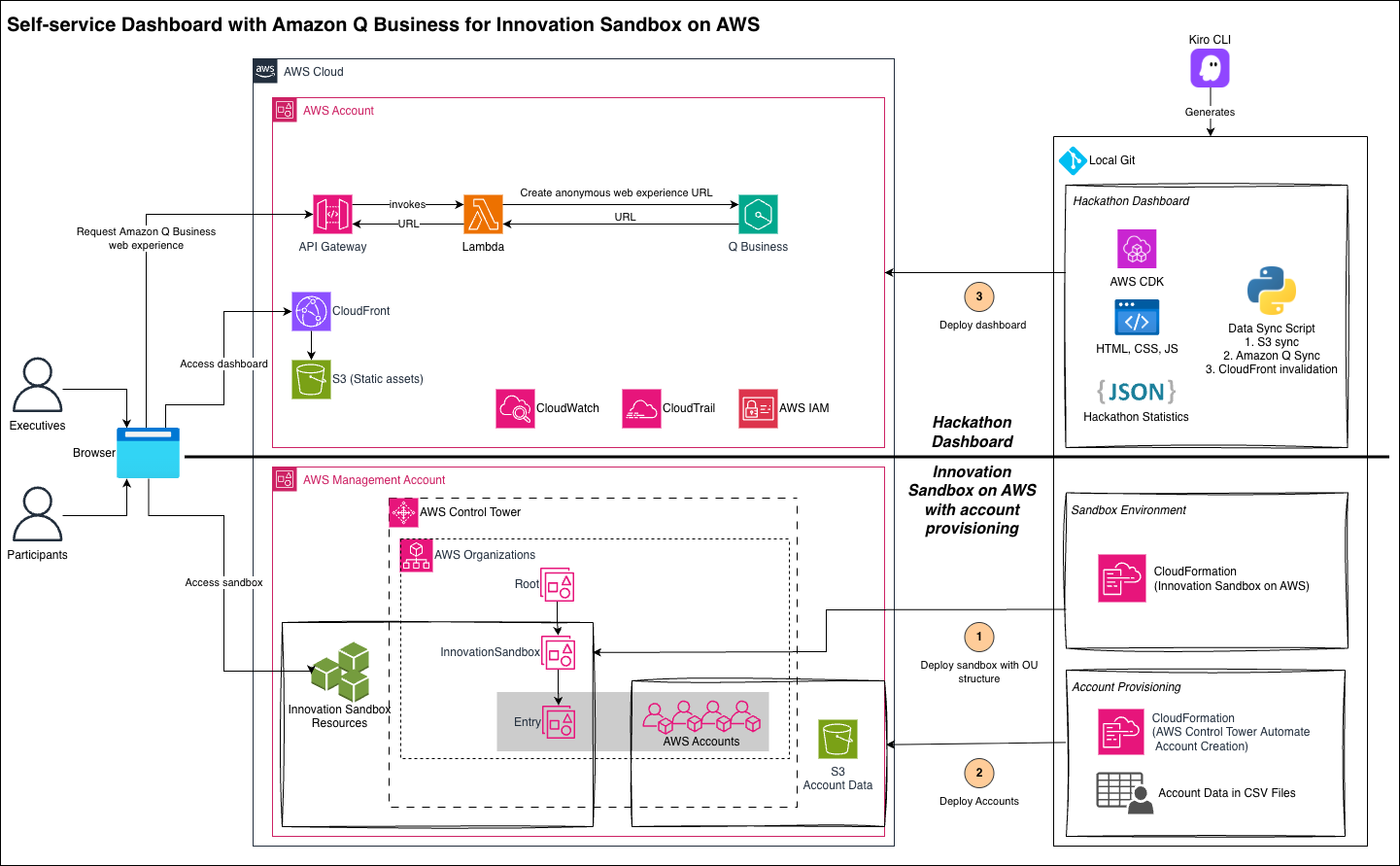
The solution AWS offers is something called an Innovation Sandbox: a framework for spinning up temporary, secure, isolated cloud environments at scale. Think of it as a pre-packaged playground for developers, with guardrails already baked in. Here’s how to build one.
Step 1: Automate Account Provisioning with AWS Service Catalog
Manually creating hundreds of AWS accounts is a non-starter. Instead, define a standardized account baseline using AWS CloudFormation — a BatchAccountCreation.yaml template that acts as your repeatable recipe for every sandbox environment.
AWS Service Catalog then turns these templates into a curated, self-service portfolio. Organizers trigger parallel account creation via its APIs, cutting provisioning time from hours down to minutes. Every participant gets an identical environment—preconfigured with IAM roles, network settings, and spending limits already locked in place.
Step 2: Build a Custom Analytics Dashboard
Once teams are building, the next challenge is visibility. You need real-time insight into what’s happening across hundreds of accounts — spending, progress, engagement. A custom dashboard becomes the central nervous system of your event, displaying the agenda, hosting a knowledge base, and providing support channels.
Here’s where it gets interesting. Integrating Amazon Q Business lets both participants and organizers ask natural language questions about documentation or event logistics and get context-aware answers back instantly. The backend typically runs on serverless components like AWS Lambda for data processing, with CORS-enabled APIs feeding a web frontend — giving you a single pane of glass for the whole event.
Step 3: Lock Down Governance and Security
Freedom to experiment shouldn’t mean freedom to blow through budgets or compromise security. Build the entire solution following the AWS Well-Architected Framework, and reference the official Innovation Sandbox Implementation Guide for a prescriptive architecture to follow.
Governance here means things like automated budget alerts via Amazon SES, clearly defined admin versus participant roles, and lease templates that set hard limits on both duration and spend per sandbox account. Clean separation of duties keeps everything under control without micromanaging the teams.
The AI-Assisted Twist
One smart move gaining traction is ditching static code snippets in favor of prompt engineering. Rather than handing developers boilerplate, you give them well-crafted prompts for tools like Amazon Q that generate CDK scripts tailored to specific architectures. It encourages deeper understanding of the underlying services while still moving fast — collaborative, AI-assisted development inside your sandbox.
Get the provisioning, dashboard, and governance pillars working together, and you’ve got an Innovation Sandbox that actually lets builders focus on building. That’s the whole point.
Follow us on Bluesky , LinkedIn , and X to Get Instant Updates