NVIDIA has introduced cuTile BASIC, a GPU computing framework that enables developers to write CUDA-accelerated code using BASIC, one of computing’s oldest programming languages. The tool brings tile-based matrix operations to legacy BASIC codebases, allowing developers familiar with the language to leverage modern GPU hardware for AI and scientific computing workloads.
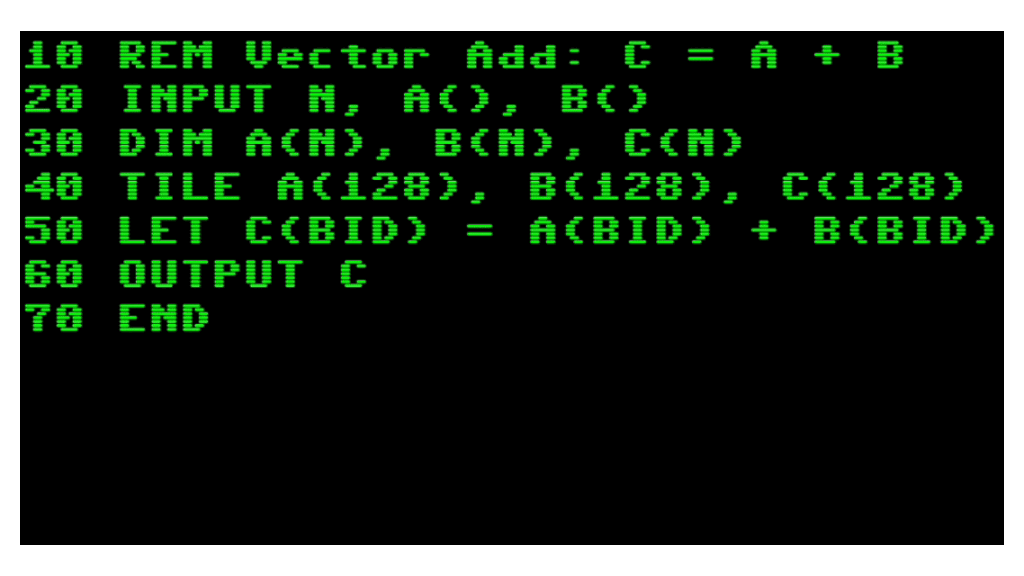
cuTile BASIC extends BASIC syntax with GPU-specific constructs designed for tensor operations. The framework introduces the TILE keyword to specify how data subdivides into blocks, and the MMA function for matrix multiply-accumulate operations. According to NVIDIA’s documentation, developers can express complex algorithms in remarkably few lines of code.
A 512×512 matrix multiplication kernel demonstrates the approach. The code specifies tile dimensions (128×32 for matrix A, 32×128 for B, and 128×128 for the accumulator) and iterates through computation blocks. NVIDIA’s implementation compiles to CUDA binaries (cubin format) and executes on GPU hardware, delivering verified results with floating-point precision within 0.005 tolerance.
cuTile BASIC compiles to the CUDA Tile IR specification, an intermediate representation designed for tile-based computing. This architecture allows BASIC programs to access GPU tensor cores without manually managing thread hierarchies or memory layouts.
The compilation pipeline includes two stages: first, cuTile BASIC code compiles to cubin GPU binaries; second, kernels launch on GPU hardware. In demonstrated examples, grid size automatically scales based on tile dimensions and matrix sizes, abstracting parallelization details from developers.
The framework targets legacy BASIC codebases that could benefit from GPU acceleration, particularly in AI and scientific computing. Matrix operations underpin large language model inference and training, making GPU-accelerated linear algebra critical for modern AI workloads.
NVIDIA frames cuTile BASIC as demonstrating the broader CUDA software stack’s flexibility. The company suggests cuTile could theoretically integrate with nearly any programming language via the CUDA Tile IR format, though practical language support remains limited to BASIC at launch.
- Specific performance benchmarks against native CUDA C or Python implementations
- Availability timeline and official release date
- Supported NVIDIA GPU architectures and compute capabilities
- Whether cuTile BASIC supports custom operators beyond matrix operations
cuTile BASIC represents a niche but symbolically significant development in GPU computing accessibility. By lowering barriers for BASIC-fluent developers to access modern hardware, NVIDIA expands the tent for GPU-accelerated computing. However, practical adoption likely remains limited to educational contexts and legacy system modernization rather than new production systems.
10 REM GEMM: C(M,N) = A(M,K) * B(K,N) 15 INPUT M, N, K, A(), B() 20 DIM A(M, K), B(K, N), C(M, N) 30 TILE A(128, 32), B(32, 128), C(128, 128), ACC(128, 128) 40 LET TILEM = INT(BID / INT(N / 128)) 50 LET TILEN = BID MOD INT(N / 128) 60 LET ACC = 0.0 70 FOR KI = 0 TO INT(K / 32) - 1 80 LET ACC = MMA(A(TILEM, KI), B(KI, TILEN), ACC) 90 NEXT KI 100 LET C(TILEM, TILEN) = ACC 110 OUTPUT C 120 END
$ python examples/gemm.py [1/2] Compiling to cubin ... M=512, N=512, K=512, tile_shapes={'A': [128, 32], 'B': [32, 128], 'C': [128, 128]}, grid_size=16 [2/2] Launching kernel on GPU ... Results (showing 5 samples of 512x512 = 262144 elements): C[0,0] = -0.1199 (expected -0.1199) C[0,1] = -14.4456 (expected -14.4456) C[256,0] = -15.8891 (expected -15.8891) C[256,1] = -2.8646 (expected -2.8646) C[511,511] = 11.4724 (expected 11.4724) VERIFICATION PASSED (max_diff=0.000012, tol=0.005120)
Follow Hashlytics on Bluesky, LinkedIn , Telegram and X to Get Instant Updates