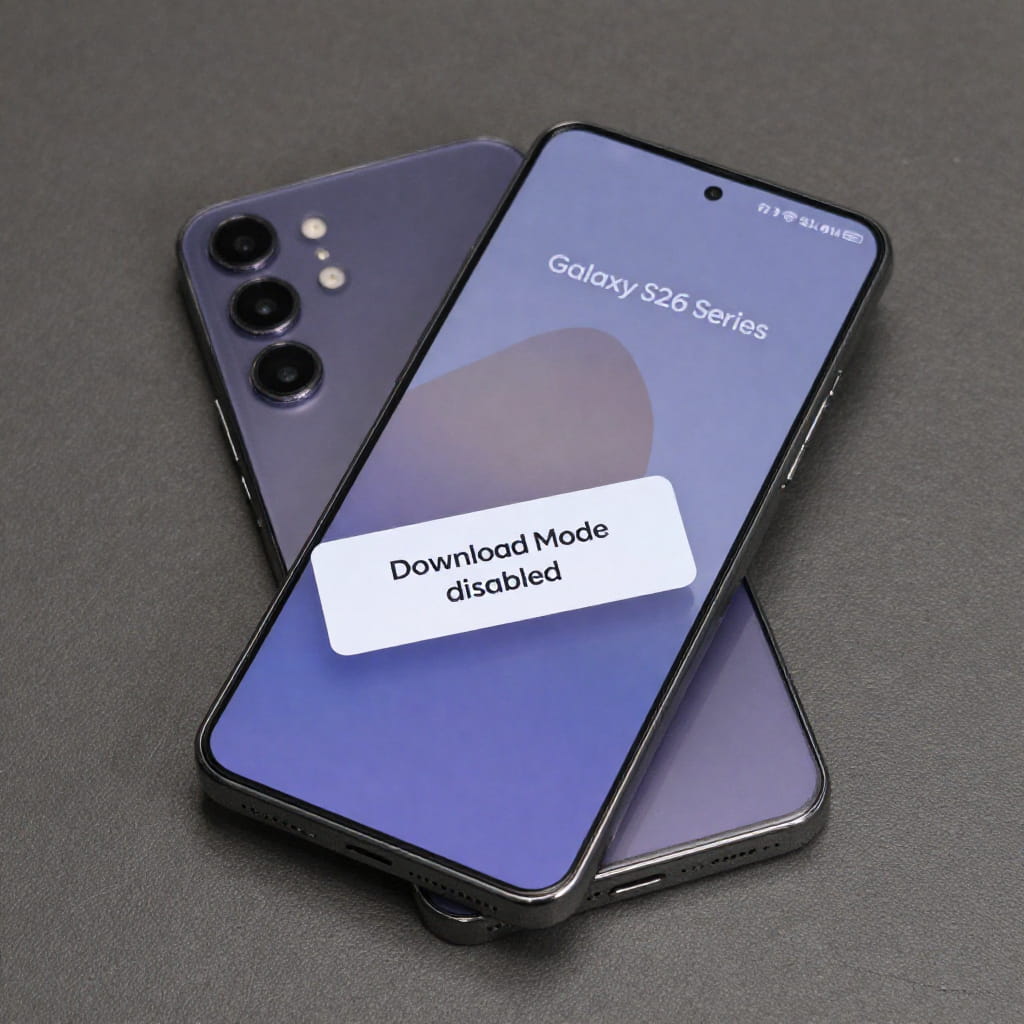
Samsung disabled Download Mode and eliminated Odin firmware flashing support starting with the Galaxy S26 series and Galaxy Z Fold 7 running One UI 8.5, confirmed through widespread reports from power users, leakers, and independent repair technicians on March 11, 2026.
Users attempting to enter Download Mode through traditional button combinations now encounter a blank blue screen with basic reboot instructions instead of the firmware flashing interface that has existed on Galaxy devices for over a decade.
What Changed and Which Devices Are Affected
According to prominent tipster Ice Universe and multiple tech outlets including Android Authority and Android Headlines, the change affects firmware builds ending in “xxC3” — specifically targeting the Galaxy S26, S26+, S26 Ultra, and Galaxy Z Fold 7. When users hold Volume Down + Power to enter Download Mode, devices display an exit screen rather than the familiar Odin-compatible interface that previously allowed firmware flashing via USB connection.
Download Mode served as the gateway for Odin, Samsung’s proprietary desktop tool used for installing official firmware packages, downgrading software to previous versions, installing custom ROMs, and recovering bricked devices. Without Download Mode access, these operations become impossible through standard methods. Samsung has not issued an official statement explaining the decision, though the timing coincides with One UI 8.5 beta development and recent firmware leak incidents.
| Affected Models | One UI Version | Status |
|---|---|---|
| Galaxy S26 / S26+ / S26 Ultra | One UI 8.5 | Download Mode disabled |
| Galaxy Z Fold 7 | One UI 8.5 | Download Mode disabled |
| Galaxy S25 / S24 (some reports) | One UI 8.5 firmware | Potentially affected in future updates |
| Galaxy A / M / Tab series | Future One UI 8.5 updates | Expected to follow |
Why Samsung Killed Download Mode
Industry observers identify two primary motivations behind Samsung’s decision. First, the company implemented A/B seamless update architecture on the S26 series, allowing firmware updates to install in the background on a separate system partition while users continue operating the device. This eliminates recovery mode failures during updates and reduces the technical need for Download Mode among average users.
Second, and more significantly, Download Mode enabled enthusiasts and leakers to extract and share internal Samsung firmware builds before official release. Recent One UI 9.0 development builds circulated online weeks before Samsung’s intended reveal, undermining the company’s marketing strategy and potentially exposing unfinished features to competitors. By removing the flashing gateway, Samsung tightens ecosystem control and prevents premature software disclosure.
What Power Users Lose
The Download Mode removal creates several immediate consequences for advanced users and independent repair operations. Users can no longer manually downgrade firmware if a new update introduces bugs, performance regressions, or battery drain issues — forcing reliance on Samsung’s official fix timeline rather than rolling back to stable previous builds.
Custom ROM development effectively dies on affected devices. Without Download Mode, the community cannot flash custom recoveries like TWRP or install LineageOS, Pixel Experience, or other third-party Android distributions that extend device lifespan beyond Samsung’s official support window. Independent repair shops lose the ability to recover soft-bricked devices through Odin, requiring customers to visit official Samsung service centers with proprietary recovery tools.
Security researchers and forensic investigators who relied on Download Mode for extracting firmware packages or analyzing system partitions now face significant barriers. The closed ecosystem approach mirrors Apple’s locked-down iPhone architecture but contradicts Android’s historical openness and repairability principles.
The S22 Concern and End-of-Life Devices
Community discussions highlight particular concern for Galaxy S22 users expecting One UI 8.5 as their final major update. Once Samsung pushes One UI 8.5 firmware to S22 devices — likely in coming months — these phones will permanently lose Download Mode access despite having years of potential functional lifespan remaining.
Unlike newer S26 devices that launched without Download Mode from day one, older devices receiving One UI 8.5 updates will experience a fundamental capability removal mid-lifecycle. Users cannot opt out of the change without forgoing security patches and feature updates, creating a forced choice between security maintenance and firmware flashing capabilities.
The situation becomes particularly problematic when the One UI 8.5 update itself introduces issues. As one community member noted, “it will be sad moment for the people who updated to One UI 8.5 and it’s the last update for their phone mostly S22 users.” If the final update causes problems, affected users have no fallback option — they’re locked into potentially degraded performance with no downgrade path.
Security vs. Repairability Trade-offs
Samsung’s shift reflects broader industry trends prioritizing security and ecosystem control over user agency and repairability. The company has not confirmed whether the change aims to combat software piracy, prevent warranty fraud through firmware manipulation, or simply standardize around seamless A/B updates that make recovery modes obsolete.
Cybersecurity experts generally support locked bootloaders and restricted firmware access as protections against malware installation and unauthorized system modifications that could compromise device security. However, right-to-repair advocates argue that eliminating user-accessible recovery mechanisms concentrates repair power exclusively with manufacturers, potentially increasing costs and reducing device longevity.
What Alternatives Remain
Samsung officially recommends Smart Switch as the sanctioned firmware recovery and management solution. The desktop application can reinstall factory firmware and restore devices to working state using official Samsung servers, though it lacks Odin’s flexibility for custom firmware installation or downgrading to specific older builds.
Authorized Samsung service centers retain access to proprietary in-house tools for complex repairs and firmware recovery operations unavailable to independent shops or end users. For average consumers, over-the-air (OTA) updates remain the primary and most secure firmware delivery method — which Samsung argues makes Download Mode redundant for 95%+ of users.
Advanced users are investigating potential workarounds including ADB commands, bootloader exploits, or hardware-level JTAG flashing methods, though none provide the straightforward reliability of Download Mode. The modding community’s historical ingenuity suggests bypass methods may eventually emerge, but Samsung’s firmware signature verification and hardware-enforced security make circumvention increasingly difficult with each generation.
Industry Implications and Future Outlook
Samsung’s Download Mode removal establishes a precedent other Android manufacturers may follow, particularly as seamless A/B update systems become standard across flagship and mid-range devices. The change positions Galaxy devices closer to iPhone’s fully locked ecosystem while maintaining Android’s underlying openness for developers and sideloading — creating a hybrid model that satisfies regulatory requirements while restricting low-level system access.
For the enthusiast community that helped popularize Galaxy devices through custom ROM development and firmware modding, the change represents a significant loss. Beebom notes Samsung is “killing custom ROMs” with the update, while Android Authority called it a “serious gut punch to Galaxy power users.” Whether Samsung reverses course based on community feedback or continues tightening ecosystem control in future One UI releases remains to be seen.
The decision arrives as global shipment leader Samsung faces increasing competition from Chinese manufacturers offering more open firmware policies and easier bootloader unlocking procedures. If power users and enthusiasts migrate toward brands maintaining Download Mode equivalents, Samsung risks losing influential early adopters who drive platform evangelism and technical innovation within the Android ecosystem.
Follow us on Bluesky, LinkedIn, and X to Get Instant Updates