+4.86%
+7.11%
+6.88%
+3.56%
-2.67%
+7.03%
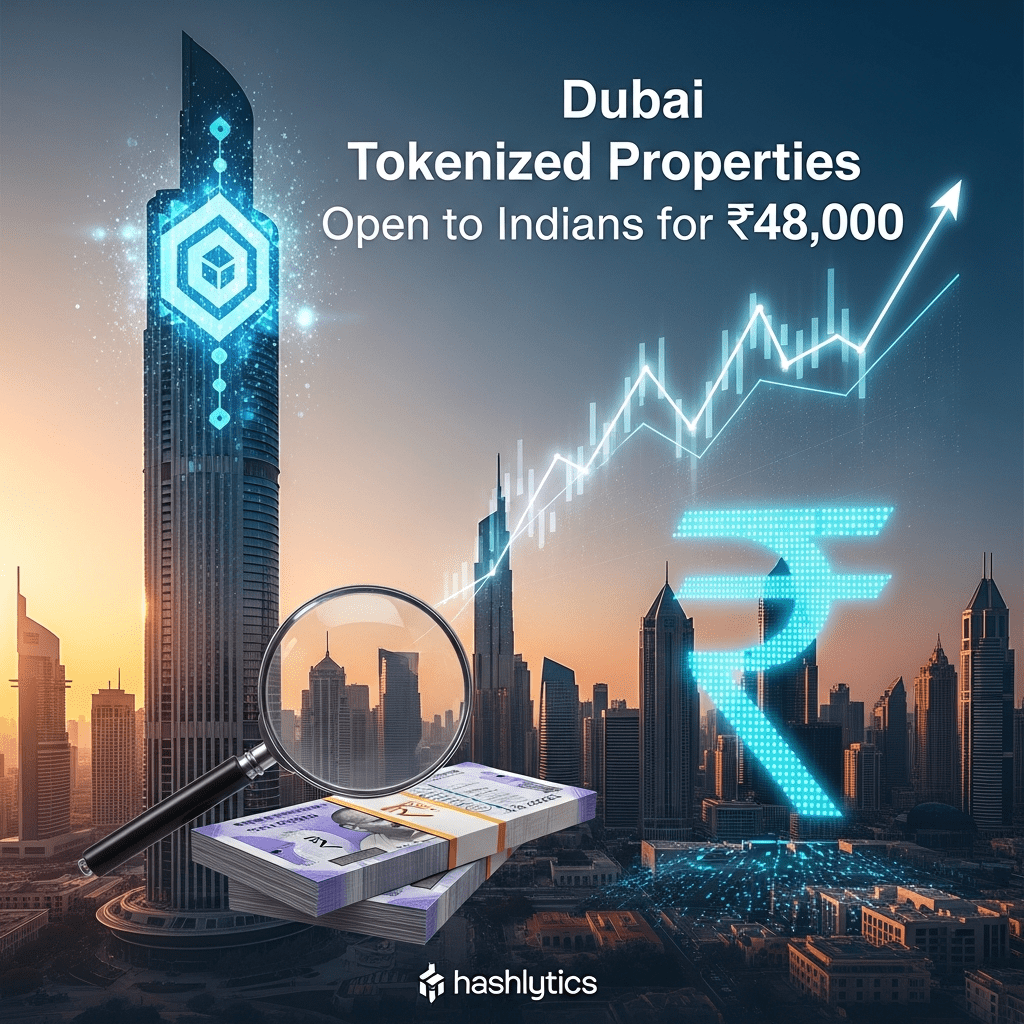
The allure of owning property in Dubai, previously exclusive to the affluent, is now within reach for a wider range of investors, including those in India, thanks to tokenization. With investments starting as low as ₹48,000 (AED 2,000), individuals can co-own a share of Dubai’s flourishing real estate market, a paradigm shift enabled by blockchain technology.
This innovative approach contrasts with India’s Real Estate Investment Trusts (REITs), which provide exposure to commercial properties. Both models aim to democratize real estate investment but differ significantly in their structure, regulations, and underlying assets.
Tokenization transforms physical properties into digital shares, or tokens, recorded on a secure blockchain. This fractional ownership model allows investors to purchase units of a property instead of the entire asset. For example, a luxury villa could be divided into a million tokens, with 10,000 tokens representing 1% ownership.
The blockchain’s immutable record of transactions enhances transparency and reduces the risk of fraud, which is especially advantageous for overseas investors. Platforms like Prypco Mint are already facilitating this, offering tokenized properties as accessible, tradable digital assets.
Dubai’s move into tokenized real estate gained traction in May 2025 with the first listing in the MENA region: a two-bedroom apartment in Business Bay’s J One development. Valued at AED 2.4 million (₹5.76 crore) and listed below its Dubai Land Department (DLD) valuation of AED 2.89 million (₹6.94 crore), the offering was fully subscribed within 24 hours by 224 investors from 44 countries.
The average investment was AED 10,714 (₹2.57 lakh), and 70% of investors were new to Dubai’s real estate market. Subsequent projects, including a one-bedroom apartment in Kensington Waters and a villa in Dubailand’s Rukan Community, sold out rapidly, highlighting the strong demand for fractional digital ownership.
These projects are part of the Dubai Land Department’s Property Tokenisation Initiative, developed in collaboration with the Virtual Assets Regulatory Authority (VARA) and powered by Zand Bank. Currently, only investors with a valid Emirates ID, including Indians, can participate, but plans are in place to expand access to international investors.
Projections estimate that by 2033, 7% of Dubai’s real estate market could be tokenized, representing a value of AED 60 billion (₹1.44 lakh crore). With minimum investments starting at just AED 2,000 (₹48,000), this opens the door to a previously inaccessible market.
Tokenization addresses several key challenges in traditional real estate investment:
- Liquidity: Tokenized shares can be traded quickly on digital secondary markets, unlike the lengthy process of selling a physical property.
- Transparency and Security: Blockchain technology ensures immutable ownership records, reducing fraud and simplifying due diligence.
- Cost Efficiency: Digital transactions reduce intermediaries and fees.
- Regulatory Assurance: Licensed and monitored projects ensure compliance with UAE property and securities laws.
- Strategic Alignment: The initiative supports Dubai’s economic diversification goals.
For Indian investors in the UAE, tokenization offers a low-barrier entry into Dubai’s thriving real estate market. However, compliance with India’s FEMA and Liberalised Remittance Scheme (LRS) rules for overseas investments is crucial.
While Dubai embraces blockchain-based tokenization, India has adopted a more institutional approach with Real Estate Investment Trusts (REITs). REITs own, operate, or finance income-generating commercial properties, functioning similarly to mutual funds but focusing on assets like office parks, shopping centers, and warehouses.
Investors purchase units in the REIT, earning dividends from rental income and potential capital appreciation. India’s REIT market began in March 2019 with the listing of Embassy Office Parks REIT. As of August 2025, four listed REITs manage assets worth over ₹1.63 lakh crore and have distributed ₹22,800 crore to unitholders.
The performance of India’s REITs varies depending on their underlying portfolios. In FY25, the four listed REITs distributed a total of ₹6,070 crore to shareholders, a 13% year-on-year increase.
- Embassy Office Parks REIT, launched at ₹300 a unit, trades around ₹385 after six years, about 4% annual price growth.
- Brookfield India REIT, launched at ₹2trades near ₹299, yielding ~2% annualised growth.
- Mindspace Business Parks REIT has fared best, climbing from ₹275 in August 2020 to ₹395, an annualised ~7.5% capital appreciation.
- Nexus Select Trust REIT, the only retail-focused trust, has seen unit prices rise from ₹100 to ₹131 in two years, an annualised return of 14%, with a 6.5% annual dividend yield, delivering a total return of ~21% per annum.
Overall, dividend yields for India’s REITs range from 6% to 6.5%, with total annual returns between 8.5% and 13% for office REITs and over 20% for the retail-focused Nexus Select Trust. The Indian REITs Association (IRA) continues to refine standards, attracting both domestic and global investors.
While both models offer fractional real estate exposure, their mechanics differ significantly:
- Ownership: Tokenization offers direct fractional ownership via blockchain tokens, while REITs offer indirect ownership through trust units.
- Liquidity: REIT units trade on stock exchanges. Tokenized assets are building liquidity through peer-to-peer and digital marketplace trading.
- Transparency: Blockchain provides instant, immutable transaction records. REITs disclose performance through scheduled filings.
- Control: Token investors can see the specific property they own shares in, while REIT investors hold a stake in a managed portfolio.
- Regulation: Dubai’s model is governed by DLD and UAE securities law, while India’s REITs operate under SEBI regulations.
Dubai’s approach is tech-driven and experimental, while India’s is institutional and yield-focused.
For Indians in the UAE, tokenization offers accessibility with low minimum investments and digital ownership. REITs provide stable income, professional management, and exchange-listed liquidity, appealing to long-term investors.
Tokens are typically subject to a three-month lock-in period and can be traded on a marketplace after. If the majority of token holders vote to sell the property, it is liquidated, and proceeds are distributed proportionally.
The future of real estate investment is increasingly fractional, digital, and borderless. Dubai’s rapid adoption of tokenized property and strong investor interest signify a leap into the next generation of asset ownership. India’s REIT ecosystem continues to mature, demonstrating the potential of institutional frameworks to deliver stability and income at scale.
Dubai’s appeal lies in its investor-friendly environment, with tax-free rental income, no annual property taxes, and no capital gains tax. Indians accounted for 22% of all Dubai property transactions in 2024, investing roughly AED 35 billion (₹84,000 crore). Dubai’s population growth and strong fundamentals underpin this confidence, suggesting sustained demand for property and innovative ownership models.
Follow us on Bluesky , LinkedIn , and X to Get Instant Updates