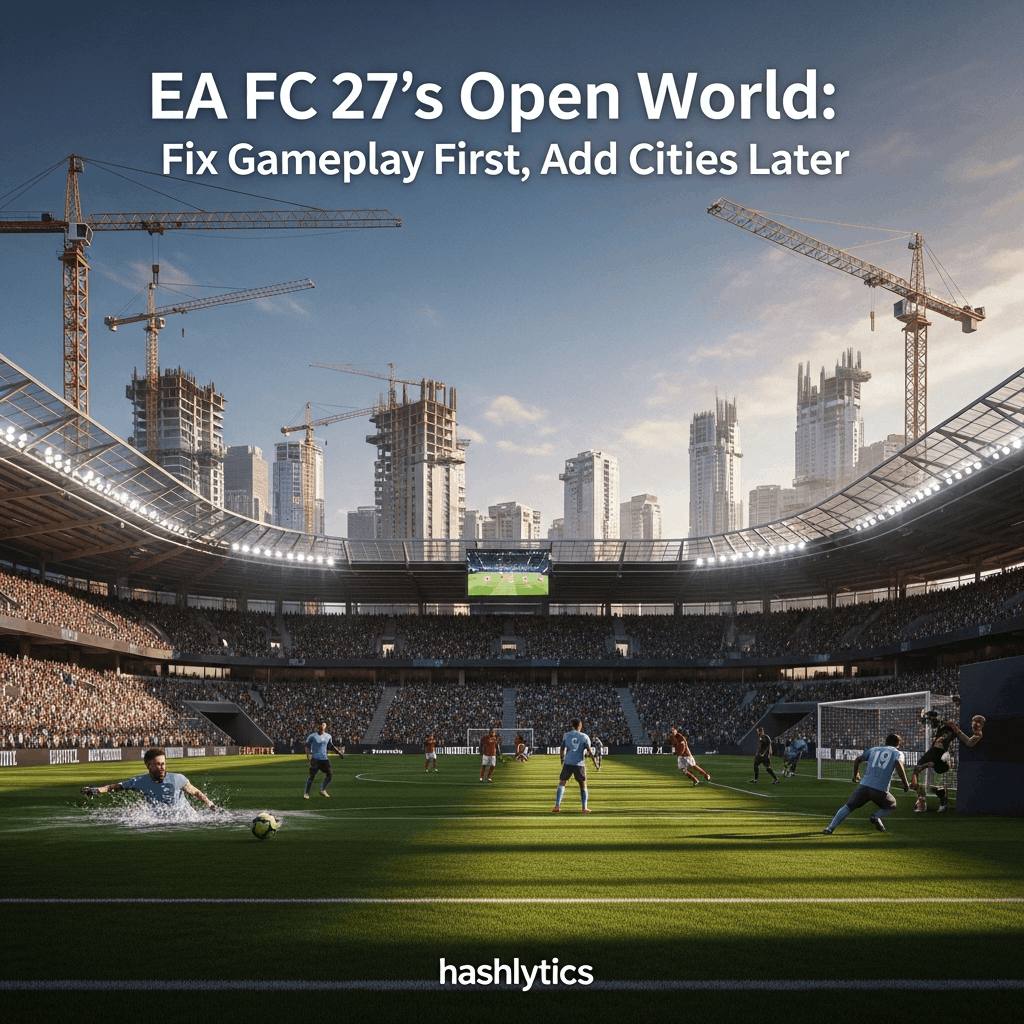
EA Sports trademarked “FC The Grounds” on January 23, 2026, official confirmation that EA FC 27 will introduce an explorable open-world mode when it launches September 25, 2026. Players will roam districts inspired by England, France, and Argentina, hitting virtual barbershops, shopping for cosmetics, training at gyms, and joining pick-up matches across themed neighborhoods.
The NBA 2K-style hub replaces traditional menus with spatial navigation, promising to transform how 200+ million annual EA FC players experience football gaming. But community reaction splits sharply: excitement about RPG-style progression versus frustration that EA prioritizes cosmetic features while core gameplay issues persist.
What The Grounds Actually Is: Districts, Mini-Games, and Battle Passes
The leaked mode functions as a persistent social hub layering on top of existing modes rather than replacing Ultimate Team, Career, or Pro Clubs. Players load into online districts modeled after major footballing nations, walking their created avatar to locations that correspond to match types instead of selecting from static menus. Think Grand Theft Auto Online if the only activities were football-themed—casual kickabouts, ranked matches, and mini-games discovered by exploring rather than clicking.
Each district offers unique visuals and atmospheres tied to regional football cultures. The England district might feature Premier League-inspired street pitches and pubs, while Argentina’s district emphasizes street football aesthetics reminiscent of Buenos Aires. The mode includes a Battle Pass with cosmetic unlocks, special events using existing licenses, and progression tied to character customization systems borrowed from Pro Clubs.
Confirmed mini-games leaked through playtests include Kickabouts (FIFA Street-style small-sided matches in enclosed arenas), Rush (EA FC’s existing 5v5 mode integrated as pick-up games), Foot Tennis (tennis rules with a football), Balloon Ball (dodgeball/Mario Kart hybrid where players shoot at balloons to eliminate opponents), Closest to the Pin (bowls-style accuracy challenge), and Draw the Line (cooperative team mode creating shapes through passing). These activities reward experience points for leveling avatars, unlocking gear, and building reputation visible to other players in the shared space.
The Community Backlash: “Just Fix the Gameplay Bro”
The most upvoted community responses to The Grounds announcement share a common theme: fix existing problems before adding complexity. “Just fix the gameplay bro,” “These theatrics are not what the players want. Better gameplay, nerf play styles, improve gameplay,” and “Focus on the quality of the product before thinking of creating a whole other thing while you haven’t dealt with the main core of the actual game” dominate social media reactions.
The frustration stems from persistent EA FC 26 issues that patch 1.4.0 attempted to address but didn’t fully resolve: overpowered AI defending requiring minimal user input, “meta” play styles (kick-off glitches, through-ball spam, goalkeeper positioning exploits) dominating competitive modes, input delay in online matches causing missed actions, and inconsistent ball physics producing unpredictable deflections. Players argue these fundamentals matter more than cosmetic hubs—a sentiment amplified by early playtest reviews calling The Grounds “the most mid garbage ever.”
One playtester’s social media post — “played it a few months ago and it’s the most mid garbage ever lmao” — went viral, revealing that numerous players accessed secret presentations showing The Grounds in development. Multiple sources confirm playtest reviews weren’t “particularly glowing”, suggesting the mode needs significant iteration before September’s launch.
The NBA 2K Warning: Open-World Bloat vs Meaningful Innovation
The Grounds directly copies NBA 2K’s “The City” and WWE 2K’s “The Island” — persistent online hubs that replaced menu-based navigation with explorable spaces. While initially exciting, both implementations suffer from what critics call “open-world bloat”: forcing players to jog three minutes across virtual plazas just to change equipment or start matches. The basketball community frequently complains about navigation friction adding tedious travel time to activities that used to require single clicks.
The fundamental tension: open worlds create immersion and discovery at the cost of efficiency. Menu systems optimize speed; spatial hubs prioritize social presence and environmental storytelling. For casual players enjoying the atmosphere, wandering districts and encountering friends organically enhances engagement. For competitive grinders optimizing ranked ladder climbs, every second spent navigating is wasted time not improving skills or completing objectives.
EA’s challenge is ensuring The Grounds adds tactical value rather than just extra steps. If the mode becomes a high-pressure showroom for microtransactions where the “coolest” gear is paywalled and unavoidable, the classic menu will look very attractive. The Battle Pass mention in leaks raises concerns about monetization intensity—will districts feel like football communities or virtual storefronts?
What Could Go Right: Identity Building and Social Play
Supporters argue The Grounds addresses a real gap: EA FC lacks meaningful off-pitch identity building. Current modes reduce players to statistics and formations; The Grounds lets you express personal style through avatar customization, discover content organically rather than through algorithmic feeds, form ad-hoc groups through proximity rather than matchmaking queues, and spectate live matches as social activity. Pro Clubs veterans anticipate this could be the “shot of adrenaline the mode has needed for a decade” by making progression feel earned through visible reputation rather than hidden numbers.
The “Districts” concept enables regional identity and competition. Imagine England vs France district rivalries manifesting in scheduled tournaments, leaderboards tracking district-level accomplishments, and cosmetic rewards celebrating regional football cultures. If implemented thoughtfully, The Grounds becomes more than navigation infrastructure—it becomes tribal identity system where your district membership matters.
The Timing Question: Why Now Instead of Gameplay First?
EA’s post-FIFA license independence granted freedom to experiment with modes beyond strict simulation standards. Without FIFA’s oversight, EA can pursue monetization-heavy social features, integrate Battle Passes and cosmetic stores aggressively, and pivot toward live-service models prioritizing retention over match realism. The Grounds represents exactly the innovation that independence enables—but also reveals EA’s strategic priorities.
Development resources are finite. Every engineer building district systems, designing mini-games, and implementing avatar progression is an engineer not refining ball physics, fixing netcode latency, or balancing competitive play styles. EA FC 27 is scheduled for September 24, 2026 release (early access September 18 for Ultimate Edition), giving EA approximately seven months from trademark filing to launch. That timeline suggests The Grounds has been in development for over a year—time players argue should’ve gone toward core improvements.
The counterargument: different teams handle different features. Environment artists building districts don’t code gameplay mechanics; progression designers implementing Battle Passes don’t fix server infrastructure. Ideally, EA pursues both simultaneously. But resource allocation still reflects priority decisions—studio leadership chose to fund The Grounds development while gameplay issues persisted across multiple patches.
What Happens If It Fails: The Journey vs Volta Precedent
EA’s track record with ambitious FIFA/FC mode additions is mixed. The Journey (single-player story mode following Alex Hunter’s career, 2016-2018) received critical praise and strong player adoption before EA retired it after three installments. Volta Football (FIFA Street-style small-sided play, 2019-present) launched with enthusiasm but became stagnant side content that most players ignore. The difference: The Journey offered structured narrative experiences complementing rather than replacing core modes, while Volta attempted to create a parallel ecosystem that never achieved critical mass.
The Grounds risks the Volta trajectory if it doesn’t deliver sustained engagement. Initial curiosity will drive exploration, but if districts feel empty after the first month, if mini-games lack depth, or if Battle Pass rewards don’t justify grinding, players will return to traditional modes and The Grounds becomes another abandoned feature consuming disc space. The mode might utilize Pro Clubs character creation and upgrade systems, but borrowing mechanics doesn’t guarantee engagement.
The worst-case scenario: The Grounds fragments the player base, dividing an already sprawling game into even more competing modes. Queue times increase for traditional playlists as users scatter across districts. Competitive integrity suffers as serious players abandon bloated navigation for third-party matchmaking. EA pivots resources to maintaining The Grounds infrastructure while neglecting the modes that retain core audiences.
The Skeptic’s Question: Is This What Football Games Need?
Football gaming’s appeal has always centered on match realism—recreating the tactics, physics, and emotional stakes of actual football. Open-world hubs with barbershops and outfit shopping feel borrowed from GTA Online or Fortnite rather than organic football game evolution. The question becomes: does spatial navigation between matches enhance football simulation, or does it dilute focus with features indistinguishable from generic live-service games?
Compare EA’s direction to eFootball (Konami’s free-to-play PES successor), which stripped away modes to focus exclusively on match quality and realistic football. eFootball’s user base remains smaller than EA FC, but its players praise gameplay responsiveness and physics authenticity that EA hasn’t matched. The divergence reveals a philosophical split: EA pursues engagement metrics, retention curves, and monetization opportunities through social features, while Konami chases pure football simulation even when commercially riskier.
Neither approach is objectively superior — different players want different experiences. But EA’s community clearly skews toward the simulation camp based on social media sentiment. When EA announces The Grounds and the dominant response is “fix gameplay first,” that signals a disconnect between developer priorities and user demands.
What Needs to Happen Before September 25
For The Grounds to succeed, EA must deliver on three fronts simultaneously. First, address core gameplay issues comprehensively through spring and summer patches—AI defending balance, meta play style nerfs, server stability, physics consistency. Show the community that foundational quality isn’t sacrificed for feature breadth. Second, design districts that enhance rather than obstruct football experiences. Navigation should feel natural, not tedious; cosmetics should celebrate football culture, not just extract revenue; mini-games should offer genuine skill expression, not shallow time-wasters. Third, communicate transparently about The Grounds’ purpose and integration. Is it a social hub complementing existing modes or a parallel ecosystem demanding equal time investment?
The September 24 release leaves approximately seven months for iteration based on playtester feedback. Those reviews calling The Grounds “mid garbage” must be taken seriously—if EA launches anyway without substantial improvements, it risks replicating Anthem or Battlefield 2042 situations where ambitious features ship incomplete and damage franchise reputation.
The Bottom Line: Innovation vs Foundation
FC The Grounds represents EA’s bet that football games need social infrastructure rivaling Fortnite and Roblox to compete for players’ time in 2026’s saturated gaming market. The vision—explorable districts celebrating regional football cultures, organic social interactions, RPG-style progression visible to communities—could redefine what football games mean beyond 90-minute matches. But visions require execution, and execution demands resources.
The community’s skepticism is earned. EA FC 26 shipped with gameplay issues still being patched six months post-launch. EA FC 25 before it had similar problems. The pattern suggests systemic prioritization of content volume over foundational quality—a sustainable strategy for casual players sampling new modes but frustrating for dedicated communities expecting competitive integrity.
Whether The Grounds becomes The Journey (beloved innovation enhancing the franchise) or Volta (ignored side content consuming resources) depends entirely on EA’s commitment to delivering both the new and the necessary. Players aren’t asking EA to choose between innovation and quality—they’re demanding both. Fix the through-ball spam, balance the meta play styles, stabilize the servers, refine the physics. Then add the open world, introduce the districts, launch the Battle Pass. Do both, do them well, or risk The Grounds becoming another case study in feature bloat undermining sports simulation fundamentals.
As one player summarized perfectly: “Just fix the gameplay bro.” Everything else is window dressing until that’s resolved.
Follow us on Bluesky, LinkedIn, and X to Get Instant Updates