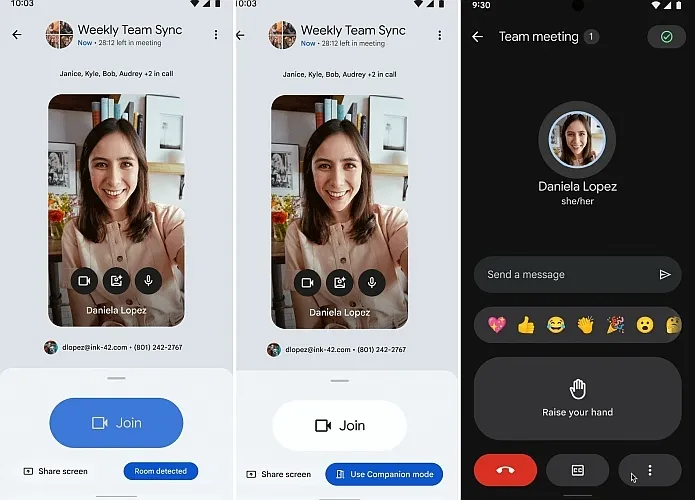
Google announced the expansion of its automatic room detection for Meet to mobile platforms, following its introduction for laptops and desktops in . The mobile rollout began for Rapid Release domains on , with a progressive deployment expected to conclude within . Scheduled Release domains will begin receiving the feature on , also over a period. To utilize the new functionality, mobile users will need Meet version 336.0 on Android or iOS, or Gmail version 2025.12.01 on Android and 6.0.251201 on iOS.
The automatic room detection system is designed for scenarios where multiple individuals are present in the same physical meeting room. Instead of manually selecting Companion Mode, the feature leverages ultrasonic audio signals, which are inaudible to human ears, emitted by conference room hardware. A user’s mobile device, via its microphone, detects these signals, prompting Google Meet to automatically suggest or activate Companion Mode. This mode allows the device to join the shared meeting session without enabling its microphone and speakers, thereby preventing audio feedback and echo disturbances that can disrupt group calls. The capability is integrated into both the Google Meet and Gmail applications on mobile devices.
Google states the primary motivation for this update is to facilitate faster and smoother entry into group video calls, particularly in hybrid work environments where participants often join from both in-person and remote locations. TechRadar noted that Google acknowledged this was a highly requested
feature by users. The system also helps to automatically check users into calls, which can assist administrators with attendance tracking. According to Joseph R. Allen, Ph.D., an organizational psychologist and professor at the University of Utah, hybrid meetings can foster greater participation and inclusivity when effectively managed with appropriate technology and practices. The new feature addresses a critical technical challenge in hybrid meetings: managing audio to ensure clear communication and prevent disruptions.
While the rollout schedule for Rapid and Scheduled Release domains has been specified, the exact date by which all users within these domains will have access to the feature is subject to the progressive rollout over . Details regarding potential user opt-out options for the proximity detection feature were not explicitly clarified by Google.
This feature is available to all Google Workspace customers and Workspace Individual subscribers, indicating a broad impact across various organizational sizes and individual professionals. The continued integration of such proximity-based technologies is expected to further refine the hybrid meeting experience, reducing technical friction and promoting more seamless collaboration. As remote and in-person work models continue to evolve, advancements in unified communications platforms like Google Meet are critical for maintaining productivity and engagement across distributed teams. The success of this update will likely be gauged by its reliability across diverse meeting room configurations and user adoption rates.
Update your Google Meet and Gmail applications to the specified versions (Meet 336.0; Gmail 2025.12.01 for Android or 6.0.251201 for iOS) to access the new functionality. When joining a meeting from a conference room, pay attention to prompts within the Meet app that suggest using Companion Mode. Enabling microphone permissions for the Meet app on mobile devices is necessary for the ultrasonic detection to function.
Follow us on Bluesky , LinkedIn , and X to Get Instant Updates