The neo-cloud market, defined as GPU-focused cloud providers serving artificial intelligence workloads, hit $25 billion in 2025 revenue and is reshaping how enterprises access computing power. According to Synergy Research Group, this emerging sector grew 223% year-over-year in Q4 2025 alone, signaling a structural shift away from traditional hyperscalers struggling to meet AI demand.
Understanding the Neo-Cloud Market’s Explosive Growth
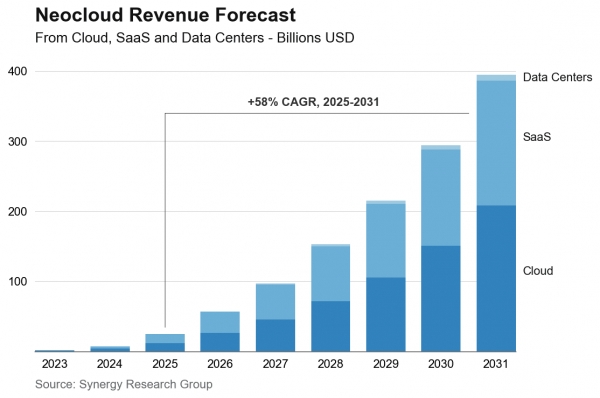
The neo-cloud market reached $9 billion in Q4 2025 and is projected to approach $400 billion by 2031, growing at a compound annual growth rate (CAGR) of 58%, according to Synergy Research. Mordor Intelligence provided a slightly lower baseline estimate of $24.07 billion for 2025 but projects similar trajectory, forecasting $35.22 billion in 2026 and $236.53 billion by 2031 with a 46.37% CAGR.
Synergy Research identified CoreWeave, Crusoe, Core Scientific, Lambda, Nebius and Nscale as standout players in this emerging category. The firm describes neo-cloud providers as reshaping competitive boundaries between infrastructure-as-a-service (IaaS) and platform-as-a-service (PaaS) within the cloud ecosystem.
Why Neo-Cloud Providers Outperform Hyperscalers on AI Workloads
The competitive advantage stems from architectural differences. Hyperscalers typically add GPUs to existing CPU-centric virtualized environments, creating performance bottlenecks. Neo-cloud providers, by contrast, design infrastructure around GPUs from inception, using bare-metal architectures that provide direct hardware access and eliminate virtualization overhead.
Networking architecture further differentiates the two models. While hyperscalers rely on Ethernet-based networking, neo-cloud providers adopt InfiniBand and RDMA protocols for high-speed GPU-to-GPU data transfer, critical for large-scale parallel AI training. Hyperscaler Ethernet environments create bottlenecks in large clusters.
Pricing reflects these efficiency gains. Neo-cloud providers typically charge $2 to $3 per hour for NVIDIA H100 SXM5 GPUs compared with $6 to $12 per hour from hyperscalers, representing 30% to 60% cost savings. Many neo-cloud operators also include data egress and storage costs, whereas hyperscalers charge separately.
NVIDIA’s Strategic Investments Fuel Market Momentum
NVIDIA has backed multiple neo-cloud leaders with substantial capital. The chipmaker invested $2 billion in CoreWeave in January 2026, participated in Nebius’s $700 million funding round in December 2024 (contributing $33 million), and followed with an additional $2 billion investment in Nebius in March 2026. NVIDIA also joined Lambda’s $480 million Series D round in February 2025 and participated in Nscale’s $433 million pre-Series C bridge financing in October 2025, though specific amounts were undisclosed.
Some observers characterize these investments as circular financing, noting that neo-cloud providers are major GPU buyers. However, NVIDIA’s backing signals confidence in the sector’s viability and the superiority of GPU-native architectures.
Cryptocurrency Miners Transition to AI Infrastructure
Declining cryptocurrency mining profitability is driving former mining companies into neo-cloud services. These firms possess existing large-scale GPU infrastructure, cooling systems, power networks and 24/7 operational expertise directly applicable to AI data centers.
CoreWeave exemplifies this transition. Originally an Ethereum mining company called Atlantic Crypto, it rebranded in 2019 and fully shifted to neo-cloud services by 2022. Other transitions include IREN (formerly Iris Energy), Hut 8, Northern Data and HIVE Digital Technologies. Bit Digital operates both businesses simultaneously, reporting a 53% decline in Bitcoin mining revenue offset by 50% growth in cloud services revenue.
These companies build AI data centers faster than traditional enterprises by leveraging existing power and cooling infrastructure already deployed at scale.
What Comes Next for Cloud Infrastructure
Synergy Research characterizes neo-cloud as not just the emergence of a new category of cloud providers but a deeper structural reconfiguration of computing architecture itself.
The market’s momentum, reflected in both venture funding and NVIDIA’s strategic backing, suggests hyperscalers will face sustained pressure to redesign infrastructure or risk losing AI-intensive workloads to specialized competitors.
Follow Hashlytics on Bluesky, LinkedIn , Telegram and X to Get Instant Updates