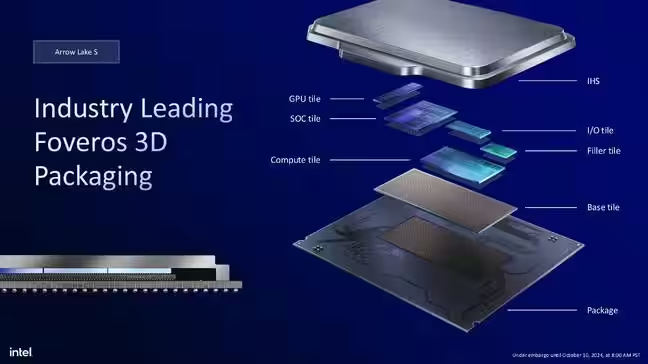
Intel’s latest architectural disclosures for the Arrow Lake series confirm the continued use of its Foveros 3D packaging technology, which integrates tiles fabbed by TSMC. This design places the memory controller on a separate tile from the performance and efficiency cores. The company claims it has increased the fabric bandwidth between these tiles to reduce memory latency and improve overall system performance.
The key hardware enhancement is the memory controller’s native support for JEDEC DDR5 speeds up to 7,200 MT/s. This is a step up from the 6,400 MT/s officially supported by its predecessors. For enthusiasts, the platform will also officially sanction speeds up to 8,000 MT/s via XMP profiles and supports large-capacity configurations with 4-rank memory modules of up to 128 GB per DIMM.
Alongside hardware improvements, Intel is introducing a new software suite called the Platform Performance Package. A key feature is the Binary Optimization Tool (BOT), which aims to improve performance in supported games without altering source code. According to Intel, BOT delivers an average gaming uplift of 8%, with some titles seeing gains over 22%.
- Multi-Threaded Performance: Intel claims an 83-103 percent performance advantage over AMD’s Ryzen 5 9600X and Ryzen 7 9700X in rendering and synthetic benchmarks.
- Gaming Performance (270K): A claimed four percent advantage in average FPS over the AMD Ryzen 7 9700X.
- Gaming Performance (250K): The $199 Core Ultra 250K is said to tie the performance of AMD’s 9600X in gaming.
Robert Hallock, VP of Intel’s enthusiast channel business, stated, We don’t see source code. We don’t change source code. We do not reverse engineer. We do not recompile. Everything that the workload was originally designed to do stays in the binary.
The architectural and software enhancements are part of Intel’s strategy to compete directly with AMD’s latest processor lineup. By improving memory speeds and introducing runtime optimizations with BOT, Intel aims to deliver superior performance in both multi-threaded applications and gaming, addressing different segments of the enthusiast market.
The new processors are expected to launch in the near future. Upon release, users will need to download the Platform Performance Package to utilize the BOT feature. Support for BOT is limited to select single-player games initially, as Intel is proceeding cautiously to avoid conflicts with anti-cheat software common in online titles. Support is expected to expand over time.
For those considering an upgrade to the Intel Arrow Lake platform, it is important to note the following:
- Verify game compatibility lists for the Binary Optimization Tool as they become available to understand potential performance gains.
- Check motherboard Qualified Vendor Lists (QVLs) to ensure compatibility with high-speed DDR5 memory (7,200 MT/s and above).
- Be aware that BOT must be manually enabled via the Intel Application Optimization utility and will not be available for online games at launch.
Follow Hashlytics on Bluesky, LinkedIn , Telegram and X to Get Instant Updates