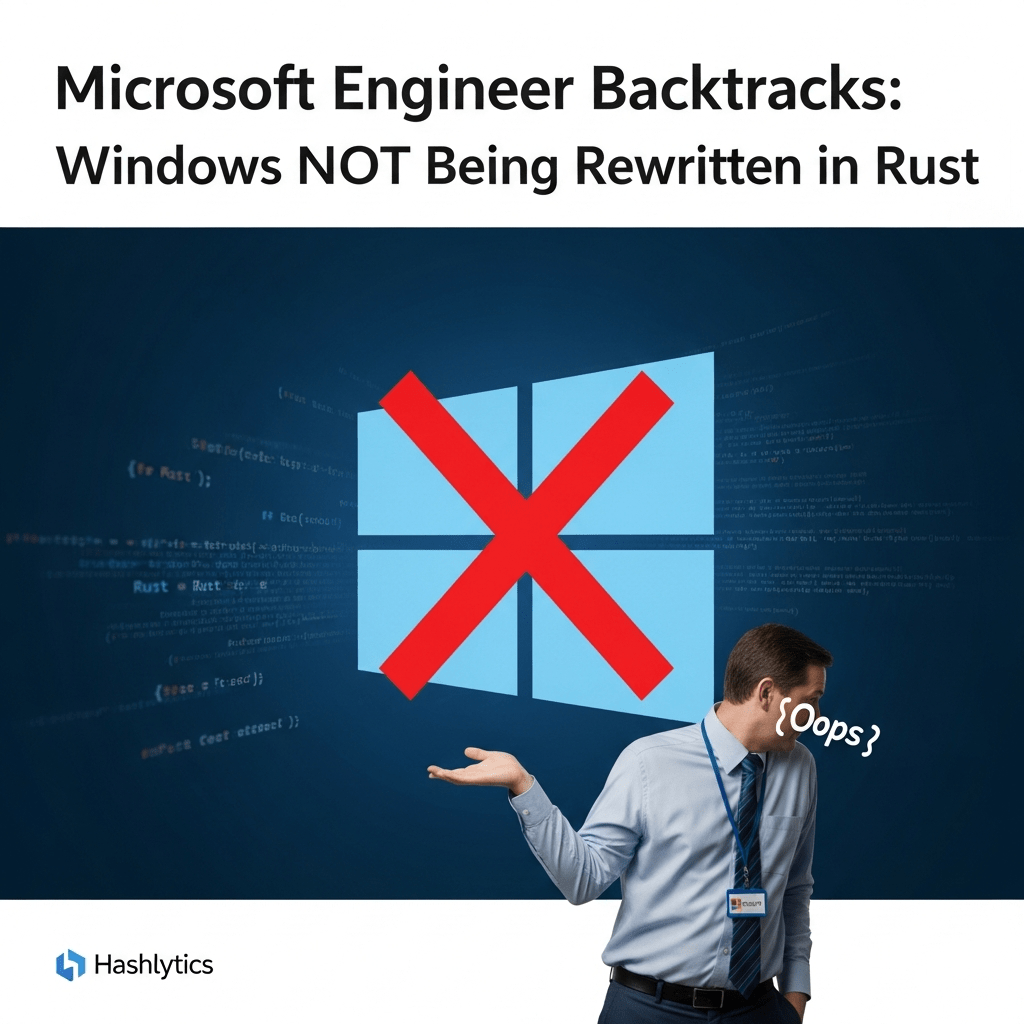
Microsoft Distinguished Engineer Galen Hunt issued a significant clarification to his viral LinkedIn post about eliminating C and C++ code from Microsoft by 2030, stating definitively that “Windows is *NOT* being rewritten in Rust with AI.” The December 24 update came after his original job posting triggered widespread media coverage interpreting the initiative as a wholesale replacement of Windows’ legacy codebase, prompting both Microsoft corporate communications and Hunt himself to narrow the scope.
In the updated post, Hunt emphasized his team’s work constitutes a research project focused on building infrastructure for language-to-language migration tools, not a mandate to rewrite Windows 11 or future versions. “The intent of my post was to find like-minded engineers to join us on the next stage of this multi-year endeavor—not to set a new strategy for Windows 11+ or to imply that Rust is an endpoint,” Hunt wrote, acknowledging his phrasing generated “far more attention than I intended…with a lot of speculative reading between the lines.”
What Hunt Actually Said vs. How It Was Interpreted
The disconnect between Hunt’s original statement and his clarification reveals how precise language matters in corporate communications. The initial LinkedIn post used sweeping declarations: “My goal is to eliminate every line of C and C++ from Microsoft by 2030” and described “combining AI and Algorithms to rewrite Microsoft’s largest codebases” with a “North Star” of “1 engineer, 1 month, 1 million lines of code.” This phrasing naturally suggested company-wide policy rather than research experimentation.
| Original Statement | Clarification | Interpretation Gap |
|---|---|---|
| “Eliminate every line of C and C++” | “Research project” on migration tools | Company mandate vs. exploratory R&D |
| “Rewrite Microsoft’s largest codebases” | “Building tech to make migration…possible” | Active conversion vs. tool development |
| “1 engineer, 1 month, 1 million LOC” | Research goal for automation infrastructure | Production timeline vs. research aspiration |
Why the Clarification Matters
The distinction between developing migration infrastructure and executing wholesale rewrites carries enormous technical and business implications. Building tools that could theoretically translate C++ to Rust differs fundamentally from committing to replace Windows’ estimated 50+ million lines of kernel and systems code by a fixed deadline. The former represents prudent research into automation possibilities; the latter would constitute one of the largest refactoring efforts in software history.
Microsoft’s official statement to Windows Latest reinforced Hunt’s clarification, confirming the company does not plan to rewrite Windows 11 using AI-assisted Rust translation. This corporate-level response suggests the media firestorm caught leadership attention, necessitating damage control to manage both internal developer expectations and external perceptions about Windows’ technical direction.
The Research Project’s Actual Scope
Hunt’s team operates within the Future of Scalable Software Engineering group under Microsoft CoreAI’s Engineering Horizons organization. Their stated mission involves building “capabilities to allow Microsoft and our customers to eliminate technical debt at scale,” pioneering tools with internal partners before potential broader deployment. The Principal Software Engineer role Hunt advertised requires at least three years of production Rust experience specifically to “help us evolve and augment our infrastructure to enable translating Microsoft’s largest C and C++ systems to Rust.”
The key word here is “enable”—developing the capability for translation differs from executing the translation itself. Hunt explicitly clarified that Rust is not even necessarily “an endpoint,” suggesting the research explores general language-to-language migration rather than mandating any specific target. This positions the project as infrastructure research that could support multiple modernization strategies rather than a Rust-specific rewrite mandate.
Industry Reaction and Technical Skepticism
The swift clarification validated widespread skepticism about the feasibility of Hunt’s original timeline. Developer communities on Reddit and Slashdot had immediately questioned how AI could reliably translate decades of battle-tested C++ code with its complex object-oriented patterns, template metaprogramming, and subtle memory management idioms into Rust’s fundamentally different ownership model. As one Slashdot commenter noted, “Rust has a very non-standard and limited OO model. Good for systems coding, not good for porting C++ to it.”
Mozilla’s experience with Rust adoption provides instructive context. Despite Mozilla funding Rust’s development specifically for browser work, the first Rust code shipped in Firefox was a small MP4 parser—thousands of lines, not millions, and chosen specifically because it represented a security-critical attack surface. The company never attempted to rewrite Firefox’s entire C++ engine, suggesting even Rust’s original sponsor recognized the practical limitations of wholesale language migration.
What Microsoft Is Actually Doing with Rust
Microsoft’s documented Rust initiatives remain significant even without the dramatic “eliminate all C++” goal. Azure CTO Mark Russinovich effectively banned new C/C++ projects in 2023, requiring Rust for new systems-level development. By 2025, Microsoft had converted approximately 36,000 lines of Windows kernel code from C/C++ to Rust according to industry reports. The company has also developed Rust tooling for Windows driver development and contributed to Rust compiler improvements.
These incremental adoptions represent orthodox software modernization—using memory-safe languages for new components and selectively rewriting security-critical modules where the benefits clearly outweigh rewrite risks. This approach contrasts sharply with the “eliminate every line by 2030” rhetoric that triggered the media response, suggesting Microsoft’s actual strategy remains conservative despite research into more aggressive automation possibilities.
The Communication Breakdown
Hunt’s clarification raises questions about how internal research projects should communicate hiring needs without triggering external misinterpretation. The original post’s language—”eliminate,” “rewrite,” “2030”—reads less like a research goal and more like a mission statement or corporate strategy. As Windows Central’s editor noted in an update, “The previous claim of attempts to ‘eliminate all of C’ from Microsoft by 2030 sounded a bit more like a mission statement than a research project.”
The episode highlights challenges in AI-era corporate communications where engineers’ social media posts can rapidly amplify into perceived policy announcements. Hunt’s position as Distinguished Engineer lent authority that made his statements read as official direction rather than research ambitions. The subsequent need for both Hunt and Microsoft corporate to issue clarifications suggests internal communication protocols may need updating to prevent similar misunderstandings.
Broader Context: AI-Generated Code Concerns
The controversy arrived amid growing concerns about Microsoft’s aggressive AI adoption in software development. CEO Satya Nadella stated in April 2025 that approximately 20-30% of code in certain Microsoft repositories was already AI-generated, while CTO Kevin Scott suggested 95% of code could be AI-written by 2030. These statements have fueled anxiety among developers about code quality, maintainability, and job security.
Windows Latest’s coverage noted persistent quality concerns with recent Windows updates, connecting AI-generated code anxieties to visible system instability. The publication’s editor commented, “I don’t think the use of AI is going to make Windows any better. It’s the intent of the leadership that needs to change.” This skepticism reflects broader industry debate about whether rapid AI-assisted development improves or undermines software reliability.
What This Means for Windows’ Future
Despite Hunt’s clarification walking back the dramatic “eliminate all C++” framing, Microsoft’s interest in Rust and automated code modernization remains real. The company continues hiring Rust specialists, investing in translation tools, and selectively adopting memory-safe languages where security benefits are clear. What changed is the timeline and scope—this is long-term research with uncertain outcomes, not a committed corporate strategy with fixed deadlines.
For Windows users, the practical impact remains minimal in the near term. Windows 11 and its successors will continue evolving through conventional development processes, with selective Rust adoption in specific components rather than wholesale language migration. The “1 engineer, 1 month, 1 million lines of code” vision represents a research aspiration for future automation tools, not an active rewrite project transforming Windows today.
Lessons for Tech Industry Communications
The episode offers a case study in how viral social media posts can force corporate clarifications when internal research goals are publicly misconstrued as policy announcements. Companies pursuing ambitious technical research face a communication challenge: how to recruit top talent by honestly describing moonshot goals without triggering premature external expectations about product roadmaps.
Hunt’s experience suggests researchers may need to explicitly label exploratory work as such, distinguish research aspirations from product commitments, and coordinate with corporate communications before posting about initiatives that could be interpreted as strategic direction. The alternative—letting dramatic research goals go viral before issuing clarifications—risks both internal confusion and external credibility damage when retractions follow.
Follow us on Bluesky, LinkedIn, and X to Get Instant Updates