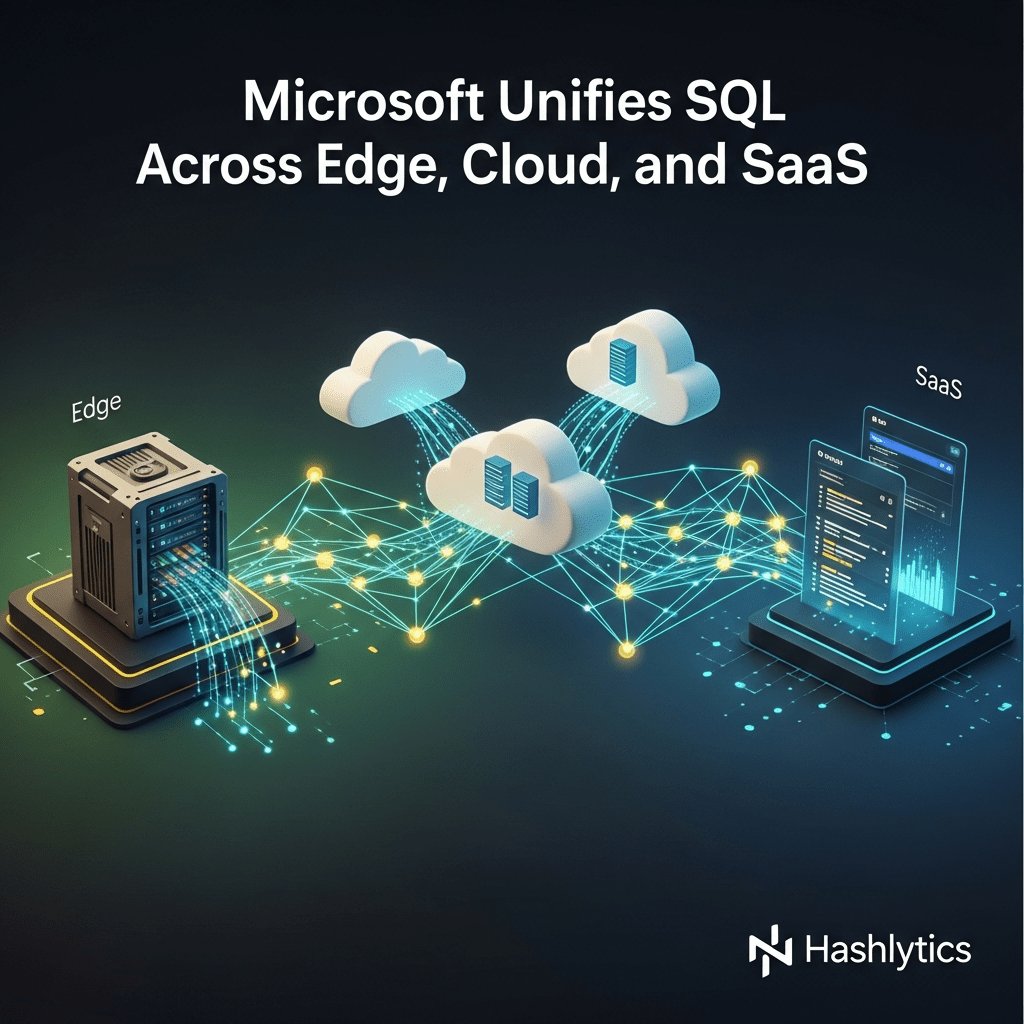
Microsoft is unifying SQL across edge, cloud, and SaaS environments, aiming to streamline development, enhance security, and accelerate the adoption of AI-powered applications. This strategy promises a seamless experience for data professionals navigating increasingly complex data landscapes. The core concept is to allow developers to “write once, deploy anywhere,” freeing them from the constraints of disparate systems. Microsoft’s vision is a future where data professionals can modernize on their own terms, leveraging familiar SQL skills across diverse environments, including on-premises servers, cloud-native Azure SQL, and the unified data analytics platform, Microsoft Fabric.
Microsoft’s commitment focuses on delivering a unified experience that transcends traditional boundaries. This consistency translates into platform consistency across hybrid and multi-cloud environments, optimized performance at scale, advanced, multi-layered security, and AI-ready tools for faster development of intelligent applications. The goal is to create a single “home” for all SQL workloads in the age of AI, simplifying data management and accelerating innovation.
A centerpiece of this unified SQL vision is SQL Server 2025, now generally available. Built upon a foundation of security, performance, and availability, this release introduces built-in AI capabilities and developer-focused enhancements. Organizations can leverage their existing data to securely support AI initiatives within SQL Server using the familiar T-SQL language.
For organizations seeking to modernize their SQL Server estates, the next generation of Azure SQL Managed Instance is also generally available. This release offers expanded storage and database capacity, flexible compute and memory options, and features designed to support diverse workload requirements. The benefits include improved performance, simplified migration, and a robust foundation for scaling applications securely.
Hexure, a life insurance software company, has already experienced the benefits, reducing processing time by 97.2% using Azure SQL Managed Instance, demonstrating the service’s transformative potential.
Migrating to Azure SQL Managed Instance is now easier with SQL Server migration in Azure Arc, now generally available. This offers Copilot-assisted migration that streamlines the entire process. Real-time replication, confident cutover, and trusted failover reduce the migration workload significantly, lowering the total cost of ownership.
Microsoft emphasizes empowering developers with AI-ready SQL tools at scale. GitHub Copilot integration enables developers to work with AI assistance directly in environments like Visual Studio Code and SQL Server Management Studio 22. Native support for retrieval augmented generation (RAG) scenarios includes vector search and semantic indexing within SQL Server and Azure SQL, while secure enclaves and Always Encrypted protect sensitive data during processing.
Connections to Azure AI services and governance tools streamline data preparation and compliance, while elastic infrastructure supports training, inference, and deployment at scale. This end-to-end approach simplifies the integration of generative AI into business processes, accelerating time to value.
Microsoft Fabric connects operations, analytics, and governance in one unified experience, unlocking the full potential of SQL data. The general availability of Fabric databases and database Mirroring in Fabric represents a significant step forward.
Fabric databases unify operational and analytical data within Fabric, backed by OneLake, the open data foundation for analytics and AI. SQL database in Fabric supports transactional processing, real-time analytics with zero ETL, and AI workloads side-by-side. Database Mirroring enables replication of SQL Server and Azure SQL into Fabric for analytics and AI scenarios without migration or refactoring.
Eastman, for example, built a new agentic sales copilot app that allows sellers to instantly query unified customer data using natural language. Fabric’s analytics and vector capabilities enable the copilot to retrieve precise answers directly from the database.
Microsoft’s “one SQL” strategy represents a shift towards a more unified and streamlined data management experience. By providing a consistent platform across diverse environments, Microsoft is empowering organizations to innovate, build intelligent applications, and unlock real-time insights. The future of SQL is designed to make legacy databases a launchpad for AI-powered innovation.