How the Safety Feature Works
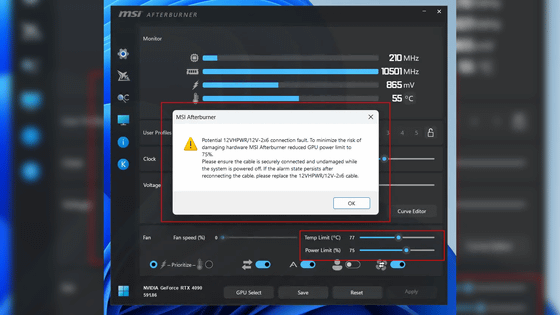
GPU Safeguard+ uses per-pin current monitoring telemetry from compatible MSI power supplies to detect faulty connections in real time. When the system identifies imbalanced current distribution across the connector’s pins, a condition that precedes thermal damage, Afterburner reduces the GPU’s power limit and issues an on-screen alert instructing users to reseat the cable.
The feature addresses ongoing concerns about NVIDIA’s 16-pin power connectors on RTX 40-series and RTX 50-series graphics cards. Since the RTX 4090’s launch in October 2022, multiple incidents of melted connectors have been reported, typically caused by incomplete cable insertion or excessive cable bending near the connector. NVIDIA and connector manufacturer Astron acknowledged the issue and released the revised 12V-2×6 standard with improved retention mechanisms, though both connector types remain susceptible to improper installation.
Hardware Requirements Limit Availability
The GPU Safeguard+ monitoring capability functions only with MSI’s MEG Ai1300P PCIE5, MEG Ai1000P PCIE5, MPG A1000G PCIE5, and MPG A850G PCIE5 power supplies released in late 2024 and 2025. These units include integrated current sensors on each 12V rail that communicate with Afterburner through MSI’s proprietary monitoring protocol.
Users without these specific power supplies can still install Afterburner 4.6.7 and access standard overclocking, monitoring, and fan control features, but the connector fault detection system remains inactive. MSI has not announced plans to license the monitoring protocol to other manufacturers or develop adapter hardware for non-MSI power supplies.
MSI’s approach represents the first software-automated response to connector faults. Thermal Grizzly’s WireView Pro II, released in November 2024, provides physical monitoring through an inline adapter that displays per-pin current and temperature data on an integrated screen, but requires manual interpretation and offers no automated protection.
ASUS implemented a “Power Detector+” feature in GPU Tweak III software for ROG graphics cards that uses onboard LEDs and software notifications to alert users of potential connection issues. However, ASUS’s system relies on GPU-side sensors rather than power supply telemetry and provides warnings without automatic power limiting.
CableMod, whose angled adapter cables were implicated in several melting incidents, discontinued its 12VHPWR products in November 2023 after internal testing revealed that tight bend radius specifications could compromise connector integrity even with proper insertion.
Industry Response
The PC hardware community has expressed mixed reactions to MSI’s implementation. Hardware forums and social media discussions acknowledge the safety benefit while criticizing the closed-ecosystem approach that limits the feature to MSI power supply owners. Some users noted that the hardware lock-in contradicts Afterburner’s history as vendor-neutral overclocking software that works with graphics cards from NVIDIA, AMD, and Intel regardless of board partner.
NVIDIA has not commented on third-party monitoring solutions but continues to recommend that users ensure complete connector engagement and avoid excessive cable strain. The company’s internal analysis of returned RTX 4090 units with melted connectors attributed the majority of failures to user installation error rather than manufacturing defects.
Power supply manufacturers including Corsair, Seasonic, and be quiet! have not announced similar monitoring implementations for their units, though several have released cables with improved strain relief and redesigned connector housings intended to prevent improper seating.
Technical Context
The 12VHPWR connector delivers up to 600W through twelve power pins and four sense pins that confirm proper connection before allowing high current draw. The 12V-2×6 revision introduced longer sense pins that engage before power pins during insertion, ensuring the retention mechanism fully seats before power delivery begins.
Incomplete insertion leaves contact resistance on power pins, creating localized heating that can melt the connector housing and damage both the cable and GPU. Current imbalance across pins indicates that some contacts carry disproportionate load, a condition that MSI’s per-pin monitoring can detect before temperatures reach critical levels.
The 75% power limit imposed by GPU Safeguard+ reduces RTX 4090 power draw from 450W to approximately 337W, bringing it below the 300W threshold of the earlier 12-pin Micro-Fit connector used on RTX 3090 Ti. This provides operational safety margin while maintaining enough performance for users to save work and properly reseat the cable rather than experiencing immediate system shutdown.
Follow us on Bluesky , LinkedIn , and X to Get Instant Updates