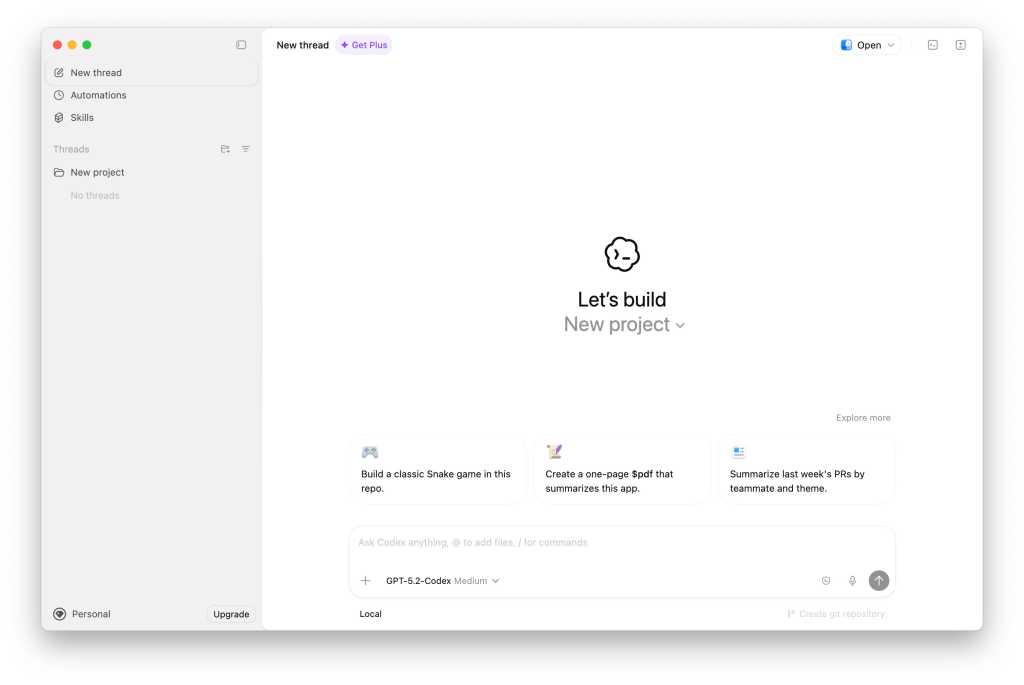
OpenAI has shipped a native macOS application for its coding AI, Codex, moving beyond browser-based tools to compete directly with GitHub Copilot and Anthropic’s Claude. The app positions itself not as a code completion tool but as an agentic project manager that can handle multiple complex workflows simultaneously.
What Codex Actually Does
| Feature | Details |
|---|---|
| Platform | macOS (Windows and Linux planned) |
| Core Function | Agentic AI coding assistant with multi-threaded task management |
| Integration | Standalone app; supplements IDEs like Xcode |
| Pricing | Tied to paid OpenAI API plans; rate limits doubled for two months at launch |
| Key Capabilities | Separate threads/projects for multitasking, pre-programmed skills, workflow automation |
The Agentic Bet
Codex organizes work into separate threads and projects, allowing developers to run multiple agentic tasks in the background and receive status updates as they complete. This is a deliberate departure from inline code completion tools. Instead of suggesting the next line of code, Codex is designed to manage entire workflows: refactoring modules, generating test suites, or implementing feature specifications across multiple files.
The native macOS integration gives it access to system features unavailable in browser-based competitors. This includes tighter file system access, native app hooks, and the ability to run background processes without browser sandbox restrictions.
Where It Fits in a Crowded Market
Codex enters a fiercely competitive field. GitHub Copilot is already integrated into the daily workflow of millions of developers, excelling at inline code suggestions. Amazon Q, Google’s Jules, and Microsoft’s Copilot variants are all vying for the same developer attention. Anthropic’s Claude already integrates with Xcode and offers similar advanced reasoning capabilities.
OpenAI’s differentiation strategy is clear: position Codex as a higher-level project manager rather than a line-by-line assistant. Whether developers want this type of tool is the open question. GitHub Copilot succeeded because it fit seamlessly into existing workflows. Codex requires developers to shift context to a separate application, which introduces friction but potentially unlocks more complex capabilities.
Early Reception and Performance Concerns
Initial feedback has been mixed. Some developers have praised its innovative approach. One early user noted: I started asking it for ideas for new features and at least a couple of them were better than I was thinking of.
But the most significant complaint centers on system resource consumption. Early reports suggest Codex runs heavy background processes that impact overall system performance. For developers who value lean, efficient tools that don’t compete with their compiler or build system for CPU cycles, this is a critical issue.
The macOS-only launch also limits initial reach. Windows and Linux developers, who represent a substantial portion of the market, will have to wait for future releases.
Strategic Implications
The launch reflects OpenAI’s broader strategy of moving its AI capabilities from cloud services into native applications. This follows the same pattern as its ChatGPT desktop app: build direct relationships with users rather than relying solely on API integrations through third-party platforms.
By going native, OpenAI gains more control over the user experience and can build features that web-based tools can’t easily replicate. But it also means taking on the operational burden of cross-platform desktop development, updates, and support at a time when the company is already stretched thin across multiple product lines.
What This Means for Developers
Codex represents a bet that developers want an AI agent capable of managing complex, multi-step workflows rather than just autocompleting functions. For macOS developers already invested in the OpenAI ecosystem who need a project-level assistant, it offers capabilities that inline tools don’t provide.
But for developers satisfied with deeply integrated tools like GitHub Copilot or concerned about performance overhead, there’s little immediate reason to switch. The success of Codex will depend on whether OpenAI can resolve the resource consumption issues and convince developers that the agentic workflow model is worth the context-switching cost.
Follow us on Bluesky , LinkedIn , and X to Get Instant Updates