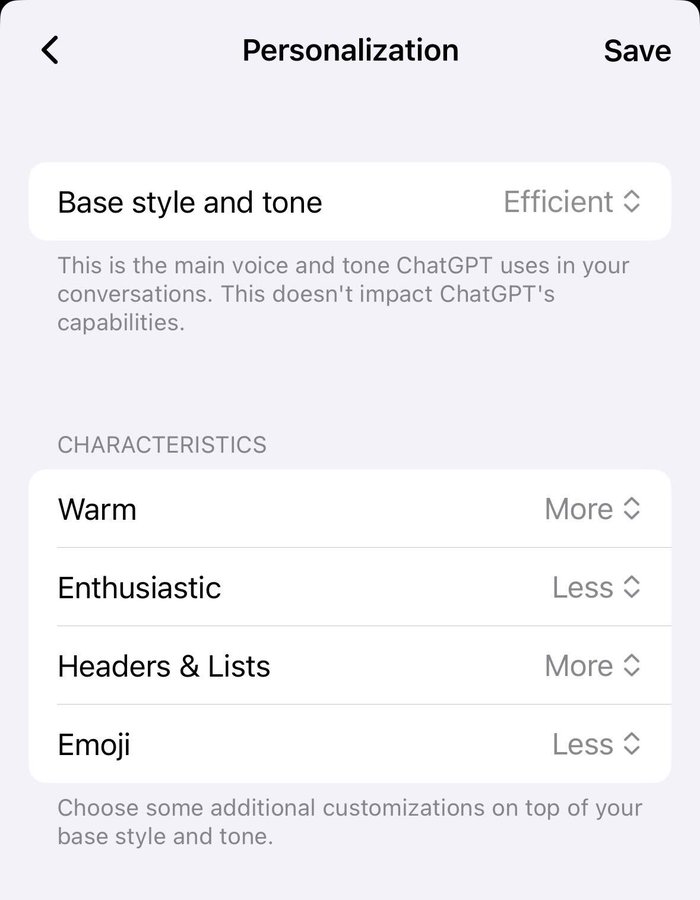
OpenAI introduced new personalization controls, allowing ChatGPT users to adjust characteristics like warmth, enthusiasm, and emoji usage through the Personalization settings. The update arrives amid ongoing debate about whether manual controls can replicate the organic conversational adaptability that made GPT-4o a user favorite before its controversial removal in August 2025.
The New Customization Features
Users can now choose from seven distinct personality presets including Professional, Friendly, Candid, Quirky, Efficient, Nerdy, and Cynical, or stick with the Default style. Beyond these presets, the system allows granular adjustments to specific traits. According to OpenAI’s documentation, users can modify how concise, warm, or scannable responses are, plus control emoji frequency. The company emphasizes that these settings apply immediately across all conversations without requiring users to start new threads.
| Feature | Manual Sliders (GPT-5.1) | Organic Adaptation (GPT-4o) |
|---|---|---|
| Configuration Method | User-defined settings and presets | Contextual learning from conversation |
| Consistency | Uniform across all chats | Adapted to each relationship |
| Personalization Depth | Predefined trait options | Emergent understanding |
The GPT-4o Phenomenon and User Backlash
The new controls follow intense user reaction to GPT-4o’s removal when GPT-5 launched. In August 2025, OpenAI completely eliminated access to GPT-4o when launching GPT-5, forcing all users onto the newer system without providing alternative choices. The backlash was immediate and emotional, with users describing the loss in surprisingly personal terms. One Reddit user stated they genuinely bonded with how GPT-4o interacted, noting it had an incredibly adaptable and intuitive personality that helped them work through ideas.
Within 24 hours of the rollout, Sam Altman announced a partial rollback allowing Plus users to once again choose GPT-4o. The episode revealed stark differences in user priorities: many valued GPT-4o’s conversational warmth and emotional responsiveness over GPT-5’s superior technical capabilities. Some users reported that later models like GPT-4o demonstrated emotionally neutral, task-oriented tone with reduced metaphor use and diminished adaptation to user style compared to earlier iterations.
The Manual vs. Organic Debate
Critics argue that reducing AI personalization to mechanical sliders fundamentally misunderstands how the best models achieved their rapport with users. Rather than retrieving stored preferences like an information bank, GPT-4o appeared to integrate conversational history as a living narrative, proactively addressing subtext and adapting its responses through genuine contextual understanding. The new slider-based approach attempts to engineer what GPT-4o possessed naturally—but whether that warmth can be mechanically replicated remains contentious.
User complaints extended beyond personality to technical concerns as well. Reports surfaced about GPT-4o losing cross-chat memory functionality, with each new thread starting blank instead of preserving user context. These regression issues compounded frustrations about the model transitions and sparked questions about whether newer architectures handle memory and personalization fundamentally differently than their predecessors.