+5.82%
+6.15%
+2.46%
+2.78%
+10.56%
+6.37%
A global divergence in cryptocurrency policy is accelerating, with nations treating digital assets as either seizable criminal proceeds, tools of statecraft, or regulated financial instruments. Recent actions in Russia and Iran highlight the use of crypto as a tool for state control and economic survival, while East Asian markets push towards formal integration.
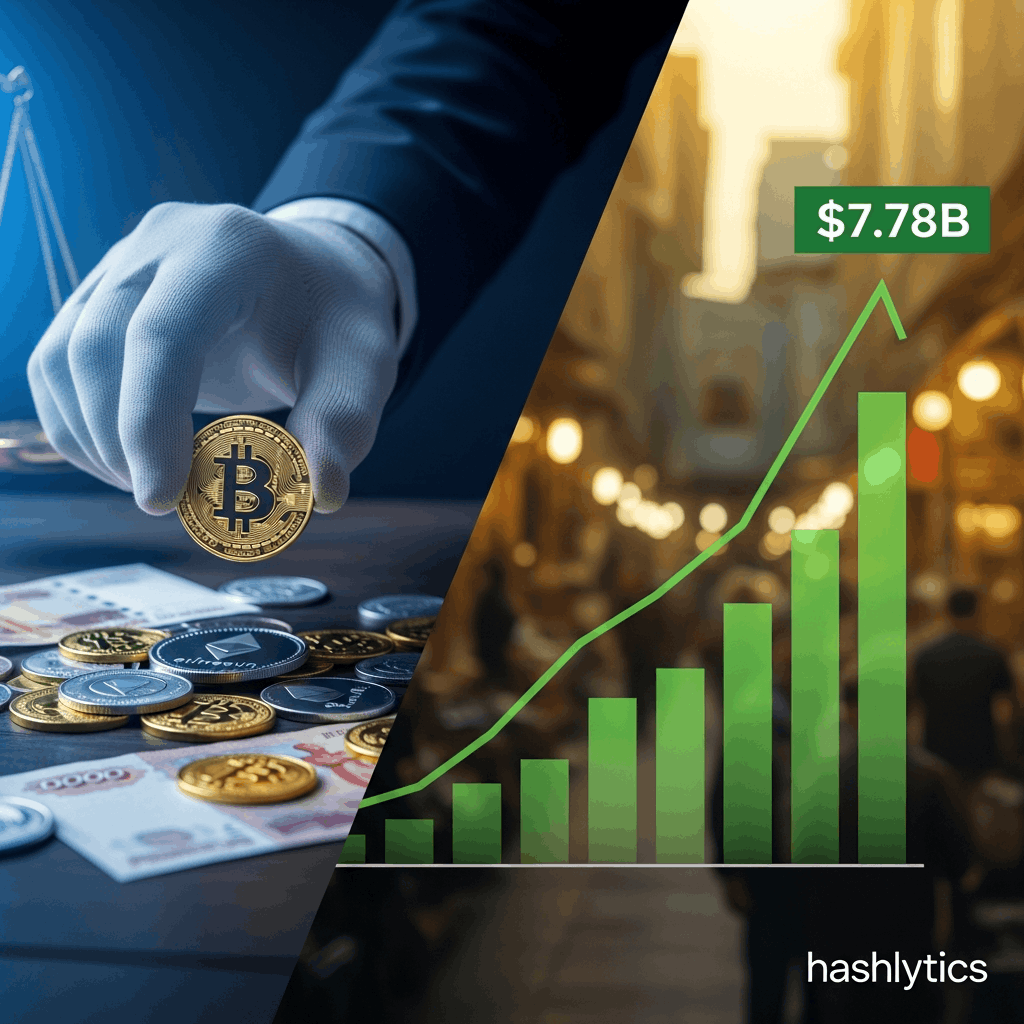
- Iran Crypto Ecosystem Value: Reached $7.78 billion in , according to a report from Chainalysis.
- IRGC-Linked Inflows: Addresses linked to the Islamic Revolutionary Guard Corps received over $3 billion in
- B2B Stablecoin Payments: Year-over-year growth exceeded 730% in , with annual volume hitting $390 billion, per Artemis and Stablecon.
- Russian Legal Status: A new law signed by President Vladimir Putin officially defines virtual currencies as “intangible assets,” permitting court-ordered seizure.
Governments are moving past abstract crypto debates and implementing concrete, nationally-focused strategies. Russia’s law formalizes the state’s power over digital assets, treating them like any other seizable property in criminal proceedings. This legitimizes their existence within the legal system, but purely for confiscation. In contrast, Iran leverages crypto mining and stablecoins to build a parallel economy, reportedly to circumvent sanctions and stabilize its currency. Meanwhile, the Bank of Korea’s push for bank-led stablecoins and Japan’s tokenization initiatives show a clear path towards integrating digital assets into the traditional financial system under strict regulatory oversight.
These divergent national policies create a fragmented global landscape, potentially fostering regulatory arbitrage where illicit actors move to jurisdictions with weaker controls. Iran’s state-sponsored mining operation, a cornerstone of its crypto economy, is also highly vulnerable. It is also noted that Iran’s military strikes on its power grid could severely disrupt production capacity, undermining a key source of state revenue. Furthermore, the effectiveness of Russia’s seizure law depends entirely on law enforcement’s technical ability to access and control private keys and hardware wallets.
The key forward indicator is the implementation of new legal frameworks. Observers should monitor the first major cryptocurrency seizures executed under Russia’s new law to gauge its practical enforcement. In South Korea, the progress of the upcoming Digital Assets Basic Act will determine the operational requirements for foreign issuers like Tether and Circle. Finally, Japan’s AML pilot program, running from to , will signal the future of information sharing among exchanges and regulators in the region.
- National interests are driving divergent crypto policies, from seizure to state-sponsored adoption.
- Iran is using Bitcoin mining and stablecoins as instruments of economic policy and sanctions evasion.
- Advanced economies like South Korea and Japan are focused on regulated stablecoins and asset tokenization.
- Russia has legitimized crypto within its legal system primarily to enable state confiscation.
Follow Hashlytics on Bluesky, LinkedIn , Telegram and X to Get Instant Updates