
- Total Parameters: 519 billion (Source: SK Telecom)
- Active Inference Parameters: ~33 billion (Source: SK Telecom)
- Core Consortium: SK Telecom, Krafton, Rebellions, Seoul National University, KAIST (Source: SK Telecom)
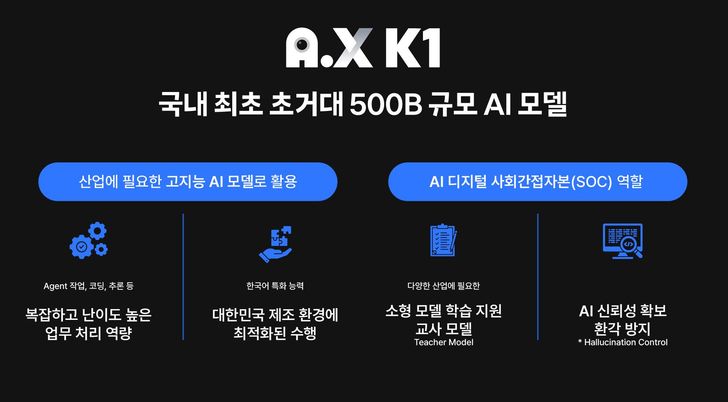
The A.X K1 model represents a significant milestone in the development of non-English-centric foundation models. By training the model primarily in Korean, SK Telecom aims to create a system with a deeper understanding of local culture, history, and linguistic nuance, a critical differentiator from models predominantly trained on English data. The model’s architecture suggests a Mixture-of-Experts (MoE) approach, where a massive knowledge base (519B parameters) is stored, but only relevant “experts” (~33B parameters) are activated for a given task. This design allows for high performance on complex tasks like coding and reasoning while managing inference costs, a strategy also employed by models from firms like Mistral AI.
SK Telecom plans for A.X K1 to serve as a “teacher model,” capable of transferring its knowledge to smaller, specialized models. This strategy, combined with a plan to open-source the model via an API, aims to build a domestic AI ecosystem around its technology, supporting everything from enterprise productivity tools to AI semiconductor validation with consortium partner Rebellions.
While the parameter count is impressive, it is not a direct proxy for performance. The model’s true capabilities will remain speculative until independent benchmarks comparing it to established models like OpenAI’s GPT-4 or Google’s Gemini are released. The success of its ecosystem ambitions also hinges on developer adoption, which will be influenced by the quality of its API, documentation, and the terms of its open-source license. The high cost of training and operating such a large model presents a significant long-term challenge to achieving profitability.
The key indicators to monitor will be the release of public performance benchmarks and the model’s integration into SK Telecom’s consumer-facing `A.` service, which could provide a powerful distribution channel. The industry will also be watching for initial use cases from partners like game developer Krafton. Finally, the role A.X K1 plays in South Korea’s national AI strategy will be critical, as government support could be a deciding factor in its competition with global tech giants.
Follow us on Bluesky , LinkedIn , and X to Get Instant Updates