- Unique AI Capabilities: According to Daniel Rausch, VP of Alexa and Echo at Amazon, 76% of Alexa+ usage involves tasks no other AI can perform.
- User Engagement Growth: Tens of millions of Early Access customers are having two to three times more conversations with Alexa+ compared to the original assistant.
- Task-Specific Increases: Alexa+ users are shopping three times more and using recipes five times more than before. Heavy smart home customers also utilize Alexa+ 50% more for smart home control.
- Opt-Out Rate: The number of users opting out of the Alexa+ experience after trying it is in the low single digits, which Rausch describes as “effectively… almost none”.
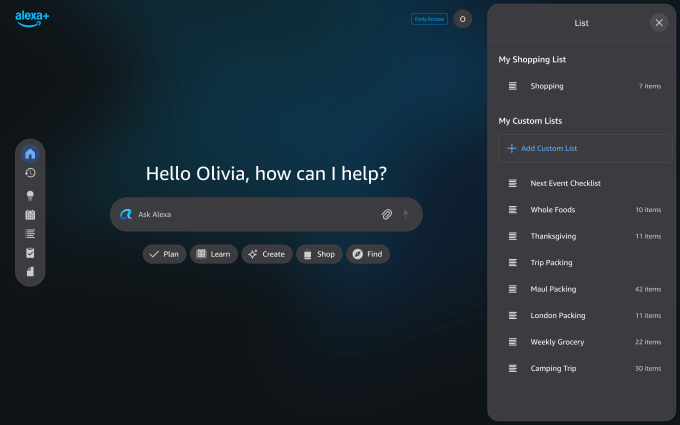
Amazon’s decision to bring Alexa+ to the web is a clear strategic play to expand its reach beyond its hardware footprint of over 600 million devices sold globally. By allowing users to interact with Alexa+ through a browser, Amazon is removing hardware barriers and aiming for ubiquitous accessibility, akin to its major AI rivals. The emphasis on family management – centralizing personal documents, emails, and calendars to track everything from school schedules to pet vaccinations – highlights Amazon’s intent to differentiate Alexa+ by embedding it deeply into the daily operational fabric of a household. This could be Alexa+’s most significant selling point, leveraging its established presence in the smart home to create a truly “agent-forward” experience that anticipates and manages complex, multi-step tasks.
While the reported engagement metrics are impressive, the expansion into web-based AI pits Alexa+ against well-entrenched competitors like Google and OpenAI, which have extensive personal data and productivity suites. Amazon acknowledges it doesn’t have the same wealth of personal data that rivals like Google already possess. Instead, it relies on users actively sharing data and uploading files. Furthermore, despite Rausch’s dismissal of online complaints, social media and forums do indicate instances of Alexa+’s “misfires and mistakes,” which could erode user trust, especially when handling sensitive family data. The “effectively… almost none” opt-out rate, while positive, could also be a function of Early Access users being more forgiving or invested in the ecosystem.
As Alexa.com rolls out more broadly beyond Early Access customers, I’ll be closely monitoring several key indicators. The success of Amazon’s strategy hinges on its ability to convince users to share sensitive personal data for the family management features – a significant trust hurdle. We should watch for data privacy policies and user interface design that instill confidence. Additionally, the evolution of Alexa+’s “agentic” capabilities and its seamless integration with third-party services (like Expedia, Angi, and Yelp) will be crucial for competitive differentiation against other web-based AI assistants. Finally, the adoption rates and sustained engagement outside of Amazon’s hardware ecosystem will reveal whether Alexa+ can truly thrive as a cross-platform AI assistant.
- Alexa+ is strategically expanding to the web, aiming for broader accessibility and direct competition with other generative AI chatbots.
- Amazon is prioritizing family and household management as a core differentiator, seeking to become an indispensable hub for daily life.
- Initial Early Access data shows strong user engagement and unique usage patterns, suggesting a positive reception for the enhanced AI.
- A critical challenge for Amazon will be building user trust to encourage sharing of personal data, an area where rivals currently hold an advantage.
- The long-term success of Alexa+ on the web will depend on its ability to deliver consistent, error-free performance and truly “agentic” capabilities that simplify complex tasks.
Follow us on Bluesky , LinkedIn , and X to Get Instant Updates