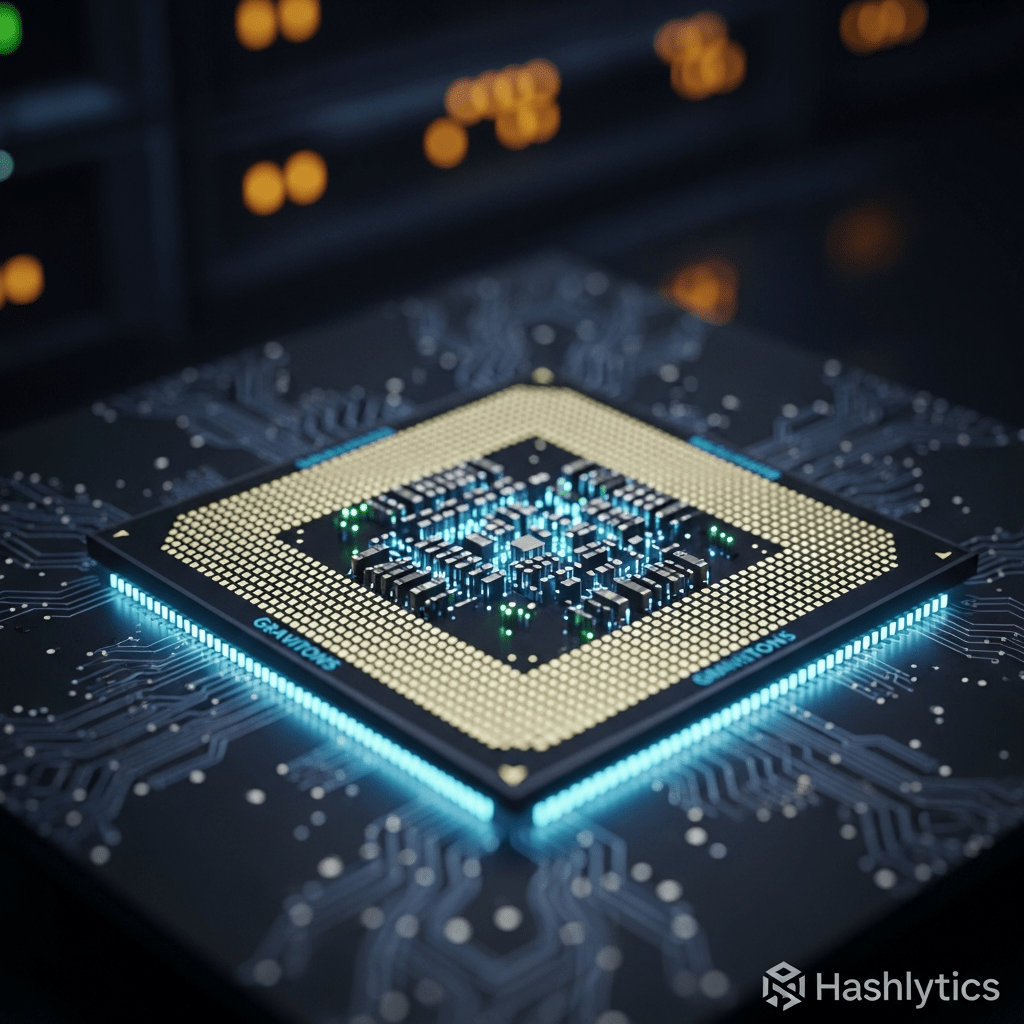
For years, the mantra has been faster, cheaper, greener. But achieving all three simultaneously? That’s the holy grail AWS is chasing with its custom-designed silicon. The Graviton5 aims to deliver measurable impact, from the data center to the bottom line.
At the heart of this upgrade lies a dense architecture: 192 cores packed onto a single chip. This high core density minimizes the distance data must travel, slashing inter-core communication latency by 33% while boosting bandwidth. Imagine the implications for real-time gaming, high-performance databases, and big data analytics – workloads where every millisecond counts.
The real magic, however, might be in the cache. Graviton5 boasts a 5x larger L3 cache compared to previous generations. Think of it as a super-fast memory buffer, keeping frequently accessed data within arm’s reach of the processor. Less waiting, faster response times – it’s a win-win.
And the benefits don’t stop there. Network and storage bandwidth see significant boosts, with up to 15% higher network bandwidth and 20% higher Amazon Elastic Block Store (EBS) bandwidth. Larger instances even get twice the network bandwidth. The result? Faster data transfers, quicker backups, and improved performance for distributed applications.
Performance gains are exciting, but security remains paramount. Graviton5 leverages the AWS Nitro System, a trusted foundation for security-conscious organizations. This system offloads virtualization, storage, and networking functions to dedicated hardware, freeing up compute and memory resources while implementing a zero-operator access design.
But AWS isn’t resting on its laurels. Graviton5 introduces the Nitro Isolation Engine, a mathematically verified system designed to ensure workload isolation. This is serious security, proven with mathematical certainty. AWS is even offering customers access to the Nitro Isolation Engine implementation, inviting scrutiny and reinforcing trust.
Ultimately, the proof is in the pudding. And the early taste tests are promising. Major players across diverse industries are already singing Graviton’s praises.
- Adobe is using Graviton to personalize broadcasts in real-time for millions.
- Epic Games relies on Graviton to power competitive gaming experiences.
- Formula 1 leverages Graviton to deliver real-time insights to viewers.
- Pinterest hosts over 500 million monthly active users on Graviton-based infrastructure.
Airbnb, a company known for its meticulous attention to performance, is seeing improvements of up to 25% compared to other system architectures. “AWS Graviton5-based Amazon EC2 instances are some of the fastest EC2 instances we have ever tested,” said Denis Sheahan a principal performance engineer at Airbnb.
Atlassian, a leader in work management software, observed 30% higher performance and 20% lower latency on Jira when testing Graviton5-based M9g instances. Siemens Digital Industries Software reports a 20% performance improvement and over 30% compute cost reductions on AWS Graviton4, with early Graviton5 testing showing an additional 30% performance boost.
Even SAP, a stalwart of enterprise software, is seeing “a stunning 35% to 60% increase in the performance of our OLTP queries on SAP HANA Cloud” with Graviton5-based Amazon EC2 M9g instances, according to Stefan Bäuerle, senior vice president and head of SAP HANA & Persistency at SAP.
Synopsys, a leader in engineering solutions, collaborates with AWS to enable Amazon’s custom silicon development. Sanjay Bali, senior vice president in strategy and product management at Synopsys, notes that early results on Graviton5 show up to 35% runtime improvements for Fusion Compiler and PrimeTime. Their joint partner, Arm, is observing up to 40% faster runtimes for Synopsys VCS on Graviton5 relative to previous generations.
The Graviton5-based M9g instances are currently in preview, with C9g instances for compute-intensive workloads and R9g instances for memory-intensive workloads slated for 2026. As AWS continues to push the boundaries of silicon design, the implications for cloud computing are profound. The quest for faster, cheaper, and greener is far from over, but Graviton5 represents a significant leap forward, setting a new benchmark for performance and efficiency in the cloud.