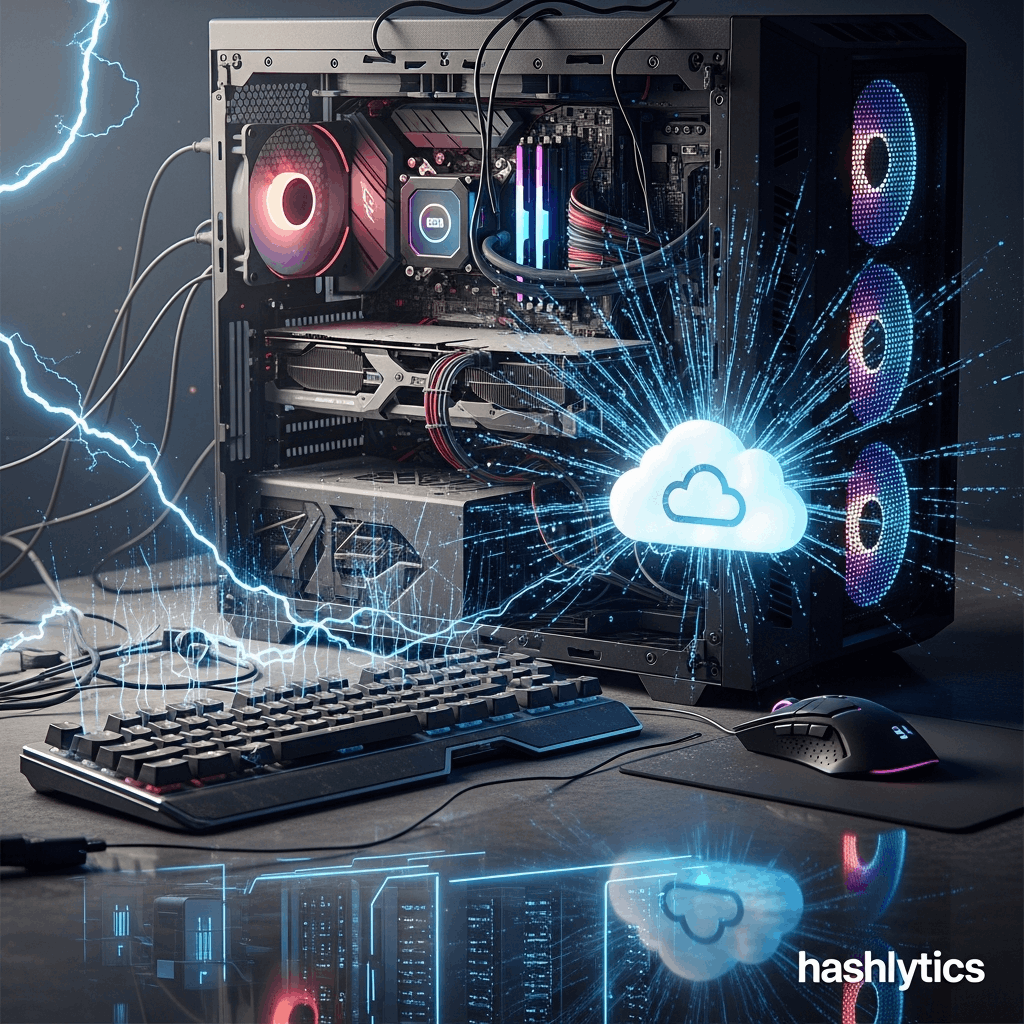
Amazon founder Jeff Bezos believes gaming PCs will become obsolete relics, replaced by cloud computing services where users rent processing power like electricity. Speaking at a talk originally given in 2024, Bezos compared local PC hardware to a 100-year-old electric generator he saw in a brewery museum—inefficient technology from a pre-grid era destined for replacement by centralized utilities.
The prediction gains credibility from the 2026 RAM crisis driving memory prices to untenable levels. AI demand has caused chip manufacturers like Micron and Samsung to prioritize data centers over consumer products, with memory shortages predicted to persist until 2028. Building powerful home PCs is becoming prohibitively expensive, making Bezos’s cloud-first vision frighteningly plausible.
The Cloud Gaming Reality Check
Cloud gaming infrastructure already exists and is growing rapidly. The global cloud gaming market was valued at $2.27 billion in 2024 and is projected to reach $21.04 billion by 2030, according to Grand View Research, representing a 44.3% compound annual growth rate. Major platforms have established footholds: Xbox Cloud Gaming officially launched in India after expanding to Amazon Fire TV devices, while services like Boosteroid integrated with Whale TV for 4K smart TV gaming.
Browser technology has evolved to support this shift. WebGPU’s universal support across Chrome and Mozilla browsers enables high-performance graphics rendering without local GPU hardware. Google Cloud, AWS, and Azure already offer GPU and TPU rental for AI workloads — the same infrastructure could power consumer gaming experiences.
Economics Favor the Cloud
As Windows Central reported, Bezos described his revelation at the brewery: “If a hotel wanted electricity, they had their own electric generator. I thought, this is what computation is like today; everyone has their own data center. That’s not going to last. You’re going to buy compute off the grid. That’s AWS.”
The hardware cost argument strengthens as AI drives 2026 gaming hardware price hikes and console delays. NVIDIA’s RTX 5070 now costs what a full gaming PC cost five years ago. Memory modules have doubled in price. Meanwhile, Xbox Cloud Gaming subscription costs $30 per month — $360 annually compared to a $1,500+ gaming PC that becomes obsolete in three years.
| Computing Model | Initial Cost | 3-Year Total |
|---|---|---|
| Gaming PC (2026) | $1,500-$2,500 | $1,500-$2,500 |
| Xbox Cloud Gaming | $0 (device agnostic) | $1,080 |
| GeForce NOW Ultimate | $0 (device agnostic) | $600 |
The Ownership Trade-Off
Critics on platforms like Slashdot warn that Bezos’s vision represents digital feudalism — a return to the mainframe era where computing power was rented, not owned. Users would own screens, keyboards, and mice while subscribing to operating systems and computing power, creating permanent dependency on tech giants.
Privacy concerns intensify this resistance. Cloud gaming requires streaming every keystroke and mouse movement to remote servers, giving providers visibility into every user action. Unlike Netflix or Spotify subscriptions that stream passive content, cloud computing subscriptions would monitor active work and play.
However, hundreds of millions have already accepted subscription models for music (Spotify), video (Netflix), and productivity (Microsoft 365). Cloud gaming platforms like NVIDIA GeForce Now reached 25 million registered users by 2024, suggesting consumer acceptance of non-ownership models may be higher than ownership advocates assume.
Technical Barriers Remain
Despite market projections, significant obstacles prevent immediate cloud dominance. NVIDIA’s GeForce Now recently imposed a 100-hour monthly cap even for paid subscribers because the economics don’t work at unlimited usage levels. GPU rental rates exceed $1.10 per hour for RTX 40-class instances, according to Mordor Intelligence, requiring subscription conversion rates above 8% to break even.
Latency remains problematic for competitive gaming. Input lag of even 30-50 milliseconds becomes noticeable in fast-paced titles, and edge computing infrastructure hasn’t reached sufficient density to serve all markets with sub-20ms latency. Rural and developing markets with limited high-speed internet access remain excluded from cloud gaming entirely.
Asia Pacific accounts for 47.9% of the cloud gaming market despite these challenges, driven by mobile-first gaming cultures and dense urban populations with excellent connectivity. North America follows at 50% market share growth during forecast periods, leveraging early 5G adoption and robust cloud infrastructure investments.
2026: The Inflection Point?
Market forces are converging to accelerate Bezos’s prediction. Memory shortages won’t normalize until 2028 at the earliest. AI infrastructure investments continue prioritizing data centers. Console manufacturers face delays and price hikes. Meanwhile, 5G penetration reaches critical mass and edge computing density increases.
Microsoft’s Windows 365 already offers cloud-based Windows desktops for enterprise customers. Extending this to consumers with gaming capabilities requires no new technology — only pricing models that make sense. If a $50-per-month subscription provides gaming PC performance without $2,000 upfront costs, many consumers will choose the subscription despite ownership trade-offs.
The gaming industry generated nearly $200 billion in 2025, with 95% of sales already digital rather than physical. Cloud gaming represents the logical next step in removing physical dependencies. Smart TV integration eliminates the need for any local hardware beyond a controller, and browser-based gaming through WebGPU removes installation barriers entirely.
Will Enthusiasts Resist?
Hardcore gamers with custom-built rigs, enthusiasts who overclock components, and competitive players requiring zero-latency responses will resist cloud transitions. But these users represent perhaps 5-10% of the gaming market. The remaining 90% of casual gamers prioritize convenience over absolute performance.
Bezos’s prediction may prove correct not through technical superiority but through economic inevitability. If component shortages persist and hardware prices remain elevated, consumers will choose accessible cloud options over expensive local hardware—just as they once abandoned on-site power generation for the electrical grid.
Follow us on Bluesky, LinkedIn, and X to Get Instant Updates