+3.26%
+5.96%
+2.51%
-0.69%
0.00%
-1.70%
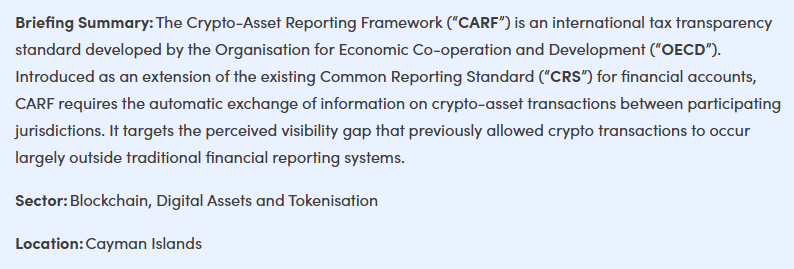
The Cayman Islands has officially adopted the Crypto-Asset Reporting Framework (CARF) Regulations, 2025, establishing a new global standard for crypto-asset tax reporting. Enacted to enhance international tax transparency, these regulations, effective , obligate local crypto-asset service providers to collect and report detailed user and transaction data to tax authorities. This information will then be automatically exchanged with partner jurisdictions where users are tax resident, with the first exchanges scheduled for .
On , the Cayman Islands government published the Tax Information Authority (International Tax Compliance) (Crypto-Asset Reporting Framework) Regulations, 2025, and amendments to the Common Reporting Standard (CRS), formalizing the jurisdiction’s commitment to the Organisation for Economic Co-operation and Development (OECD)‘s global tax transparency initiatives. These regulations will apply from the , with Cayman Reporting Crypto-Asset Service Providers (Cayman RCASPs) required to begin data collection from , for new users. Existing Cayman RCASPs must register with the Department for International Tax Compliance (DITC) by , while new providers have until of the following year to register.
Reporting obligations under the CARF Regulations fall upon Cayman RCASPs, defined as individuals or entities providing services that facilitate Exchange Transactions
or Transfers
in Relevant Crypto-Assets
for customers. Relevant Crypto-Assets encompass digital representations of value utilizing distributed ledger technology, such as Bitcoin, stablecoins, Non-Fungible Tokens (NFTs), and utility tokens, but exclude Central Bank Digital Currencies (CBDCs) and specific electronic money products.
Services in scope typically include operating trading platforms, acting as brokers or dealers, and providing counterparty services. Due diligence procedures, similar to existing Anti-Money Laundering (AML) and Know Your Customer (KYC) processes, require RCASPs to identify “Reportable Users” and collect self-certifications including tax residency and Tax Identification Numbers (TINs). For pre-existing users, this data must be collected by .
The OECD has issued Frequently Asked Questions (FAQs) to provide interpretative guidance, particularly addressing decentralized finance (DeFi) platforms and non-custodial services. These FAQs clarify that non-custodial service providers can meet the definition of a Reporting Crypto-Asset Service Provider if they exercise Control or Sufficient Influence
(COSI) over the platform, aligning with existing anti-money laundering standards.
The Cayman Islands’ adoption of CARF aligns with a global movement towards greater tax transparency in the crypto-asset sector. Over 60 jurisdictions worldwide have committed to implementing CARF, with first information exchanges set for . This initiative, spearheaded by the OECD in response to a G20 mandate, aims to combat potential tax evasion facilitated by the decentralized nature of crypto-assets, which previously fell outside traditional financial reporting standards like the Common Reporting Standard (CRS). The move reinforces the Cayman Islands’ position as a cooperative financial hub while upholding international tax compliance standards.
Clarity is still awaited from the Cayman Islands’ Department for International Tax Compliance (DITC) and the Tax Information Authority (TIA) regarding whether the OECD’s CARF FAQs will form an integral part of the CARF Regulations. The OECD distinguishes these FAQs as guidance from its commentary, which is an integral part of CARF, a distinction the DITC’s ‘Quick Guide’ appears to maintain.
The first annual reports under CARF are due by , covering data from the . These reports, utilizing the OECD’s CARF XML schema, will be submitted electronically to the DITC/TIA, which will then automatically exchange the information with tax authorities in reportable partner jurisdictions. The OECD continues to develop additional detailed guidance on the application of CARF to non-custodial and decentralized services. Non-compliance with the CARF Regulations can result in significant penalties, including fixed fines up to CI$50,000 (approximately US$61,000), daily continuing default penalties, and potential personal liability for directors and officers.
Entities operating as crypto-asset service providers in or from the Cayman Islands should promptly assess their status as a Cayman RCASP and determine their reporting obligations. It is critical to implement robust compliance policies and procedures to meet the new due diligence requirements for both new and pre-existing users by their respective deadlines. Businesses should also prepare for registration with the DITC by , for existing providers, and establish internal systems for collecting and reporting the required user identification and transaction details accurately. Understanding the OECD’s Crypto-Asset Reporting Framework and its evolving guidance is essential to avoid potential penalties.
Follow us on Bluesky , LinkedIn , and X to Get Instant Updates