The Problem Watermarking Is Trying to Fix
Social media users and content creators often present AI-generated text as human-written, and there has been no reliable way to check. Watermarking exists to close that gap, giving platforms and readers a way to verify origin without relying on guesswork or unreliable detection tools.
How LLMs Actually Pick Their Words
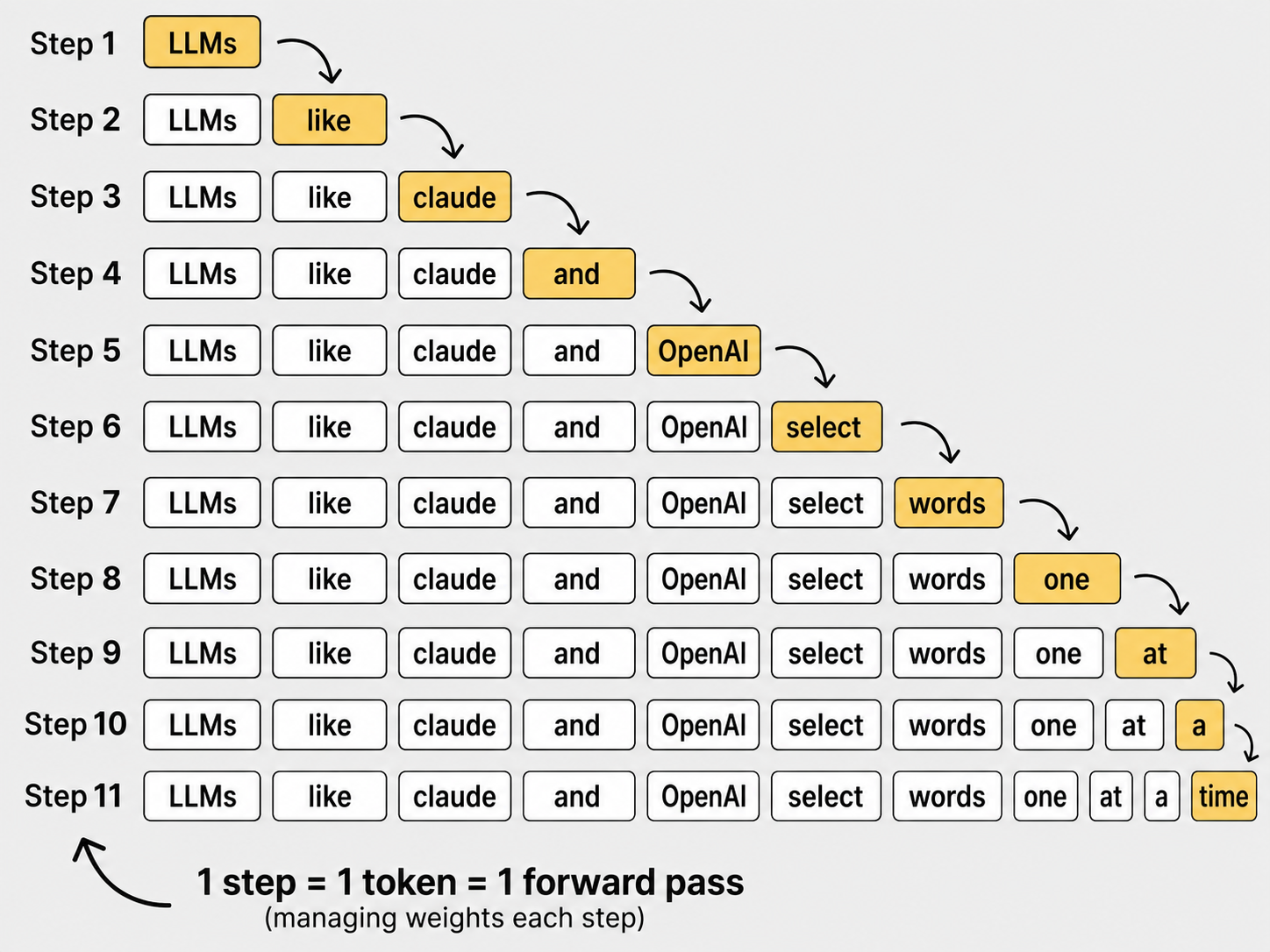
To understand how watermarking works, it helps to know how language models generate text in the first place. Large Language Models build sentences one word at a time, and every choice is based on probability rather than certainty.
Here’s the basic process:
- The model calculates a pool of possible next words for any given sentence
- Each word in that pool carries a different likelihood of being selected
- Words with higher probability sit closer to the center of that statistical distribution
- Every word in the pool remains a technically valid option, even the less likely ones
You can learn more about this process on OpenAI’s research pages, which break down the mechanics in more depth.
Where the Watermark Actually Lives
Watermarking exploits this probabilistic selection process directly. Instead of always picking the most statistically likely word, the model introduces a subtle, intentional bias, tilting its choices slightly toward one side of the probability distribution.
A human reader would never notice this. The words still make complete sense in context, and the sentence reads naturally. But a specialized detector can spot the deviation because it’s looking for the pattern, not the meaning.
A single biased word tells you nothing on its own. Spread across hundreds of words, though, that tiny recurring bias creates a detectable statistical signature. Academic researchers have published detailed papers on how these detection methods work if you want to go deeper into the math behind it.
Where This Technique Falls Short
Watermarking is not foolproof, and Claude’s own documentation acknowledges this. A few real limitations stand out:
- Short text is hard to detect. Claude notes that a “critical mass of text” is needed for reliable detection. A tweet or a two-sentence caption likely won’t contain enough data to reveal a pattern.
- Structured code resists watermarking. Outputs like HTML or JavaScript have far fewer valid word or syntax choices, which limits how much of a statistical signature can be embedded.
- Editing breaks the signal. Heavy paraphrasing, translation, or substantial rewriting can weaken or destroy the watermark entirely, making detection unreliable after the fact.
Who This Actually Catches
Despite these gaps, the method still holds real value for a specific group: people who generate large volumes of AI text and post it directly to social media with minimal editing. That’s where watermarking will be most effective, since the technique needs enough raw, unedited output to work.
Companies like Anthropic, the creators of Claude, are leading this effort, betting that even imperfect detection is better than none at all.
Follow Hashlytics on Bluesky, Facebook, LinkedIn , Telegram and X to Get Instant Updates