+1.02%
+1.52%
-4.38%
+2.16%
+0.71%
+1.12%
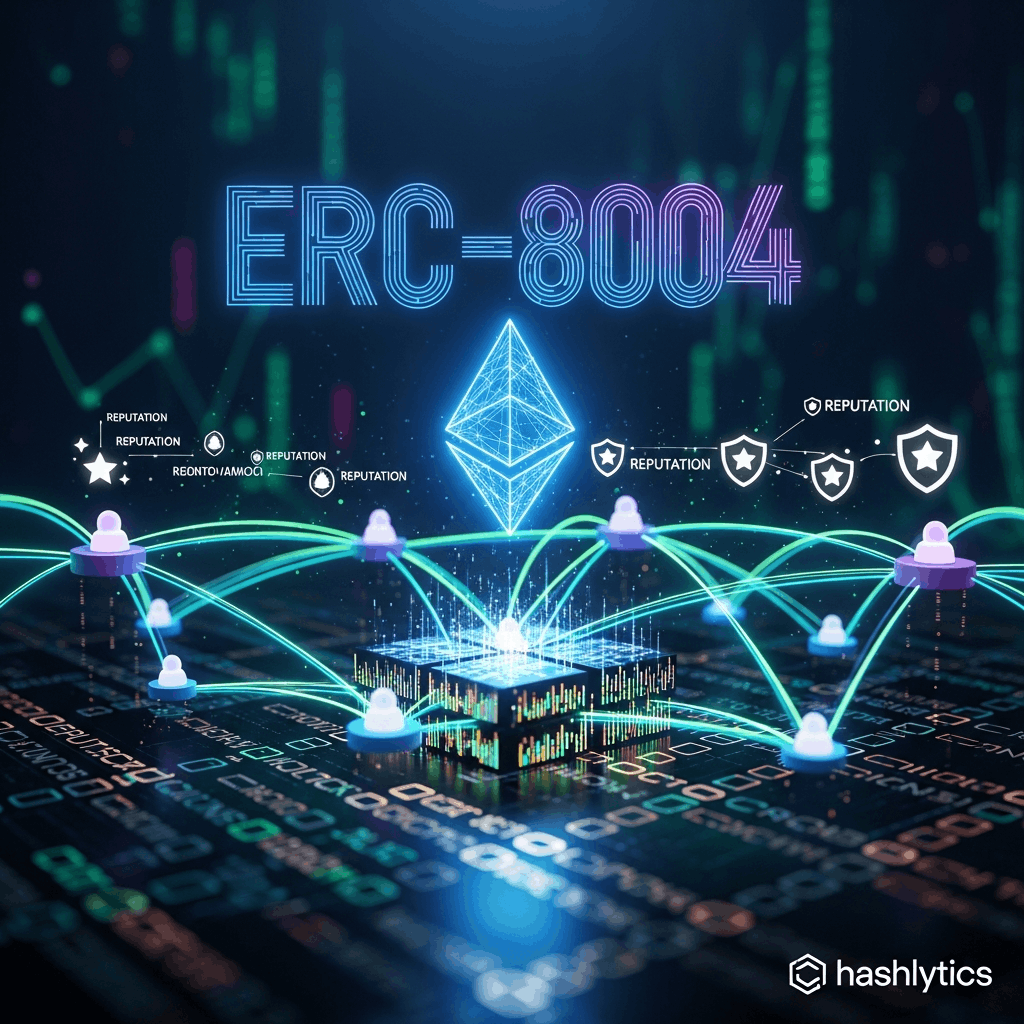
Ethereum’s ERC-8004 standard is heading to mainnet soon, introducing infrastructure that enables AI agents to build verifiable reputations, discover each other across organizations, and interact without gatekeepers. Created August 13, 2025 by engineers from MetaMask, Ethereum Foundation, Google, and Coinbase, the protocol addresses a fundamental problem: how can AI agents safely interact with unknown counterparts without pre-existing trust relationships?
according to Eco’s analysis.
What Problem Does ERC-8004 Solve?
Consider an AI agent managing a DeFi portfolio that wants to hire another agent for market analysis. Without shared infrastructure, the hiring agent faces impossible questions: How does it discover qualified analysts among thousands of options? How can it verify competence without prior interaction? How does reputation transfer if an analyst moves between platforms?
Traditional centralized platforms solve these problems through gatekeeping and proprietary reputation systems — creating vendor lock-in that contradicts blockchain’s decentralized ethos. ERC-8004 provides an alternative by extending Google’s Agent-to-Agent (A2A) protocol with blockchain-based trust mechanisms, transforming A2A from a protocol designed for trusted environments into one supporting open agent economies.
The Three Registry Architecture
ERC-8004 introduces three lightweight on-chain registries deployable on any EVM-compatible chain. The Identity Registry gives each agent a portable, censorship-resistant identifier based on ERC-721 that resolves to an AgentCard — a JSON file declaring the agent’s name, services, communication endpoints (MCP, A2A), wallet addresses, and supported trust models. The Reputation Registry provides a standard interface for posting and fetching feedback signals, with scoring occurring both on-chain for composability and off-chain for sophisticated algorithms. The Validation Registry offers generic hooks for requesting independent validator checks including stakers rerunning jobs, zkML verifiers, TEE oracles, and trusted judges.
According to the official ERC-8004 specification, this architecture leaves application-specific logic off-chain while storing only essential trust-related data on-chain — a hybrid approach that balances transparency with scalability.
How Does Reputation Actually Work?
When an agent completes work for a client, the client can submit feedback to the Reputation Registry consisting of a signed fixed-point value, optional tags for filtering, endpoint URI, and optional off-chain JSON with additional context. All fields except the core value rating are optional, making the system flexible for different use cases.
Critically, feedback given by another agent uses the agentWallet address as the clientAddress to facilitate reputation aggregation. This enables specialized services to emerge including agent scoring systems, auditor networks, and insurance pools that aggregate feedback data to produce trust scores for specific contexts or industries.
Is Trust Universal or Contextual?
Trust in ERC-8004 is not a universal value but a vector from one agent to another. Alice’s trust for Bob will differ from Charlie’s trust for Bob, and Alice’s trust varies by context/domain of interaction,
explains the awesome-erc8004 documentation. This reinforces why the standard supports modular, context-aware reputation systems rather than attempting to create a single global trust score.
Tiered Security: Matching Trust to Value
One of ERC-8004’s most sophisticated features is proportional security — trust mechanisms that scale with value at risk. For low-value tasks like content creation or basic queries, social consensus based on accumulated feedback provides sufficient security. For financial transactions or smart contract operations, validators must stake economic value that can be slashed for incorrect validations, creating strong incentives for honest behavior. For mission-critical operations like medical diagnosis or legal advice, agents can require zero-knowledge machine learning proofs or trusted execution environment attestations that provide cryptographic certainty.
According to QuillAudits’ technical analysis, this tiered approach addresses the fundamental insight that ordering pizza requires different security guarantees than medical diagnosis.
The standard doesn’t force a one-size-fits-all solution but provides pluggable trust models developers can mix and match.
What About Payments Between Agents?
ERC-8004 deliberately excludes payment mechanisms to remain unopinionated and avoid coupling trust infrastructure with specific payment protocols. However, payment proofs can be included as optional attributes in off-chain schemas. The team is collaborating with groups working on A2A payment extensions based on the x402 protocol, and payment references can serve as lightweight hooks in Reputation records for correlation between work performed and compensation received.
Deployment Reality: Layer 2 Focus
While ERC-8004 can deploy on Ethereum mainnet or any EVM-compatible chain, the high-throughput nature of agent interactions makes Layer 2 networks the most likely deployment targets. According to PayRam’s developer guide, it is most likely to see significant adoption on Layer 2s like Optimism, Arbitrum, or Base, where gas fees are lower.
Frequent micropayments and feedback submissions would become prohibitively expensive on mainnet at current gas prices.
The standard’s lightweight design minimizes on-chain storage costs. Much agent interaction migrates to Ethereum’s Layer 2 networks where throughput is higher and fees lower, with mainnet perhaps serving as a high-security settlement or coordination layer — consistent with how rollups currently operate.
Market Implications: The Trillion-Dollar Agent Economy
Research suggests the AI sector could exceed $1 trillion in valuation by 2031, with autonomous agents representing a significant portion as they evolve from passive assistants into active economic participants. Without shared infrastructure for agent identity and reputation, this emerging economy risks fragmenting into isolated proprietary systems controlled by major tech companies.
ERC-8004 could unlock entirely new business models including decentralized agent marketplaces where anyone can deploy an AI agent offering services with payments and ratings handled on-chain, specialized reputation aggregation services providing trust scores for different industries and use cases, agent insurance pools that protect clients from poor-quality work based on validation history, and autonomous organizations coordinating work among agent collectives without human management overhead.
Can Agent Identities Be Traded?
Since the Identity Registry uses ERC-721 NFTs to represent each agent’s identity, an agent’s identity is technically tradable on any NFT marketplace. According to PayRam’s FAQ, trading an agent identity NFT would be equivalent to selling ownership of the agent itself, not trading a protocol currency.
This raises interesting questions about agent ownership, reputation portability when ownership transfers, and whether reputation should be bound to technical infrastructure or to the organizational entity controlling it.
Current Status and Adoption Timeline
ERC-8004 currently holds peer review status within Ethereum’s improvement proposal process, with a complete specification available and three operational registries defined. The protocol has strong community support with more than ten prototypes built against the initial draft during 2025.
The Ethereum Foundation explicitly designated ERC-8004 as a key component of its strategic roadmap, with the newly established Decentralized AI team actively promoting the standard through community calls, builder programs, and conferences. A full-day summit at Devconnect on November 21, 2025 explored Ethereum as a coordination layer for the AI economy, with multiple teams demonstrating working implementations.
According to the official roadmap, the v1 specification will freeze for implementation after incorporating feedback from open community review and real-world prototype testing. While off-chain schemas and conventions may evolve over time, the on-chain standard itself should remain stable and change only for materially important reasons—similar to how ERC-20 and ERC-721 achieved longevity through careful initial design.
Security Considerations and Limitations
While ERC-8004 cryptographically ensures registration files correspond to on-chain agents, it cannot cryptographically guarantee that advertised capabilities are functional and non-malicious. This is why the three trust models—reputation, validation, and TEE attestation—become essential for actual deployment.
Key risks include Sybil attacks where malicious actors create multiple identities to manipulate reputation systems, reputation gaming through collusion between agents to artificially inflate scores, scalability challenges if all agent interactions require on-chain transactions, and potential smart contract vulnerabilities in registry implementations. QuillAudits emphasized that for this future to be sustainable, the underlying smart contracts powering ERC-8004 must remain free from vulnerabilities.
Developers have noted that the Identity Registry requires external security mechanisms like zkTLS to prevent malicious agents from impersonating legitimate domains. This highlights that ERC-8004 provides foundational infrastructure but doesn’t solve all trust problems—additional layers of security remain necessary for production deployment.
What This Means for Developers
Developer surveys show that 72% of Web3 developers prioritize composability and standardization when choosing new protocols—both central to ERC-8004’s design philosophy. The standard provides developers with a shared, open-source framework for agent trust so they don’t need to reinvent identity, reputation, and validation infrastructure for each project. It enables permissionless innovation by allowing developers to build in an open ecosystem, avoiding vendor lock-in from proprietary closed systems.
For teams building on ERC-8004, the Ethereum Foundation created a support program including collaborative product-scope review, technical guidance, weekly calls, optional deep dives, and launch visibility. The program aims to accelerate adoption by reducing friction for early implementers and building a community of practice around the standard.
The Path Forward: From Standard to Economy
ERC-8004 represents more than a technical specification—it’s infrastructure enabling a future where AI agents operate autonomously, transparently, and trustlessly across a decentralized economy. By enabling discovery and portable reputation, the standard allows AI agents to interact across organizations ensuring credibility travels everywhere, unlocking a global market where AI services can interoperate without gatekeepers.
As one Web3 summit speaker noted, Don’t ask ‘if’ your business will use AI agents. Ask ‘how’ you will trust them. An open standard is the only scalable answer.
Whether ERC-8004 becomes as transformative for AI agents as ERC-20 was for tokens depends on adoption by major platforms, security of early implementations, and whether the promise of portable reputation proves more valuable than the convenience of centralized alternatives.
With mainnet deployment approaching and multiple teams building production implementations, 2026 will test whether Ethereum can establish itself as the neutral coordination layer for the trillion-dollar AI agent economy.
Follow us on Bluesky, LinkedIn, and X to Get Instant Updates