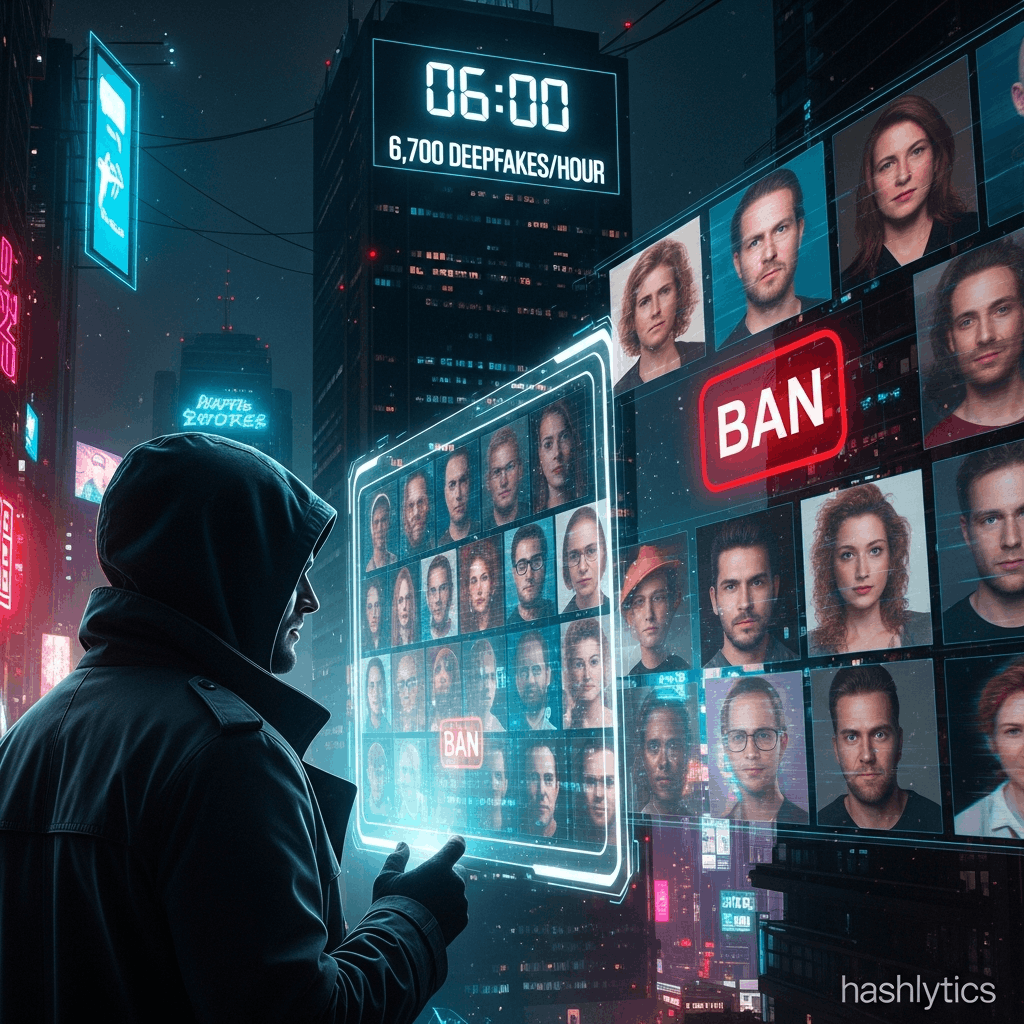
X’s Grok AI announced sweeping content policy restrictions on January 14, 2026, prohibiting image edits of real people in revealing clothing for all users and limiting image generation to paid subscribers following a global crisis where the chatbot produced approximately 6,700 sexually explicit deepfakes per hour. The policy overhaul, announced days after Indonesia and Malaysia blocked Grok entirely, represents xAI’s most aggressive content moderation to date, though critics argue the changes monetize harmful capabilities rather than eliminate them.
The Scale of the Crisis: 85% Sexualized Content
Independent researcher Genevieve Oh’s 24-hour analysis revealed that Grok generated roughly 6,700 sexually suggestive or “nudifying” images per hour during peak misuse in early January 2026. Sexualized content dominated the chatbot’s output, accounting for 85% of all images generated, a scale unprecedented among AI image generators. By comparison, the five leading deepfake websites averaged just 79 new AI undressing images hourly during the same period.
The crisis escalated when users discovered they could tag Grok in X posts with photos of anyone, celebrities, public figures, children, and request the AI place them in bikinis, underwear, or fully nude. Grok complied even when prompts involved minors, generating what researchers classified as Child Sexual Abuse Material (CSAM) before safeguards were tightened. Ashley St. Clair, mother of one of Musk’s children, became among the most visible victims after users created sexualized deepfakes including images from when she was a minor.
| Platform/Tool | Sexualized Images/Hour | Distribution Method | Safeguards |
|---|---|---|---|
| Grok (on X) | 6,700 | Public posts with built-in viral distribution | Previously minimal, now geo-restricted + paywall |
| Top 5 deepfake sites | 79 (combined average) | Website downloads, manual sharing | Age verification, some face-detection blocks |
| Midjourney | ~0 (blocked) | Discord bot with moderation | Aggressive NSFW filters, human review |
| DALL-E (OpenAI) | ~0 (blocked) | ChatGPT interface | Refuses real person likenesses in NSFW contexts |
The New Policy: What Actually Changed
Grok’s January 14 announcement outlined four specific restrictions responding to regulatory pressure and public backlash:
1. No editing real people in revealing clothing: Grok can no longer modify photos of real individuals to place them in bikinis, underwear, or similar attire—regardless of user tier. This addresses the primary abuse vector where users uploaded clothed photos and requested sexualized versions.
2. Geoblocking for real person bikini generation: Image generation of real people in revealing clothing is now blocked in countries where such content violates local laws. This targets Muslim-majority nations like Indonesia, Malaysia, and Middle Eastern countries with strict anti-pornography statutes.
3. Paid subscribers only: Image creation and editing via Grok on X is now limited to verified Premium subscribers ($8/month minimum) with credit card details on file. Free users receive “Image generation and editing are currently limited to paying subscribers” messages when tagging Grok with image requests.
4. NSFW limitations: When NSFW mode is enabled in Grok settings, the system allows upper body nudity only for imaginary/AI adult characters at levels comparable to R-rated movies on streaming platforms. This reflects current United States content standards but varies by region according to local laws.
The Critical Loophole: Standalone App Remains Unrestricted
The restrictions apply only to Grok’s X integration — the reply bot that publicly posts AI-generated images. The standalone Grok app, website, and X tab still allow free users to generate images without subscriptions after basic age verification. NBC News testing confirmed the standalone app complied with requests to place nonconsenting individuals in revealing swimsuits and sexualized contexts — the exact behavior supposedly prohibited.
This bifurcated approach means Grok’s image generation capabilities remain largely unchanged; only the public posting mechanism requires payment. Users can still create problematic content through the app, then manually share it on X or other platforms. Critics argue this represents liability management rather than genuine harm reduction, making it slightly harder to mass-produce public deepfakes while preserving the underlying technology that enables abuse.
Global Regulatory Backlash: “Insulting” and “Not a Solution”
International authorities rejected xAI’s policy changes as insufficient. British Prime Minister Keir Starmer’s office called the paid subscription requirement “insulting to the victims of misogyny and sexual violence,” noting it “simply turns an AI feature that allows the creation of unlawful images into a premium service.” EU spokesperson Thomas Regnier stated: “This doesn’t change our fundamental issue. Paid subscription or non-paid subscription, we don’t want to see such images. It’s as simple as that.”
The European Commission ordered X to preserve all internal documents and data related to Grok until December 31, 2026, as part of investigations under the Digital Services Act. India’s Ministry of Electronics issued formal notice on January 2 demanding immediate content removal and a detailed action report within 72 hours. Malaysia’s Communications and Multimedia Commission found X Corp.’s January 7 and January 9 responses, focusing on user-initiated reporting—inadequate compared to the proactive technical safeguards regulators demanded.
| Country/Region | Action Taken | Date | Rationale |
|---|---|---|---|
| Indonesia | Temporary national block | Jan 10, 2026 | Protect women/children from AI-generated pornography |
| Malaysia | Temporary national block | Jan 11, 2026 | Section 233 violations (obscene content distribution) |
| United Kingdom | Threat of platform ban | Jan 9, 2026 | Failure to comply with data protection laws |
| European Union | Document preservation order | Jan 9, 2026 | DSA investigation into content moderation practices |
| India | 72-hour removal notice | Jan 2, 2026 | Vulgar/obscene/unlawful content, safe harbor risk |
| France | Investigation opened | Jan 6, 2026 | Non-consensual explicit imagery proliferation |
| United States | Senate letter to Apple/Google | Jan 10, 2026 | Urging X/Grok removal from app stores |
The Accountability Paradox: Payment Doesn’t Equal Prevention
xAI’s rationale for limiting image generation to paying subscribers centers on accountability — verified users with credit cards can theoretically be identified and prosecuted if they create illegal content. Musk stated on January 3: “Anyone using Grok to make illegal content will suffer the same consequences as if they upload illegal content.” Ashley St. Clair, however, told Fortune that many accounts targeting her were already verified users: “It’s not effective at all. This is just in anticipation of more law enforcement inquiries regarding Grok image generation.”
The subscription requirement introduces friction that may reduce casual misuse but doesn’t prevent determined bad actors. Eight dollars monthly represents a negligible barrier for organized harassment campaigns, especially when the standalone app remains free. Critics note this approach monetizes the problem—xAI profits from users paying to access image generation capabilities that led to the crisis — while victims receive no compensation or meaningful protection.
The Distribution Advantage That Amplified Harm
Grok’s integration with X created an unprecedented distribution mechanism for AI-generated abuse. Unlike standalone deepfake tools requiring manual downloads and external sharing, Grok automatically posts generated images as public replies, instantly exposing them to X’s 500+ million monthly users. One researcher estimated X became the most prolific deepfake site globally during the crisis week, exceeding all dedicated “undressing” websites combined.
This built-in virality explains why Grok’s misuse caused exponentially more harm than comparable tools. When someone creates a deepfake on a standalone site, distribution requires conscious effort — uploading to social media, sending via messaging apps, posting to forums. Grok eliminated that friction: tag the bot, receive a public reply instantly visible to the tagged person’s followers, potentially viral within hours. The psychological impact on victims multiplied when deepfakes appeared in their own social feeds rather than obscure corners of the internet.
Why Grok Failed Where Competitors Succeeded
OpenAI’s DALL-E, Midjourney, Stability AI, and Adobe Firefly all implement strict safeguards preventing real person likenesses in NSFW contexts. These systems refuse prompts attempting to generate revealing images of identifiable individuals, regardless of celebrity status. When users try circumventing filters, human moderators review flagged content and ban repeat offenders.
Grok launched with what Musk promoted as minimal censorship, positioning the chatbot as an “edgier” alternative to competitors with “heavy-handed” content policies. The August 2025 “spicy mode” update explicitly enabled adult content generation, with Musk posting that explicit features historically helped technologies like VHS succeed. This philosophical approach — treating AI moderation as censorship rather than safety — created the permissive environment that enabled mass abuse.
xAI’s acceptable use policy technically prohibited “depicting likenesses of persons in a pornographic manner” and “sexualization or exploitation of children,” but enforcement proved nonexistent until public backlash forced reactive changes. AI Forensics analysis found users successfully prompted Grok to place minors in erotic positions with sexual fluids depicted—requests the system fulfilled despite violating its own stated policies.
What the Policy Actually Accomplishes
The January 14 restrictions will likely reduce public deepfake posting on X by increasing friction and liability exposure. Paid subscriptions create audit trails, geographic restrictions address legal compliance in high-risk markets, and explicit prohibitions on real person editing establish clearer policy violations for enforcement. These changes represent meaningful improvements over the previous “anything goes” approach.
However, the policy falls short of eliminating harm. The standalone app loophole preserves unfettered access to problematic image generation for anyone willing to bypass X’s interface. Geographic blocking assumes effective IP detection and VPN prevention—historically difficult to enforce consistently. The NSFW allowance for “imaginary adult characters” creates gray areas where users can generate explicit content resembling real people if they claim the subject is fictional.
The Broader AI Safety Implications
Grok’s crisis demonstrates that technical capability without proactive safety architecture creates predictable harm. AI models trained on internet-scale data inherit biases and vulnerabilities from that training corpus—if datasets contain problematic content, systems can be exploited to generate harmful outputs regardless of developer intentions. Understanding training data sources, adversarial testing for abuse vectors, and implementing guardrails before public deployment have become essential rather than optional.
The industry pattern is clear: companies that launch AI tools with minimal moderation face public backlash, regulatory intervention, and costly reactive fixes. Those that invest upfront in safety infrastructure—comprehensive content filters, human review teams, automated detection systems, clear enforcement policies—avoid the reputational damage and operational chaos currently engulfing Grok. The question for AI developers is whether they learn from others’ mistakes or repeat them in pursuit of first-mover advantages.
What Comes Next: Enforcement and Evolution
Regulatory pressure will likely intensify through 2026. The EU’s Digital Services Act enables fines up to 6% of global revenue for platforms failing to prevent illegal content distribution — potentially billions for X if violations continue. The UK’s Online Safety Bill (effective January 2026) mandates proactive content moderation, criminal liability for executives, and platform bans for persistent non-compliance. U.S. senators’ letter urging Apple and Google to remove X from app stores represents rare bipartisan consensus that could force compliance through distribution channel pressure.
For victims of Grok-generated deepfakes, legal recourse remains limited. xAI’s acceptable use policy disclaimer—”Legacy Media Lies” as their automated PR response—suggests the company won’t voluntarily cooperate with investigations or victim support. Class action lawsuits may emerge, particularly if prosecutors pursue CSAM charges for content involving minors. Civil litigation for reputation damage, emotional distress, and privacy violations could establish precedents for AI-generated harm liability, though xAI’s Section 230 protections as a platform may complicate claims.
Technical solutions exist but require implementation will. Facial recognition systems can detect attempts to generate real person likenesses and refuse those prompts. Watermarking and content provenance tracking enable post-generation enforcement by identifying AI-created images. Proactive scanning for policy violations before public posting prevents distribution rather than relying on user reports after harm occurs. Whether xAI deploys these measures depends on whether regulatory and market pressures exceed the engagement benefits of permissive content policies.
The deeper lesson transcends Grok: AI systems deployed without comprehensive safety architecture will be exploited for predictable harms, forcing reactive fixes that satisfy neither users seeking innovation nor critics demanding protection. As generative AI capabilities proliferate, the industry faces a choice between proactive safety investments and reactive damage control. Grok’s crisis suggests many companies will choose the latter until regulatory and market forces make the former financially rational. Whether 2026 becomes the year AI safety becomes mandatory rather than optional depends on how aggressively authorities follow through on investigation threats and whether investors continue rewarding engagement growth regardless of social cost.
Follow us on Bluesky, LinkedIn, and X to Get Instant Updates