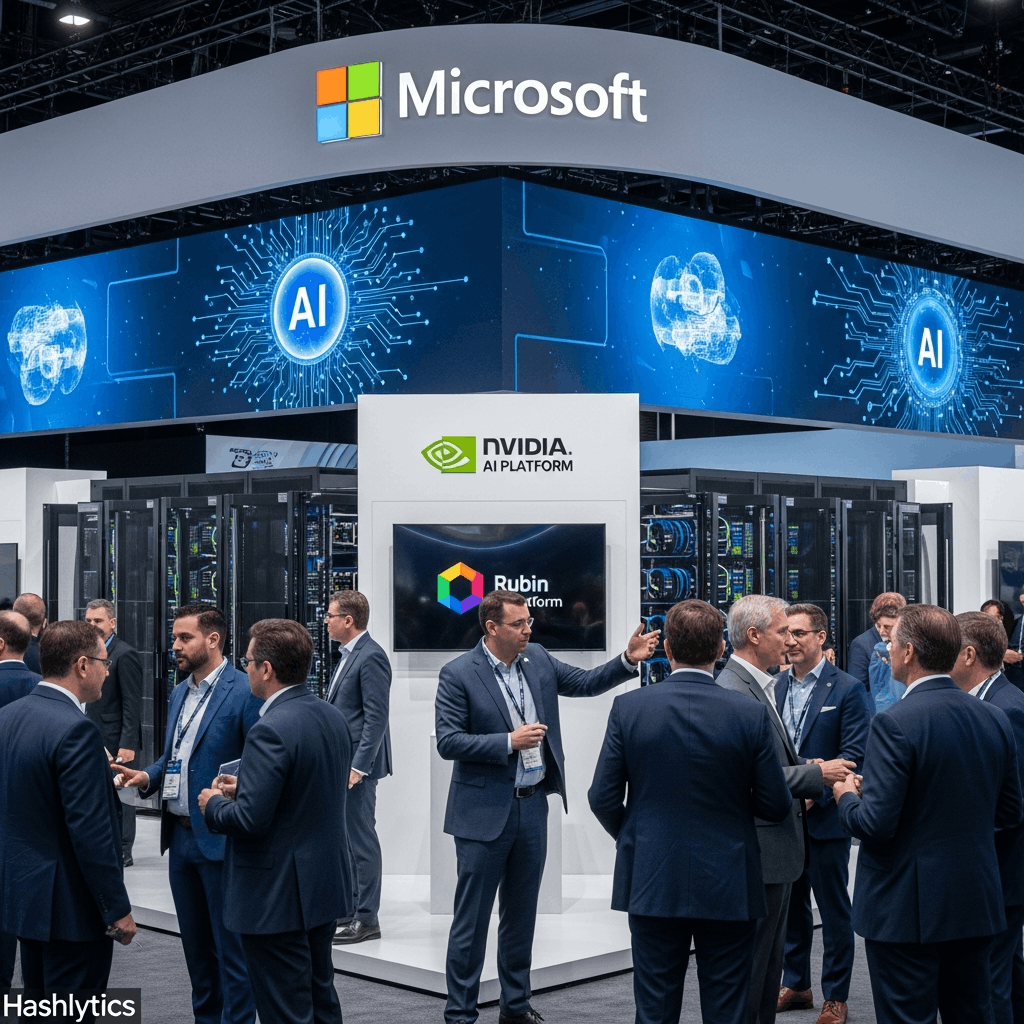
- Rubin Platform Launch: Unveiled at , with full production for later delivery.
- Vera Rubin NVL72 System Bandwidth: Features ~260 TB/s of scale-up bandwidth.
- NVIDIA ConnectX-9 Networking: Delivers 1,600 Gb/s (1.6 Tb/s) throughput per GPU for ultra-fast scale-out networking.
- Rubin Performance Uplift: Rubin GPU offers 50 petaflops of NVFP4 inference performance, 5x that of Blackwell, and 35 petaflops of NVFP4 training performance, 3.5x that of Blackwell.
- Azure MLPerf Benchmarks: Microsoft Azure has published industry-leading large-scale benchmarks, including training a 175-billion-parameter GPT-3 model in 4 minutes on 10,752 NVIDIA H100 GPUs. More recently, Azure’s MLPerf outperforms a leading cloud competitor by 28% for Llama 70B fine-tuning with the same number of GPUs.
Azure’s proactive engagement in co-designing its infrastructure with NVIDIA for platforms like Rubin and its predecessor, Grace Blackwell, provides a crucial competitive advantage. The raw intel highlights that Azure’s rack architecture has already been redesigned to handle Rubin’s formidable bandwidth, including the ~260 TB/s scale-up bandwidth of Vera Rubin NVL72 systems and the ultra-fast NVIDIA ConnectX-9 1,600 Gb/s networking. This pre-tuning extends to managing the tighter thermal windows, higher rack densities, and new memory expansion architecture demanded by Rubin’s HBM4/HBM4e memory stack and multi-die GPU packaging.
For enterprises, this means faster access to cutting-edge AI capabilities. As NVIDIA CEO Jensen Huang noted at , Rubin arrives just in time for the next frontier of AI
. Azure’s preparedness translates directly into quicker deployment cycles, enhanced scalability for massive AI workloads, and potentially lower operational overhead for customers, avoiding costly retrofits. The platform’s proven track record with large-scale InfiniBand deployments and benchmark performance further solidifies its position as a robust environment for demanding AI training and inference.
While Azure’s readiness is impressive, it’s important to note that Microsoft is not alone in its pursuit of next-generation AI infrastructure. Major hyperscalers like AWS and Google Cloud are also among the first cloud providers slated to deploy Vera Rubin-based instances in . This suggests that while Azure may have a head start in terms of deep co-design and specific architectural optimizations, the competitive landscape for AI supercomputing remains fierce. Other providers are also heavily investing in their own AI-optimized hardware and software stacks, and it remains to be seen how their respective implementations of Rubin will compare in real-world customer scenarios and pricing models. Furthermore, NVIDIA’s strategy of delivering annual generational upgrades means the competitive race for AI hardware adoption will continue unabated.
Moving forward, I’ll be closely monitoring several key indicators. Firstly, specific customer adoption rates and the performance metrics from early enterprise deployments of Rubin on Azure will be critical. Benchmarks, particularly those from MLPerf, will continue to be a vital objective measure of real-world performance for training and inference workloads. Furthermore, details on pricing structures for Rubin instances on Azure, compared to competitors, will be crucial for assessing the total cost of ownership for AI innovators. Any insights into how Azure’s “AI superfactory modularity” and regional supercomputer approach translates into broader global availability and specialized offerings will also be a key differentiator to observe.
- Azure’s deep co-design with NVIDIA gives it a significant advantage in rapidly deploying the cutting-edge Rubin AI Platform.
- Infrastructure optimizations, from networking to cooling and power, are pre-engineered for Rubin’s demanding specifications.
- This readiness promises faster deployment, enhanced scalability, and reduced complexity for customers tackling large-scale AI workloads.
- While competitive, Azure’s proven benchmark performance and architectural foresight position it strongly in the evolving AI cloud market.
- The true impact will be seen in actual customer deployments, real-world benchmarks, and competitive pricing strategies later in .
Follow us on Bluesky , LinkedIn , and X to Get Instant Updates