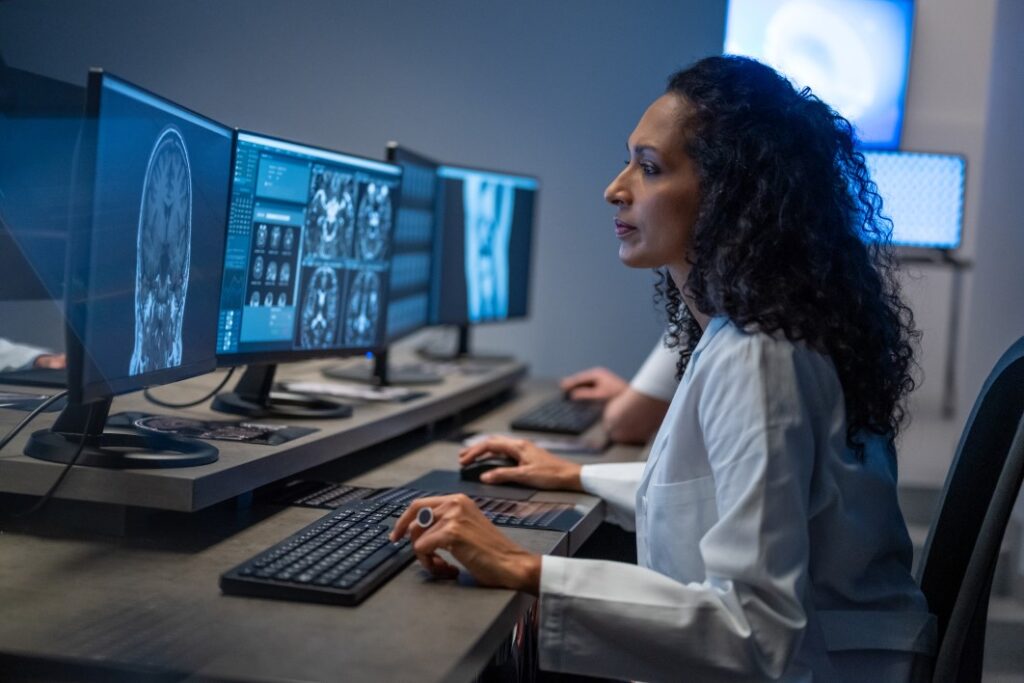
Microsoft is addressing the increasing demands on radiology teams with its new Dragon Copilot, unveiled for preview at RSNA 2025. This AI-powered assistant aims to streamline the radiologist’s workflow by leveraging generative, multimodal, and agentic AI, ultimately improving diagnostic speed, accuracy, and patient outcomes.
Dragon Copilot is designed to enhance, not replace, radiologists’ capabilities. It integrates directly into existing workflows, particularly with PowerScribe One, Microsoft’s reporting solution, offering a unified experience that highlights critical information and automates repetitive tasks. The goal is to introduce advanced AI without requiring a complete system overhaul, acknowledging the challenges radiologists face with disjointed technology and the time lost wrestling with it.
Fragmentation within the AI landscape is a major hurdle, with tools addressing narrow problems often creating integration complexities. Dragon Copilot, in conjunction with PowerScribe One, aims to deliver generative, multimodal, and agentic AI securely, scalably, and seamlessly. This cloud-native approach brings AI directly into the radiologist’s workflow, streamlining report creation without disrupting the crucial interpretation process.
Sean Cleary, MD, Vice Chair of Informatics for Imaging Sciences at the University of Rochester Medical Center, emphasized the importance of cloud-based solutions that integrate seamlessly with existing systems. He expressed confidence that Dragon Copilot, as a companion for PowerScribe One, will allow for the testing and benefiting from the latest AI advancements with minimal disruptions.
Dragon Copilot offers several key AI capabilities:
- Prior Report Summarization: Condenses lengthy prior reports into concise bullet points, providing essential context for interpreting current studies and improving diagnostic speed and accuracy.
- Chat with Credible Sources: Enables radiologists to ask questions and conduct research within the workflow, routing queries to appropriate agents and plugins for reliable, evidence-based answers, eliminating the need to switch between multiple applications.
- Report Optimization for Billing and Beyond: Leverages third-party AI insights to check report content, ensuring accuracy, quality, and compliance, ultimately reducing claim denials and improving reimbursement accuracy.
- AI Draft Report Content: Generates AI-powered draft reports from image analysis, providing radiologists with a starting point for review, validation, and refinement.
Microsoft is fostering an ecosystem where organizations can experiment, fine-tune, and build AI models tailored to their specific needs. The rise of multimodal AI, capable of analyzing medical imaging, genomics, and clinical records, is driving innovation.
Dr. Richard Bruce, Professor and Vice Chair of Informatics, Department of Radiology at the University of Wisconsin School of Medicine and Public Health, highlighted the collaborative effort to assess models like CXRReportGen, which supports grounded report generation based on image analysis from chest X-rays. He emphasized the challenge of integrating model output into clinical workflows to add value and the opportunity to collaborate on AI interoperability with Microsoft and partners like Epic and Sectra to optimize clinical workflows and improve patient care.
Microsoft Foundry offers a catalog of healthcare AI models, including MedImageInsight, MedImageParse, and CXRReportGen.
Partners play a crucial role, offering radiology-specific AI apps and agents accessible within Dragon Copilot.
Examples include:
- Lunit: AI-powered image analysis for mammography exams.
- Zotec: Ensures reports are complete, compliant, and satisfy quality measures.
Microsoft’s commitment extends beyond Dragon Copilot to the broader Microsoft Azure ecosystem. Partners are leveraging Azure to transform imaging workflows and data management in the cloud.
Examples include:
- Merge: Accelerates imaging workflows in the cloud.
- CitiusTech: Consolidates medical imaging on Azure.
- Qumulo: Enables intelligent retention and lifecycle management of imaging data.
- Milvue: Delivers automated X-ray measurements and pathology detection.
Microsoft’s Dragon Copilot represents a significant step toward integrating AI into the radiologist’s workflow. The promise is a more efficient, accurate, and patient-centric approach to diagnostic imaging. The true test will be how effectively these AI tools can be implemented and adapted to meet the diverse needs of radiology teams.