
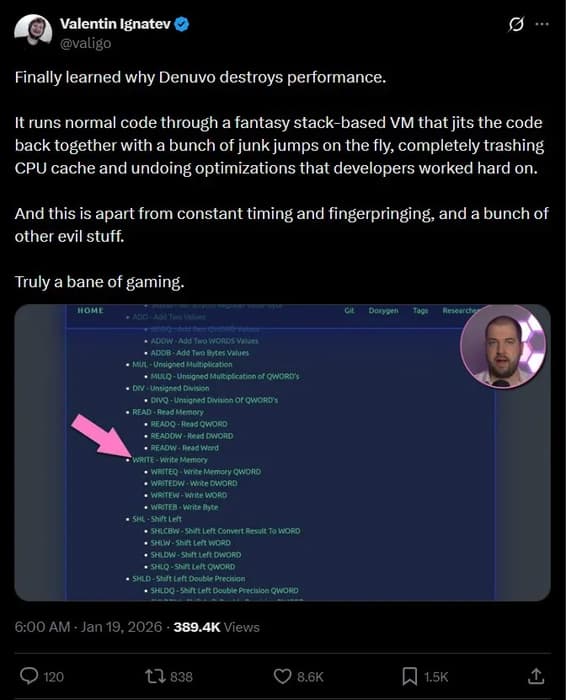
Recent benchmarks have reignited the debate over Denuvo’s anti-piracy technology, with independent testing showing measurable performance degradation in several AAA games. The findings add quantitative data to long-standing player complaints about the impact of Digital Rights Management on PC gaming.
Performance Impact Data
Testing by DSOGaming on Tekken 8 revealed significant frame rate differences between the retail version with Denuvo and a cracked version without the DRM. The cracked version ran 15-20 FPS faster in certain scenarios on specific hardware configurations.
Digital Foundry’s analysis of Resident Evil Village found that Denuvo’s anti-tamper technology caused stuttering issues in the launch version. The problems stemmed from Denuvo’s copy protection checks, which Capcom later addressed through patches.
The performance overhead primarily manifests as increased CPU utilization, leading to lower average frame rates and micro-stuttering—particularly on mid-range hardware where the additional load can push systems beyond stable performance thresholds.
Developer Response
Katsuhiro Harada, director of Tekken 8, publicly addressed performance concerns following player reports. Harada stated the team was investigating issues and clarified that any problems weren’t directly from Denuvo itself but potentially from how it interacted with the game’s code.
This distinction highlights a key point in the DRM debate: whether performance issues stem from Denuvo’s inherent design or from improper implementation by development teams.
Irdeto’s Position
Irdeto, Denuvo’s parent company, maintains that its anti-tamper solution has no perceptible impact on gameplay when implemented correctly. The company argues that performance issues are often misattributed to their software when the actual cause lies in game code or integration errors.
From the publisher perspective, Denuvo serves a critical business function. Piracy can significantly erode sales during the first weeks of release—the period when most games generate the majority of their revenue. Publishers argue that protecting this initial sales window is essential for funding large-scale AAA development.
The Trade-Off
The data reveals a direct trade-off between piracy protection and user experience. Publishers must weigh:
Piracy prevention: Protecting launch-window sales from unauthorized copies that can appear within hours of release
Customer experience: Delivering optimal performance to paying customers, particularly those with mid-range hardware most affected by DRM overhead
This creates tension between financial risk (lost sales to piracy) and reputational risk (negative reviews citing poor performance).
Post-Launch DRM Removal
An emerging pattern suggests developers recognize the long-term performance impact. Several games have had Denuvo removed months after release, once the primary sales window closed:
DOOM Eternal: Bethesda removed Denuvo in a post-launch update after the initial release period
Industry practice: This post-launch removal serves as tacit acknowledgment that DRM introduces overhead publishers tolerate during the critical sales period but eventually remove
The timing—typically 3-6 months after launch—suggests publishers view the piracy risk as highest immediately after release, with DRM becoming expendable once sales momentum slows.
Who’s Most Affected
The performance cost disproportionately impacts players with mid-range hardware. For these users, Denuvo’s CPU overhead can represent the difference between stable 60 FPS gameplay and frequent drops below playable thresholds.
High-end systems with significant CPU headroom may see minimal impact, while lower-end systems already struggle regardless of DRM presence. Mid-range configurations—the most common among PC gamers—sit in the zone where DRM overhead matters most.
What to Watch
Several indicators will shape the ongoing debate:
Day-one benchmarks: Independent testing of upcoming AAA releases with Denuvo will reveal whether newer versions reduce performance impact
Post-launch removals: Tracking which games patch out Denuvo months after release provides insight into publisher cost-benefit analysis
Competing DRM solutions: Alternative anti-piracy technologies may emerge with lower performance overhead
Industry sentiment shifts: Growing focus on software preservation and player advocacy may pressure publishers to reconsider aggressive DRM
Independent testing shows measurable performance costs associated with Denuvo in multiple AAA titles, though impact varies by game, implementation quality, and hardware configuration. The overhead is most pronounced in CPU-bound scenarios.
Publishers face a difficult strategic decision: protect launch revenue from piracy or deliver optimal performance to paying customers. The practice of removing Denuvo post-launch suggests many publishers view the trade-off as time-limited rather than permanent.
Irdeto disputes claims of significant impact, maintaining that proper implementation eliminates performance concerns. However, the pattern of post-launch removals and independent benchmark data suggests the debate remains far from settled.
Future benchmarks from trusted hardware analysts and continued monitoring of post-launch DRM removal practices will provide the clearest picture of Denuvo’s real-world impact on PC gaming performance.
Follow us on Bluesky, LinkedIn, and X to Get Instant Updates