+1.39%
+3.01%
-0.85%
-1.33%
+2.74%
+2.59%
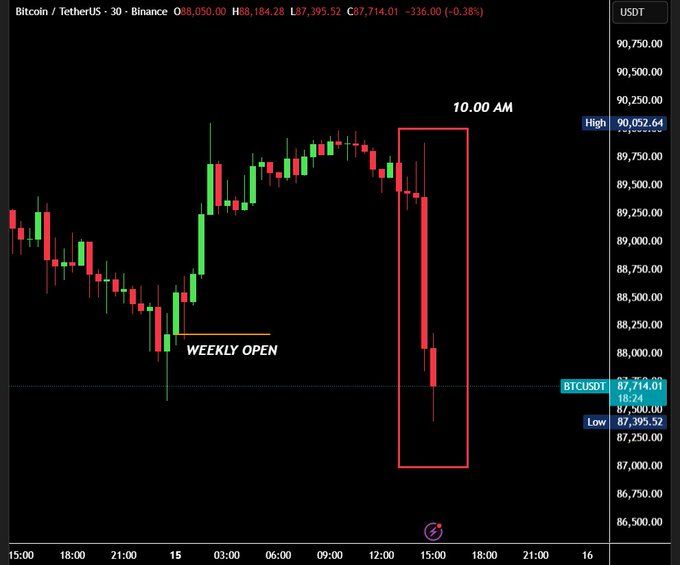
Bitcoin dropped $2,000 in 35 minutes earlier today, erasing 16 hours of gains the moment U.S. markets opened at 9:30am ET. $132 million in longs liquidated within an hour. This wasn’t random — it’s become a predictable pattern traders now call “the 10am manipulation.”
What Is the 10am Manipulation?
The pattern is simple: Bitcoin rallies overnight, then dumps sharply between 9:30-10:30am ET when U.S. equity markets open. Price recovers slowly throughout the day, only to repeat the cycle the next morning. Analysts tracked this behavior through Q2, Q3, and into November — consistent enough that traders now avoid opening longs during early U.S. hours.
The Jane Street Theory
Speculation centers on Jane Street, a high-frequency trading firm holding $2.5 billion in BlackRock’s IBIT Bitcoin ETF (their 5th largest position). The theory: dump BTC at market open → trigger liquidations → buy back lower → accumulate at retail’s expense. Rinse, repeat daily.
No regulator or exchange has confirmed this. But the pattern’s consistency—”clean wipeout within an hour followed by slow recovery,” as one analyst noted—fits high-frequency execution profiles. Jane Street has the speed, liquidity, and ETF positioning to move markets in 30-minute windows.
Why It Happens (Manipulation or Mechanics?)
Two camps exist. Team Manipulation argues institutional players intentionally hunt stop-losses and liquidation clusters at predictable times. Team Mechanics says it’s structural: ETF arbitrage, institutional hedging, and macro data releases all cluster around U.S. open, creating natural volatility spikes.
The truth? Probably both. As one trader explained: “US open still drives global liquidity. When leverage is crowded, the flush comes fast. Predictable volatility is just another form of order.” Whether intentional or emergent, the effect is identical: retail gets wrecked, institutions accumulate cheaper.
The Leverage Death Spiral
December 12’s dump liquidated $430 million across all crypto in 24 hours—$68 million Bitcoin, even more in Ethereum. When price dips below key levels (support zones where stop-losses cluster), forced liquidations cascade. Traders using 10x-50x leverage get margin-called automatically, creating sell pressure that accelerates declines without requiring a single dominant seller.
How to Trade Around It
Avoid U.S. Session Longs: Don’t open leveraged long positions between 9am-12pm ET. If you’re holding overnight gains, close before 9:30am or set tight stop-losses. The “morning pump, U.S. dump” pattern happens often enough that ignoring it is reckless.
Wait for Post-Dump Recovery: The pattern includes slow recovery after initial flush. If BTC drops $2,000 by 10:30am, it often regains $1,000-1,500 by 3pm ET. That’s your entry window—not the pre-dump highs everyone else is chasing.
Use Limit Orders, Not Market Orders: During volatile flushes, market orders get filled at terrible prices (slippage). Place limit buy orders 2-3% below current price before U.S. open. If the dump hits, you buy the dip automatically. If it doesn’t, you lose nothing.
Lower Leverage or Go Spot: As one veteran trader put it: “If a standard morning flush shakes you out, your conviction was borrowed.” High leverage magnifies losses during predictable volatility. If you can’t stomach 5% swings, don’t use 20x leverage.
Monitor ETF Flows: U.S. spot Bitcoin ETFs recorded $77 million in outflows on December 11—the day before the $2,000 dump. Sustained outflows signal institutional selling pressure. When ETFs bleed for 2-3 days straight, expect morning dumps to intensify.
Common Questions
Q: Is this illegal market manipulation?
A: Unproven. No regulator has charged anyone. Coordinated manipulation typically leaves forensic footprints (concentrated selling on one exchange, abnormal order book behavior). December 12’s dump was distributed across Binance, CME, OKX, Bybit—consistent with automated risk unwinds, not single-actor manipulation. That doesn’t mean it’s not coordinated—just that proving it requires evidence regulators haven’t found (or disclosed).
Q: When will this pattern end?
A: Possibly when institutional accumulation completes. If the theory is correct—that firms like Jane Street are dumping to accumulate cheaper—the pattern stops once they’re fully positioned. Or, if market structure legislation passes (as some tweets suggest), increased transparency requirements might deter the behavior. Until then, assume it continues.
Q: Does this affect all crypto or just Bitcoin?
A: Bitcoin leads, but altcoins follow. When BTC dumps $2,000, Ethereum typically drops 4-6%, Solana 6-8%, and smaller caps 10-15%. The liquidation cascade isn’t Bitcoin-specific—it’s market-wide. If you hold alts with high leverage during U.S. open, you’re at even greater risk.
Q: Should holders care about this?
A: Spot holders (no leverage) can ignore it. If you’re holding Bitcoin long-term, these 5% intraday swings are noise. But if you’re actively trading or using any leverage, ignoring U.S. session volatility is how you get liquidated before the next leg up.
Q: What about non-U.S. traders?
A: The pattern affects everyone. Bitcoin is a 24/7 global market, but U.S. institutional flows dominate liquidity. When U.S. markets open, global order books react. Asian and European traders experience the same dumps—they just happen at inconvenient local times (10pm in Tokyo, 3pm in London).
The Bigger Picture: Institutional Dominance
One comment summed it up perfectly: “Banks aren’t coming. They’re already here. And they’re not asking permission anymore.” Bitcoin’s maturation into an institutional asset means retail no longer sets the pace. ETF flows, futures positioning, and high-frequency strategies now drive short-term price action.
The 10am pattern is just one symptom. Others include: weekend pumps when institutional desks are closed, end-of-month volatility around CME futures expiry, and correlation with Nasdaq moves during U.S. trading hours. Crypto isn’t detached from traditional finance anymore—it’s integrated, for better or worse.
Tools to Track the Pattern
- CoinGlass liquidation heatmaps: Shows where stop-losses cluster. When price approaches heavy liquidation zones during U.S. open, expect volatility.
- Coinglass ETF flow data: Daily inflows/outflows for IBIT, FBTC, GBTC. Three days of outflows = dump risk increases.
- TradingView alerts: Set price alerts for 9:15am ET. If BTC is up 3%+ overnight, expect morning resistance.
- CME Bitcoin futures data: Open interest spikes before U.S. open signal institutional positioning. Rising OI + flat price = potential dump setup.
Whether you call it manipulation or market mechanics, the 10am dump pattern is real, measurable, and exploitable. Retail traders who ignore it get liquidated. Those who adapt—avoiding early U.S. longs, setting limit buys below market, lowering leverage—can profit from the predictability.
As one analyst noted: “Predictable volatility is just another form of order. The pattern rewards those who expect it.” Stop fighting the pattern. Trade around it instead.