+0.56%
+1.25%
-0.04%
-2.26%
+0.53%
+3.32%
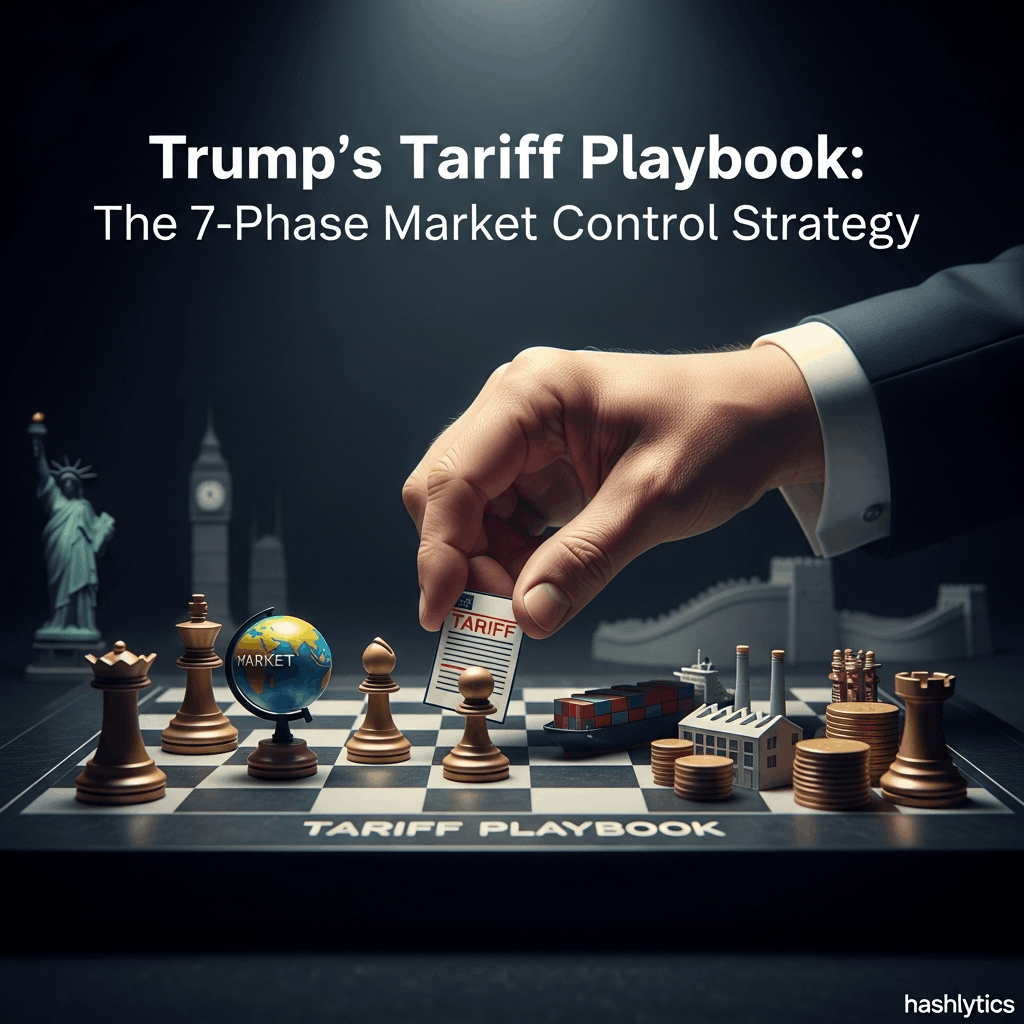
Trump doesn’t use tariffs as trade policy — he uses them as market control mechanisms. Every major tariff event under Trump follows the same seven-phase structure designed to create pressure, force negotiations, and trigger predictable market responses that ultimately strengthen his bargaining position.
Phase 1: Weekend Announcement Timing
Trump drops tariff news late Friday or weekends when US markets are closed. The January 18, 2026 Greenland tariff announcement followed this pattern perfectly — announced Saturday at 11:46 AM EST. According to NBC News, this timing prevents immediate price reaction and forces markets to absorb news over non-trading hours, creating maximum uncertainty.
As Harvard economist Lawrence Summers noted about Trump’s April 2025 reciprocal tariffs, the administration announces at 4 PM ET—exactly when major stock markets close—because they fear investors’ negative reactions. This isn’t coincidence. It’s calculated chaos engineering where timing becomes weaponized.
Phase 2: Escalation Windows
Trump never announces a single final tariff. He structures penalties with escalation timelines that create negotiation pressure. The January 18, 2026 Europe tariffs demonstrate the pattern: 10% tariffs effective February 1, increasing to 25% by June 1 if no agreement is reached. This framework appeared in previous rounds—China, Mexico, Canada, India all faced similar graduated threat structures.
| Tariff Event | Initial Rate | Escalation Rate | Timeline |
|---|---|---|---|
| Europe/Greenland (Jan 2026) | 10% | 25% | Feb 1 → June 1 |
| China (Oct 2025) | 100% | 145% | Immediate escalation |
| Reciprocal (Apr 2025) | 10% base | 20-54% by country | 90-day pause periods |
| Brazil (Jul 2025) | 10% | 50% | Effective Aug 1 |
Phase 3: Mechanical Market Reaction
The first market response isn’t rational analysis—it’s automated deleveraging. Funds execute risk protocols mechanically: prime brokers raise margin requirements, volatility models force selling, risk parity systems reduce exposure, and leverage collapses instantly. According to The Daily Economy’s data analysis, Trump’s April 2 “Liberation Day” announcement caused the Russell 2000 to drop 6.3% and the Magnificent Seven to fall 6.7% in a single day—representing the second-largest daily point loss in S&P 500 history.
January 19, 2026 European markets showed this pattern again. The Stoxx Europe 600 fell as LVMH experienced its biggest drop since April, while German automakers Volkswagen and Mercedes-Benz declined sharply. Bloomberg Intelligence estimated that Greenland-driven escalation could erase most European earnings growth in 2026, triggering mid-single-digit corrections.
Phase 4: Bitcoin’s Amplified Response
Bitcoin consistently sells harder during Phase 1 because it functions as the global risk pressure valve. The October 10, 2025 China tariff announcement demonstrated this principle at scale. When Trump announced 100% tariffs on Chinese goods at 5 PM Eastern—after US equity markets closed—crypto became the only outlet for global investors to express shock.
The result: $19 billion in leveraged positions liquidated within 24 hours, affecting 1.6 million trader accounts. Bitcoin crashed 14% from $122,000 to $105,000 as perpetual futures contracts with 50-100x leverage faced cascading margin calls. According to FTI Consulting’s analysis, order book depth shrank by 90% on key venues, with bid-ask spreads widening from single-digit basis points to double-digit percentages.
Why does Bitcoin always crash harder? It trades 24/7 with high leverage availability, thin liquidity during political shocks, and no circuit breakers or trading halts. When traditional markets close, crypto derivatives markets absorb all global risk-off pressure simultaneously.
Phase 5: Narrative Transition
After mechanical selling exhausts itself, Treasury officials appear with carefully chosen language. Words like “negotiations,” “constructive talks,” “temporary,” and “not catastrophic” begin circulating. Volatility stops rising, selling pressure slows, and markets remember tariffs take weeks to implement.
The April 2025 Liberation Day crash followed this script. After the S&P 500 fell 4.88% and Nasdaq dropped 5.97% on April 2, Trump announced a 90-day pause on April 9 for countries except China. NPR reported the Dow surged nearly 8% on the pause announcement—one of the largest single-day gains on record.
Phase 6: Resolution Framework
This phase produces delays, reductions, frameworks, partial agreements, or “historic deals.” Markets rally as uncertainty collapses. According to Wikipedia’s comprehensive tariff timeline, Trump has repeatedly used this pattern:
Japan signed a deal reducing its rate from 24% to 10%. Vietnam negotiated down from proposed 46% to 20%. The UK reached an agreement maintaining 25% on steel while negotiating broader terms. Taiwan achieved what Premier Cho Jung-tai called the “best tariff deal” despite running trade surpluses with the US.
Each “victory” allows Trump to claim diplomatic success while maintaining leverage over remaining holdouts. The pattern creates competitive pressure—countries race to negotiate before deadlines, fearing they’ll face worse terms than early movers.
Phase 7: Market Recovery and New Highs
After resolution, markets don’t just recover—they often exceed pre-shock levels. The April 9, 2025 pause triggered an 8% single-day rally in the Dow. By mid-year, according to market data, stocks reached new highs despite effective tariff rates climbing to 27%—the highest level in over a century.
This counterintuitive outcome stems from uncertainty resolution being worth more than tariff costs themselves. When businesses know the rules—even if the rules are expensive—they can adapt. It’s the uncertainty that freezes capital deployment and suppresses valuations.
The Greenland Escalation: Different But Familiar
The January 2026 Greenland tariffs follow this template but carry higher stakes. Europe can retaliate symmetrically through the EU’s Anti-Coercion Instrument—the “trade bazooka” that French President Macron requested activating. According to Al Jazeera, this mechanism enables steep retaliatory tariffs, market access restrictions for US goods, and limits on US use of EU-based financial infrastructure.
Additionally, the situation involves NATO allies, territorial pressure on Greenland, and overlaps with Supreme Court review of presidential tariff authority under the International Emergency Economic Powers Act. Denmark, Finland, France, Germany, Netherlands, Norway, Sweden, and the UK issued a joint statement warning the tariffs “undermine transatlantic relations and risk a dangerous downward spiral.”
Yet even with these complications, the playbook’s structure remains intact. We’re currently in Phase 3 (mechanical selling) transitioning to Phase 4 (narrative shift). ING’s global head of macro Carsten Brzeski advised European leaders to “just ignore it and wait and see,” recognizing the pattern from previous rounds.
Why the Playbook Works
This strategy succeeds because it exploits three structural market vulnerabilities. First, automated trading systems respond mechanically to uncertainty, creating violent but temporary dislocations. Second, 24/7 crypto markets absorb disproportionate pressure when traditional markets close, flushing excessive leverage. Third, the negotiation window incentivizes countries to compete for deals rather than coordinate resistance.
As one observer noted, “it’s basically chaos engineering for global trade. everyone else is debating the syntax of policy while he’s just toggling environment variables to see who breaks first.”
Markets now understand this pattern, yet continue reacting to each iteration. Why? Because even knowing the playbook doesn’t eliminate the uncertainty of execution. Variables include which countries will actually negotiate, whether the Supreme Court will restrict tariff authority, whether Europe will truly retaliate with €93 billion in countermeasures, and whether this cycle’s recovery will follow historical patterns.
Implications for 2026
Based on historical patterns, expect the following timeline for the Greenland tariff cycle: Phase 1-3 (current): Market shock, leverage flush, mechanical selling through late January. Phase 4-5: Narrative shift and Treasury officials discussing “progress” in negotiations, likely early February as the February 1 deadline approaches. Phase 6: Partial agreements or delays announced, probably between February and May before the June 1 escalation. Phase 7: Market recovery above pre-announcement levels by mid-2026.
However, this cycle carries unique risks. The Supreme Court could rule against IEEPA tariff authority, undermining the legal foundation. European unity might hold, creating coordinated resistance rather than competitive negotiation. NATO tensions could escalate beyond trade into security relationships. Bitcoin’s leverage ratios remain elevated despite October’s flush, setting up potential for another $10+ billion liquidation event.
The playbook is simple, proven, and remarkably consistent across targets. For traders and investors, the question isn’t whether the pattern will repeat—it’s which phase we’re currently in and how to position accordingly.
Follow us on Bluesky, LinkedIn, and X to Get Instant Updates