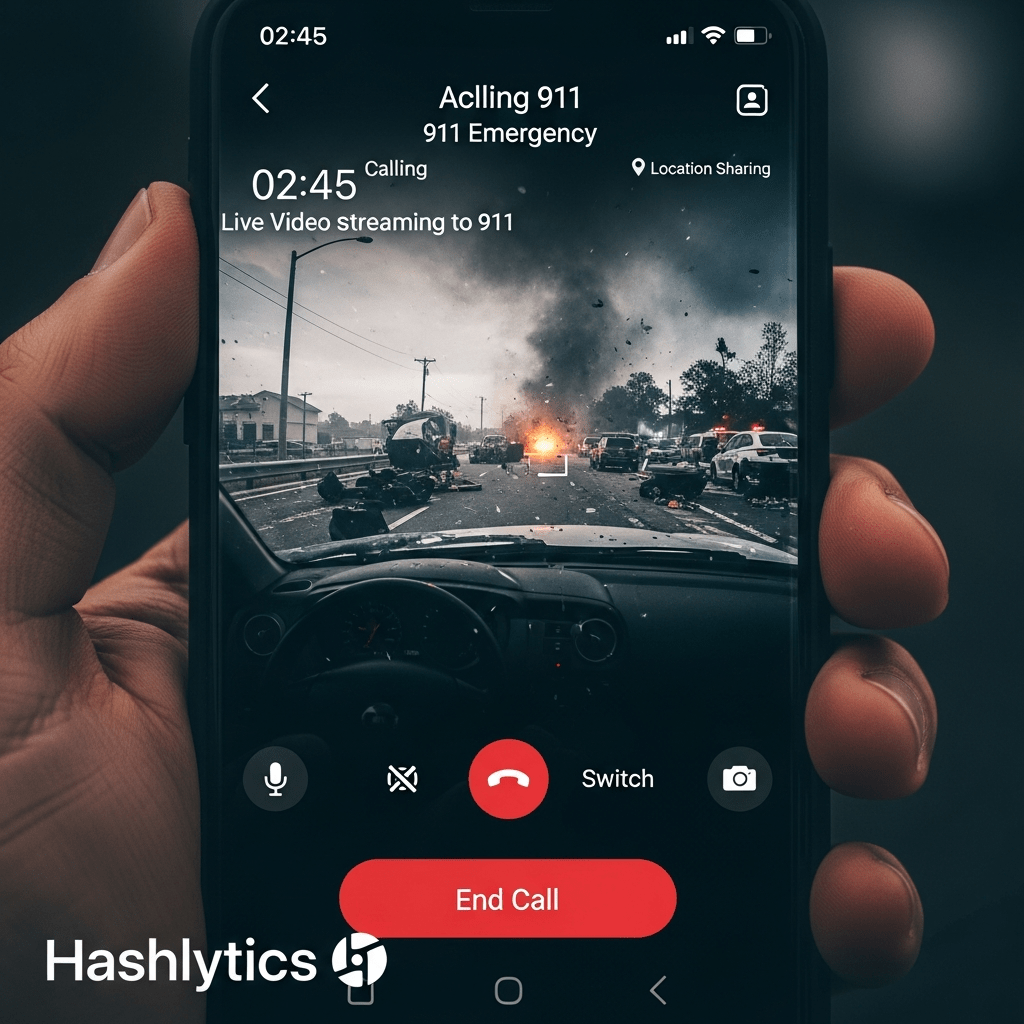
Google launched Emergency Live Video today, letting Android users stream encrypted video to emergency dispatchers during 911 calls. Available across the U.S. and select (unspecified) regions of Germany and Mexico, it runs on any Android 8+ device with Google Play Services — covering most phones still in use.
How It Works: Dispatcher-Initiated Only
Unlike video calling apps, users cannot initiate streaming. During an emergency call or text, if the dispatcher determines “seeing the scene would be helpful and it’s safe to do so,” they send a request to your phone. One tap starts secure, encrypted streaming. You control camera angle (front/rear flip) and can stop sharing instantly via a prominent button that remains accessible throughout.
| Feature | Details |
|---|---|
| Initiation | Dispatcher-only (users cannot start unprompted) |
| Encryption | End-to-end encrypted by default |
| User Control | Stop sharing anytime, camera flip during stream |
| Compatibility | Android 8+ with Google Play Services |
| Setup | None required (backend enabled via Play Services update) |
| Availability | U.S. nationwide, select Germany/Mexico regions |
Why Dispatcher Control Matters
This design prevents misuse while ensuring responders only request video when genuinely beneficial. Research from RapidSOS (the backend provider) shows video changes emergency response decisions in 58% of cases—often revealing situations are less critical than described (50% of video calls) or more serious than initially reported (13%).
The Germany/Mexico Mystery Google Won’t Clarify
Community response immediately flagged the vague “select regions” phrasing for Germany and Mexico. One X user asked: “Do you have an overview of these ‘selected regions’ in Germany?” Another replied: “Ikr, this is the most crucial information and they’ve not only left it out, but they’re ghosting us too.”
Google’s partner documentation offers no specifics. The company states it’s “closely working with public safety organizations around the world” but provides no regional breakdown, population coverage estimates, or expansion timelines beyond “coming to more regions.”
Why This Ambiguity Is Frustrating
- Emergency services operate at municipal/state levels, not nationally, vague “regions” tells users nothing
- Germans in Bayern might have access while those in Nordrhein-Westfalen don’t, with no way to know until an actual emergency
- Mexico’s federal structure means some states participate while others don’t, creating dangerous uncertainty
The lack of transparency undermines trust in a life-saving feature. Users need clear answers: “Is this available where I live?” Instead, they get corporate vagueness that leaves them guessing during crises.
Integration With Existing SOS Features
As one commenter asked: “I assume this ties in with the SOS features typically present on most phones?” Yes—Emergency Live Video extends Android’s emergency suite:
- Emergency Location Service (ELS): Automatically shares precise GPS coordinates with 911 (active since 2016)
- Car Crash Detection: Pixel/Samsung phones detect accidents via accelerometer, auto-call 911 if unresponsive
- Fall Detection: Watches/phones detect hard falls, alert emergency contacts or call 911
- Satellite SOS: Send emergency messages when cellular/Wi-Fi unavailable (Pixel 9+ only)
- Emergency Live Video: New—adds visual context to voice/text emergency communications
What About GPS Coordinates?
Multiple users questioned whether video includes location data. One wrote: “What about sharing your GPS coordinates too? That seems like it could be pretty helpful.” Another replied: “It is done since the 70s.”
They’re both right, and talking past each other. Enhanced 911 (E911) has transmitted cell tower triangulation since the 1990s, but accuracy ranged from 50-300 meters. Android’s Emergency Location Service, launched 2016, sends precise GPS coordinates (accurate to ~5 meters) automatically during 911 calls, completely separate from video. Emergency Live Video doesn’t replace GPS sharing, it adds visual context on top of existing location data dispatchers already receive.
Android vs iPhone: Who Got There First?
Apple launched Emergency SOS Live Video with iOS 18 in September 2024, but Android’s implementation is actually more accessible:
| Feature | iPhone (iOS 18) | Android |
|---|---|---|
| Device Support | iPhone 14 and newer only | Any Android 8+ device (2017 models onward) |
| Sharing Method | Live video OR photos from camera roll | Live video only |
| Initiation | User or dispatcher | Dispatcher-only |
| U.S. Coverage | Limited (RapidSOS partner regions) | Nationwide |
| Encryption | Yes | Yes |
Android’s broader device compatibility (covering potentially hundreds of millions more phones) compensates for Apple’s year-earlier launch. However, iPhone’s ability to share photos from the camera roll (e.g., showing medical bracelets or prescription bottles) offers flexibility Android currently lacks.
Privacy and Security Design
Google emphasizes three safeguards:
- Dispatcher-only initiation: Prevents accidental or malicious streaming
- Explicit consent required: Prompt appears on-screen; tapping is mandatory
- Instant stop control: Large “Stop sharing” button accessible throughout stream
Video streams through RapidSOS’ HARMONY AI system, which aggregates emergency data but doesn’t store raw video post-incident. Dispatchers see the feed in real-time only; recordings depend on local 911 center policies (most centers record all emergency calls/videos for quality assurance and legal protection).
What Happens to the Video After?
- Video transmission: Encrypted end-to-end during call
- Dispatcher recording: Depends on local 911 center policy (most record everything)
- User device: No local copy saved automatically
- RapidSOS retention: No permanent storage of video content
Real-World Scenarios Where Video Helps
Google highlights use cases where visual context dramatically improves outcomes:
- Car accidents: Show vehicle damage severity, entrapment, hazards like leaking fuel or blocked roads
- Medical emergencies: Display patient symptoms (skin discoloration, breathing patterns) for better triage
- Wildfires: Show rapidly changing fire spread and escape route visibility
- Home invasions: Provide suspect descriptions and real-time suspect location updates
- Guided assistance: Dispatcher walks user through CPR with visual confirmation of chest compressions
When Video Changes Response
RapidSOS data shows video alters dispatcher decisions in 58% of calls:
- 50% of cases: Situation less critical than described → downgrade response (saves resources)
- 13% of cases: Situation more serious than described → upgrade response (e.g., send trauma team instead of basic EMT)
- 37% of cases: Video confirms initial assessment
Technical Backend: RapidSOS HARMONY AI
Emergency Live Video operates through RapidSOS, which integrates with 98% of U.S. 911 centers. The HARMONY AI system combines:
- Live video streams from Android/iPhone
- GPS coordinates from Emergency Location Service
- Caller phone number and carrier data
- Medical ID info (if user configured it)
- Language preference
This unified dashboard gives dispatchers comprehensive incident visibility without juggling multiple systems. Critically, RapidSOS provides redundant network pathways — during disasters when call volumes spike 12,500%, the system routes through alternative connections to maintain video capability when standard networks overload.
International Expansion Challenges
Global rollout faces obstacles beyond technical integration:
- Fragmented emergency infrastructure: Each country has different 911-equivalent systems (112 in EU, 110 in Germany, 066 in Mexico)
- Regulatory frameworks: GDPR compliance in EU, data sovereignty laws in other regions
- Public-private partnerships: Emergency services must agree to integrate third-party video systems
- Network reliability: Requires stable mobile data in emergencies (not guaranteed everywhere)
Google’s “select regions” language likely reflects partnerships with specific German Länder (states) and Mexican states that completed technical integration first, rather than nationwide rollouts.
Expect these developments in 2026:
- Regional clarity: Pressure on Google to publish exact coverage areas (cities, states, provinces)
- Expanded Germany/Mexico: More regions added as local 911 centers complete RapidSOS integration
- Additional countries: UK, Canada, Australia most likely next (English-speaking, advanced emergency infrastructure)
- Photo sharing: Android may add iOS-style camera roll sharing for medical bracelets, prescriptions
- Satellite integration: Emergency Live Video over satellite for Pixel phones in no-coverage areas
The Bigger Picture: Rich Emergency Communication
Emergency Live Video represents the evolution from voice-only 911 calls (1960s technology) to multimedia-rich emergency communication. We take real-time video for granted in daily life (FaceTime, Zoom, Instagram Live) but emergency services remained stuck in the landline era. That gap is finally closing.
As RapidSOS integration deepens, expect future capabilities like:
- AI-assisted medical triage based on visual symptoms
- Automated translation of video-based distress signals
- Drone coordination using user-shared video for search and rescue
- Integration with smart home cameras for broader situational awareness
How to Check If It’s Available for You
There’s no public coverage map, but you can verify eligibility:
- Ensure Android 8+ (check Settings → About Phone → Android version)
- Confirm Google Play Services installed and updated
- Test emergency features: Open Phone app → Settings → Emergency information
- During an actual emergency, if your local 911 center supports it, the dispatcher will offer video streaming
The feature requires no manual activation—it’s backend-enabled via November 2025 Play Services update. If available in your region, it simply works when dispatchers request it.
Emergency Live Video solves a genuine problem—verbal descriptions fail during high-stress emergencies. By letting dispatchers see what’s happening in real-time, Android users get faster, more accurate help. The dispatcher-only initiation and instant stop controls address privacy concerns, while encryption ensures security.
However, Google’s refusal to specify exact “select regions” in Germany and Mexico undermines user confidence in a life-saving feature. Transparency matters—people need to know whether this works where they live before an emergency, not during one.
Despite communication failures, the technology itself represents a significant leap forward in emergency response. As integration expands globally, video-enhanced 911 calls could become as standard as GPS location sharing is today, obvious in hindsight, revolutionary in implementation.