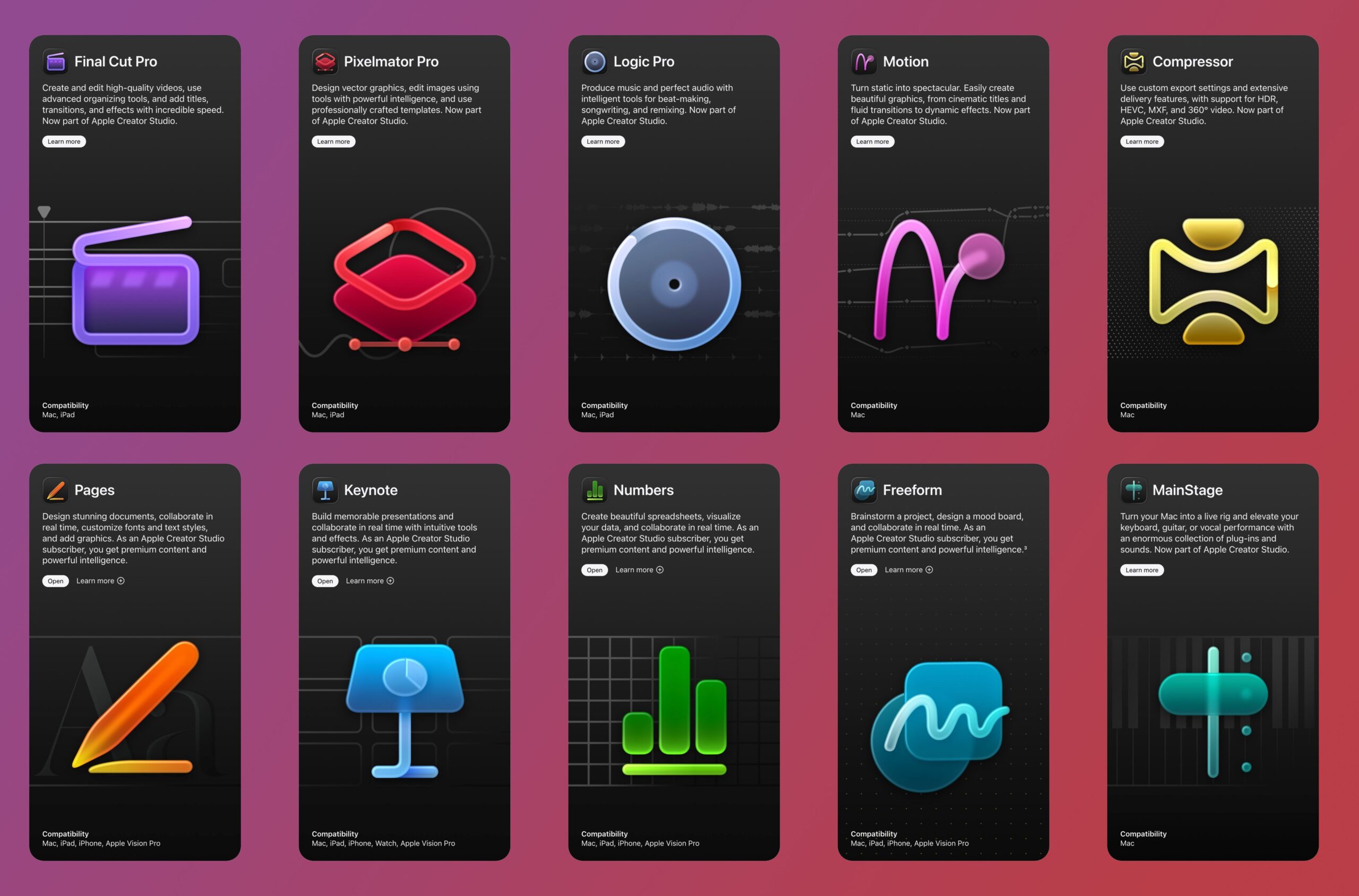
Apple recently announced Creator Studio, a $12.99/month subscription bundle that represents the company’s most aggressive play yet against Adobe’s $60/month Creative Cloud stranglehold. Launching January 28, the service packages Final Cut Pro, Logic Pro, and Pixelmator Pro alongside Motion, Compressor, and MainStage — plus premium AI features for Pages, Numbers, and Keynote — into a unified subscription that undercuts Adobe by 78% while keeping one-time purchase options intact for Mac users resistant to rental software.
The timing isn’t coincidental. Apple’s January 13 announcement comes as Adobe faces growing backlash over June 2025 price increases that pushed Creative Cloud Pro to $59.99/month — double what creators paid five years ago. Adobe’s shift from Creative Cloud All Apps to tiered Standard/Pro pricing alienated freelancers who felt trapped by cancellation fees and AI features they didn’t request. Apple’s response: deliver professional-grade tools at student-discount pricing, keep perpetual licenses available, and weaponize the one advantage Adobe can never match—native optimization for Apple Silicon.
What’s Actually Included: The Full Breakdown
Creator Studio represents Apple’s first true software bundle since iLife ended in 2013. The subscription includes six professional applications across Mac and iPad, with intelligent features flowing into productivity apps that remain free for non-subscribers. Here’s the complete inventory:
| Application | Mac | iPad | Standalone Price | Key AI Features |
|---|---|---|---|---|
| Final Cut Pro | ✓ | ✓ | $299.99 | Transcript Search, Visual Search, Beat Detection, Montage Maker |
| Logic Pro | ✓ | ✓ | $199.99 | Synth Player, Chord ID, natural language loop search |
| Pixelmator Pro | ✓ | ✓ (NEW) | $49.99 | Warp tool, Super Resolution, Auto Crop, OpenAI integration |
| Motion | ✓ | — | $49.99 | Magnetic Mask, 2D/3D motion graphics |
| Compressor | ✓ | — | $49.99 | Custom encoding workflows |
| MainStage | ✓ | — | $29.99 | Live performance companion for Logic |
| Total value | $679.94 one-time | $12.99/month or $129/year | ||
The economics reveal Apple’s strategy: subscribers break even after 10 months compared to buying all apps individually, but Creator Studio adds continuous updates, iPad versions, and AI features unavailable in standalone purchases. Students and educators pay $2.99/month — matching the price of a single Starbucks latte monthly for professional creative tools that would otherwise cost $679 upfront.
The Pixelmator Bombshell: iPad Finally Gets Photoshop Competition
Today marks the first major product announcement since Apple acquired Pixelmator in November 2024 for an undisclosed sum. Pixelmator Pro now debuts on iPad with full feature parity to the Mac version, optimized for Apple Pencil and touch input. This addresses the single biggest gap in Apple’s creative lineup: serious photo editing on iPad without resorting to Adobe’s ecosystem or Affinity Photo workarounds.
The iPad version includes layer-based editing, ML-powered selection tools, color grading, and seamless file syncing between devices via iCloud. Crucially, Creator Studio subscribers gain access to OpenAI integration for advanced image generation — Apple’s acknowledgment that while its on-device AI excels at practical tasks like Super Resolution upscaling, generative creativity requires cloud-based models.
The Pixelmator move signals Apple’s long-term vision: position Creator Studio as “Photos Pro” for serious photographers, mirroring how Final Cut Pro relates to iMovie and Logic Pro relates to GarageBand. Industry observers note Apple discontinued its professional photo editor Aperture in 2015 specifically because one-time purchase economics couldn’t support ongoing development. Subscription revenue removes that constraint, enabling Apple to finally compete with Photoshop and Lightroom on sustainable business terms.
What About iMovie and GarageBand? The Free App Dilemma
The elephant in the room: Creator Studio conspicuously excludes iMovie and GarageBand, Apple’s free entry-level creative apps. Apple confirms these apps remain free and included with every new Mac, iPad, and iPhone — but their absence from Creator Studio suggests a strategic repositioning rather than imminent discontinuation.
The logic becomes clear when examining Apple’s product ladder: iMovie and GarageBand serve as on-ramps for beginners, establishing workflows and interface familiarity that ease eventual transitions to Final Cut Pro and Logic Pro. By keeping them free, Apple maximizes the installed base of users who already understand Apple’s creative philosophy before they need professional features. Charging for entry-level tools would contradict Apple’s ecosystem strategy, where hardware sales subsidize software that makes the hardware more valuable.
However, the lack of meaningful iMovie and GarageBand updates in recent years—GarageBand hasn’t seen major new features since 2020—suggests these apps exist in maintenance mode rather than active development. Apple’s resources now flow toward Creator Studio’s professional tier, where subscription revenue justifies ongoing AI integration and feature development. Users expecting iMovie to match Final Cut Pro’s capabilities will be disappointed; the performance gap intentionally drives upgrades to the paid tier.
The same pattern extends to Pages, Numbers, and Keynote. These apps remain free with basic functionality, but Creator Studio subscribers unlock a Content Hub with premium templates, OpenAI-powered image generation, AI-assisted presentation drafting, and Magic Fill formula generation in Numbers. Apple’s message: casual users get functional software for free, but professionals pay for intelligence and premium assets.
The Adobe Comparison: Where Apple Wins and Where It Doesn’t
On paper, Creator Studio demolishes Adobe’s pricing. Adobe Creative Cloud Pro costs $59.99/month in North America (rising to €60/month in Europe), delivering Photoshop, Premiere Pro, After Effects, Illustrator, Audition, and 15+ additional applications. Apple’s $12.99/month undercuts Adobe by 78%, but the comparison misleads because the bundles serve different workflows.
| Category | Apple Creator Studio | Adobe Creative Cloud Pro |
|---|---|---|
| Pricing (Individual) | $12.99/mo or $129/yr | $59.99/mo or $719.88/yr |
| Pricing (Student) | $2.99/mo or $29.99/yr | $19.99/mo first year, then $34.99/mo |
| Video editing | Final Cut Pro, Motion, Compressor | Premiere Pro, After Effects, Audition |
| Photo editing | Pixelmator Pro | Photoshop, Lightroom Classic, Lightroom |
| Audio production | Logic Pro, MainStage | Audition, Premiere Pro audio tools |
| Graphic design | Pixelmator Pro (limited) | Illustrator, InDesign, Acrobat Pro |
| Platform support | Mac and iPad only | Mac, Windows, iPad, web, Android |
| Generative AI | OpenAI integration, on-device ML | Adobe Firefly (native), 4,000 monthly credits |
| Cloud storage | iCloud (separate subscription) | 100GB included, more with higher tiers |
| One-time purchase | Available ($679.94 total for all apps) | Not available since 2013 |
The critical differentiator: Adobe owns the entire creative workflow from ideation to publication, while Apple focuses narrowly on video, audio, and image editing. Adobe’s suite includes typography (InDesign), vector illustration (Illustrator), PDF workflows (Acrobat Pro), web design (Dreamweaver), and animation (Animate)—disciplines where Apple offers no alternatives. Graphic designers, print publishers, and multimedia agencies require Adobe’s breadth; video editors and musicians may not.
Adobe’s AI advantage also matters more than Apple acknowledges. Adobe Firefly’s Generative Fill in Photoshop and Generative Extend in Premiere Pro enable professionals to fix impossible shots, extend short clips, and create assets from thin air using prompts. Apple’s AI features — Visual Search, Beat Detection, Montage Maker — optimize workflows but don’t replace missing footage or generate new content with the same sophistication. For creators whose work depends on generative AI rather than productivity enhancements, Adobe retains its lead.
The Platform Lock-In Reality
Apple Creator Studio works exclusively on Mac and iPad. Period. No Windows support, no Android apps, no web-based editing for emergency fixes from a borrowed laptop. This represents Apple’s ecosystem strategy at its most aggressive: deliver exceptional value to those already invested in Apple hardware, while making it financially painful to leave. A videographer switching from Mac to Windows must either abandon Creator Studio’s workflow mastery or maintain both ecosystems — an expensive proposition that discourages platform migration.
Adobe’s platform agnosticism serves freelancers who work across client infrastructures and studios with mixed hardware fleets. Creative Cloud runs identically on Mac and Windows, with mobile apps for iOS and Android that sync seamlessly. For professionals whose work environments they don’t control, Adobe’s universal compatibility justifies the higher subscription cost. Apple targets the estimated 35% of creative professionals who exclusively use Mac hardware and have no Windows dependencies.
Who Should Subscribe: The Decision Matrix
Creator Studio’s value proposition scales inversely with Adobe dependency. Here’s who benefits most:
Immediate adopters: Video editors and musicians working exclusively on Mac/iPad who currently pay for Final Cut Pro and Logic Pro subscriptions on iPad (previously $4.99/month each). Creator Studio consolidates these into one cheaper subscription while adding Pixelmator Pro and productivity app enhancements. Content creators producing YouTube videos, podcasts, and social media who need professional polish without Adobe’s enterprise complexity also gain dramatically—$12.99/month buys studio-grade tools that previously cost $500+ upfront.
Students represent Creator Studio’s sweet spot. At $2.99/month ($29.99 annually), students pay less for Apple’s professional suite than Adobe charges for a single app. Educational institutions with Apple hardware fleets can standardize on Creator Studio, teaching workflows that transfer directly to professional environments while avoiding Adobe’s $349/year student pricing that jumps to $659.88/year post-graduation.
Skip Creator Studio if: Your workflow requires Illustrator, InDesign, or After Effects — Apple has no equivalents. You collaborate with teams using Adobe file formats (Premiere Pro projects, Photoshop PSDs with smart objects) that don’t translate cleanly to Final Cut Pro or Pixelmator Pro. You work across Windows and Mac environments. You depend on Adobe Firefly’s generative AI for client deliverables, as Apple’s AI features prioritize workflow optimization over content creation. You’re already heavily invested in Adobe plugins, presets, and third-party integrations that don’t exist in Apple’s ecosystem.
The hybrid approach: Many professionals will maintain both subscriptions, using Creator Studio for personal projects and Adobe for client work requiring specific formats or tools. At $72.99/month combined, this still costs less than Adobe’s Pro Plus tier with added Stock credits, while enabling format flexibility and redundant workflows when one app fails under deadline pressure.
The Broader Implications: Subscription Fatigue Meets Ecosystem Lock-In
Creator Studio’s launch crystalizes two competing trends in professional software. First, subscription revenue has proven so lucrative that even Apple—historically resistant to rental models beyond iCloud and services—now embraces monthly payments for applications that once cost $299 one-time. Industry observers predicted this shift in 2023 when Final Cut Pro and Logic Pro debuted iPad subscriptions, noting Apple wouldn’t maintain dual business models indefinitely.
Second, Apple’s strategy weaponizes its vertical integration advantage. Creator Studio apps leverage Metal graphics APIs, Neural Engine AI acceleration, and Unified Memory architecture in ways Windows software can’t match. Final Cut Pro renders 4K timelines 2-3x faster on M-series Macs compared to Premiere Pro on equivalent Windows hardware, according to independent benchmarks. Logic Pro’s virtual instruments run with imperceptible latency thanks to low-level system access Adobe lacks as a third-party developer.
This performance moat matters as AI features proliferate. Creator Studio’s on-device Super Resolution, Auto Crop, and Beat Detection run locally without cloud latency or usage limits, while Adobe’s Firefly credits cap at 4,000 monthly generations before throttling. Apple’s pitch: pay less, work faster, and avoid generative credit anxiety—but only if you commit fully to Apple hardware costing $1,000-$4,000+ per device.
What Happens Next: The Post-Launch Roadmap
Creator Studio’s January 28 launch represents phase one of a multi-year strategy. Apple’s press materials conspicuously mention Freeform gaining premium features “later” in 2026, suggesting ongoing app additions to justify subscription renewal. Industry speculation centers on three possibilities:
First, iMovie and GarageBand could receive “Pro Lite” tiers exclusive to Creator Studio subscribers—advanced features that bridge the gap between free and professional without requiring full app transitions. This would mirror how Pages/Numbers/Keynote now offer premium templates and AI tools to subscribers while remaining free for basic use.
Second, Apple may bundle Creator Studio with higher Apple One tiers (currently $39.95/month for Premier with 2TB iCloud, Apple TV+, Apple Music, Apple Arcade, Apple News+, and Apple Fitness+). A hypothetical Apple One Ultimate at $49.99/month combining all services plus Creator Studio would compete directly with Microsoft 365 Family ($99.99/year) and Adobe Creative Cloud, positioning Apple as a one-stop subscription for prosumers.
Third, enterprise licensing seems inevitable. Apple emphasized Family Sharing supporting up to six users, but corporate Creative Cloud licenses generate billions for Adobe. Apple’s absence from business licensing leaves money on the table, particularly as production companies seek alternatives to Adobe’s escalating enterprise pricing.
Strategic Disruption, Not Total Replacement
Apple Creator Studio won’t kill Adobe Creative Cloud—it will fragment the market. Freelance videographers and musicians on Mac hardware gain a credible alternative that costs 78% less while delivering comparable or superior performance. Graphic designers, publishers, and multimedia agencies remain locked into Adobe’s ecosystem by tools Apple doesn’t offer and workflows Apple can’t replicate.
The long-term impact manifests in market psychology rather than immediate subscriber churn. Adobe’s pricing power erodes when customers know they can jump to Apple for $12.99/month and maintain professional output quality. This competitive pressure should moderate Adobe’s annual price increases and force feature velocity improvements—exactly the dynamics that benefit consumers regardless of which platform they choose.
For Apple, Creator Studio represents services revenue diversification as iPhone sales plateau. The installed base of 1.5 billion Apple devices creates a massive addressable market even if conversion rates stay low. If just 2% of Mac users subscribe to Creator Studio, Apple generates over $500 million annually in high-margin recurring revenue while strengthening ecosystem lock-in through professional workflows.
As one community member aptly noted when the announcement dropped: “Low key this will be a bigger game changer than people realize.” Not because Creator Studio replaces Adobe tomorrow, but because it proves Apple can compete on price, performance, and value in a market Adobe has dominated unchallenged for over a decade. The creative software landscape just became interesting again — and that benefits everyone except Adobe’s CFO.
Follow us on Bluesky , LinkedIn , and X to Get Instant Updates