
+0.56%
+1.25%
+7.66%
+0.34%
-0.23%
-0.64%
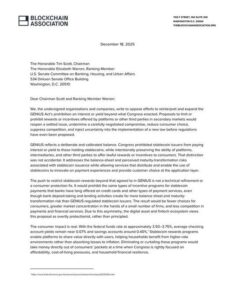
Over 125 cryptocurrency firms have united to defend stablecoin rewards programs against mounting pressure from traditional banks, urging Congress to preserve the GENIUS Act as it was written when signed into law in July 2025. The coalition, coordinated by the Blockchain Association, includes major players like Coinbase, Ripple, Gemini, Kraken, and a16z Crypto.
The Regulatory Battle
At the heart of this dispute is a critical distinction in the GENIUS Act’s framework for payment stablecoins .


While the law prohibits stablecoin issuers from paying interest or yield directly to holders, it remains silent on whether third-party platforms and exchanges can offer rewards programs. Banks argue this creates a dangerous loophole, while the crypto industry insists it reflects Congress’s deliberate design.
| Position | Banking Industry | Crypto Industry |
|---|---|---|
| Interpretation | Ban should extend to all rewards | Law intentionally allows platform rewards |
| Main Concern | Deposit flight from banks | Fair competition and innovation |
| Regulatory Stance | Close the “loophole” | Preserve current framework |
Consumer Impact and Market Competition
The crypto coalition argues that restricting platform rewards would harm competition and consumer choice. Currently, platforms like Coinbase offer around 4% annual rewards on stablecoin deposits, rates that match or exceed many traditional bank savings accounts. Industry leaders maintain that banks should compete on merit rather than seek regulatory protection for their business models.
Research cited by the coalition found no significant correlation between stablecoin adoption and deposit levels at community banks. They also point to approximately $2.9 trillion in bank reserves currently earning interest at the Federal Reserve rather than being deployed into loans, questioning banks’ claims about deposit constraints.
As the FDIC moves forward with implementation rules under the GENIUS Act, the debate over stablecoin rewards shows no signs of cooling. The outcome will shape whether digital payment innovation can flourish alongside traditional banking or whether incumbent financial institutions can leverage regulation to limit competition. With Senate Banking and Agriculture Committees currently negotiating crypto market structure legislation, the final resolution could define the future of digital payments in America.
The letter by the Blockchain coalition: