For those tracking the global silicon wars, this is more than just a spec bump. The appearance of the SM8850 designation in the official documents confirms not only the processor but also signals a crucial strategic move by Samsung, prioritizing uniform, high-end performance across global markets.
For years, Samsung played a delicate dance, segmenting its flagships between its in-house Exynos chips and Qualcomm’s Snapdragon. That dynamic often left international users feeling shortchanged. The FCC listing, however, suggests that the rumored universal adoption of Qualcomm’s silicon is now hard fact.
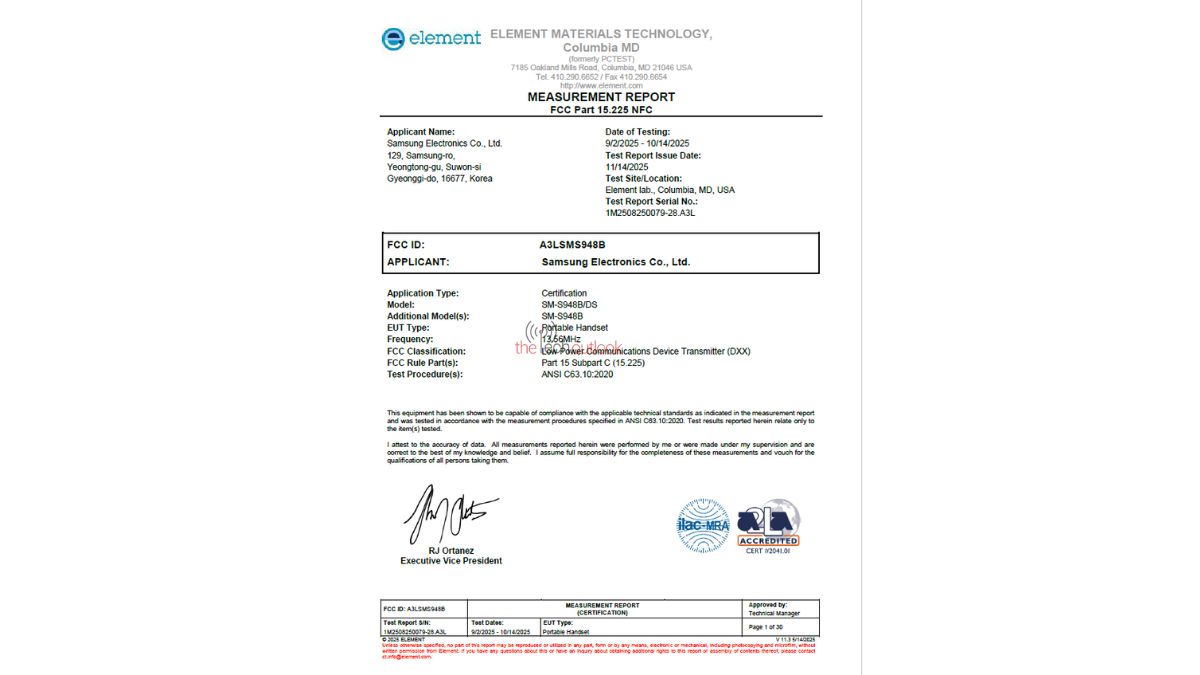
The certification documents—which span model variants like ‘SM-S948B’ (international) and ‘SM-S948U’ (US), explicitly name the Snapdragon 8 Elite Gen 5. This isn’t just the standard Qualcomm offering; industry whispers suggest this “Elite” moniker implies a custom, overclocked version optimized specifically for Samsung, following the successful strategy deployed in previous generations.
“The inclusion of the SM8850 across key regional models is a tacit admission that when it comes to peak mobile AI processing and sustained gaming performance, Qualcomm is still the universal benchmark Samsung needs to hit,” said one industry analyst familiar with the filing.
This confirmation backs up earlier reporting suggesting that the Galaxy S26 Ultra for all the markets will come equipped with the Snapdragon 8 Elite Gen 5 for Galaxy chip (over-clocked version*). This unified approach simplifies development, reduces performance disparity complaints, and ensures that every customer, regardless of geography, gets the best possible experience right out of the box.
While the chipset grabs the headlines, the supporting infrastructure detailed in the FCC filing provides a glimpse into how Samsung is tackling the next decade of mobile data transfer. The S26 Ultra is loaded with bleeding-edge connectivity features.
- WiFi 7: Confirmation of triple-band support (2.4GHz, 5GHz, 6GHz) ensures the S26 Ultra is ready for the next standard in wireless networking, promising massive throughput and lower latency for data-intensive applications like cloud gaming and decentralized AI processing.
- UWB (Ultra-Wideband): Essential for precise spatial awareness, UWB is listed with dual antenna support (UWB1 and UWB2 Rx-only), enhancing smart home integration, digital key functionality, and asset tracking.
- WPT: Wireless Power Transfer, or wireless reverse charging, is included, confirming the device can act as a charging pad for accessories like earbuds or smartwatches.
Furthermore, the listing reveals advanced antenna management via Qualcomm Smart Transmit Plus EFS v24. This technology is crucial for maintaining signal integrity while managing multiple transmit factors, a necessary complexity when cramming WiFi 7, UWB, and 5G into a single, sleek chassis.
The Power Source
No powerhouse is complete without adequate endurance. Separate regulatory filings, previously spotted on the BIS database, provided clarity on the expected battery capacity. The Samsung Galaxy S26 Ultra batteries that carry the model numbers of ‘EB-BS948ABE’ and ‘EB-BS948ABY’ were also listed on the BIS database, suggesting the device will pack a 4855 mAh rated battery (5000 mAh typical value).
Paired with the expected efficiency gains of the 4nm Snapdragon 8 Elite Gen 5, this 5,000 mAh typical capacity should provide robust all-day performance, a critical factor given the power demands of high-refresh-rate displays and intensive on-device AI tasks.
FCC certification marks the final technical hurdle before mass production ramps up in earnest. While these documents don’t