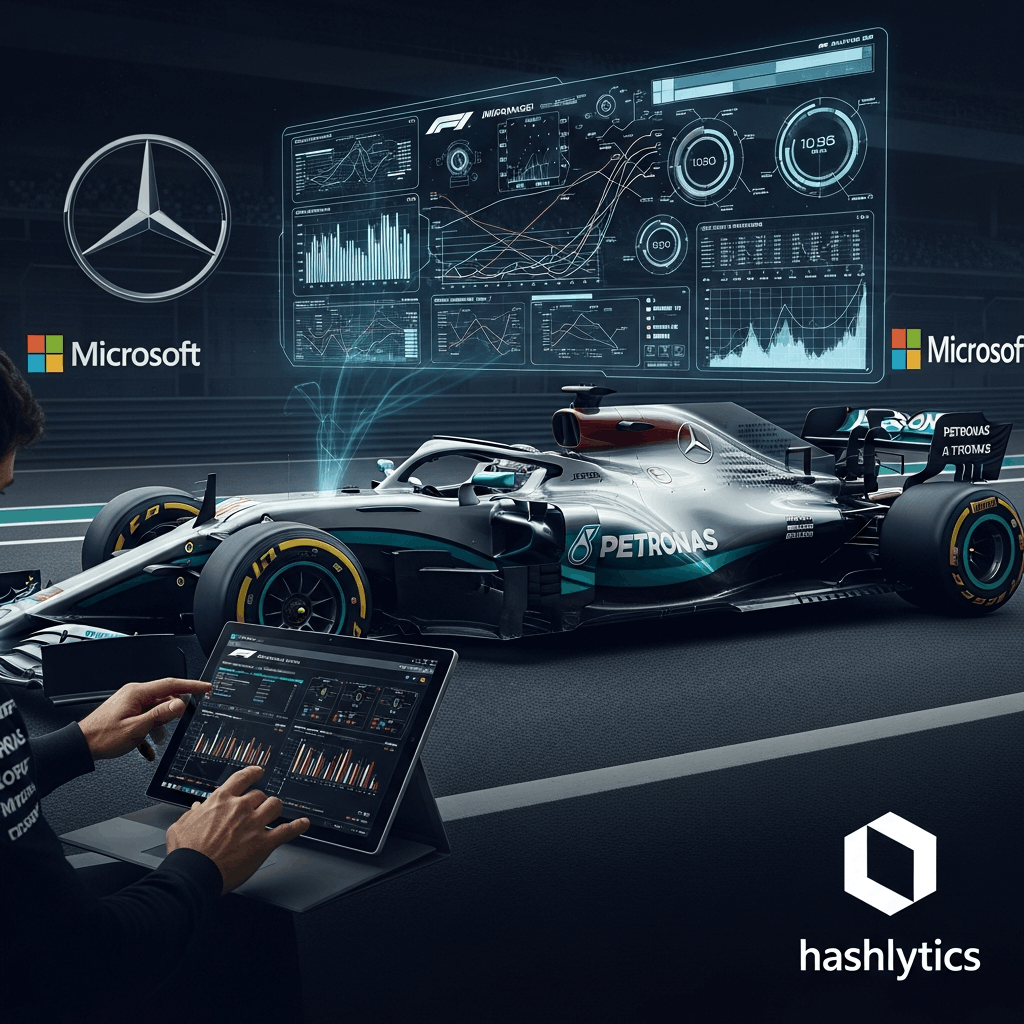
- Data Throughput: Each car generates over 1.1 million data points per second, according to a joint announcement from the companies.
- Sensor Density: More than 400 individual sensors are fitted to each Mercedes F1 car, monitoring everything from tire temperature to aerodynamic pressure.
- Core Technology: The partnership leverages Microsoft Azure‘s cloud platform, specifically utilizing Azure Kubernetes Service (AKS) for dynamic compute scaling.
The central challenge in modern Formula 1 isn’t merely collecting data, but translating its immense volume into real-time, actionable intelligence. By integrating Azure, the Mercedes team gains access to elastic high-performance computing (HPC) capabilities. This is a crucial advantage under the sport’s stringent financial regulations. Instead of investing in costly on-premise data centers, the team can use AKS to dynamically scale computing resources to meet the intense demands of a race weekend and scale back down during off-periods, optimizing operational expenditures.
This agility allows engineers to run more complex and precise simulations for race strategy, performance analytics, and aerodynamic modeling. The goal is to turn the torrent of 1.1 million data points per second into faster, more accurate predictions for tire degradation, fuel consumption, and optimal pit stop windows—decisions that can define a race outcome. As Judson Althoff, a Microsoft executive, stated, the aim is to harnessing data and turning it into real-time intelligence that powers faster decisions.
While powerful, this technology is not a panacea for performance. Nearly every team on the grid has a formidable technology partner; for instance, Red Bull Racing works with Oracle and Ferrari leverages AWS. The competitive differentiator will not be the access to cloud and AI, but the quality of the models and the speed of integration by Mercedes’ engineers. The platform is an enabler, but the intellectual property—the algorithms and analytical frameworks—remains the key battleground.
Furthermore, digital intelligence can only amplify the performance of the underlying physical asset. If the car’s aerodynamic concept or power unit is fundamentally flawed, even the most sophisticated AI-driven strategy cannot overcome a deficit in raw pace. The partnership must work in concert with, not in place of, world-class engineering and design.
The success of this partnership will be measured on the track. Key indicators will be Mercedes’ strategic decision-making during races, particularly under changing conditions or safety car periods. We should also monitor how effectively the team innovates within the constraints of the FIA’s cost cap, as the variable-cost model of cloud computing could unlock budget for other areas of car development. Finally, look for any public disclosures or case studies detailing specific performance gains attributed to new AI-driven simulation models.
- Modern F1 is a contest of digital infrastructure as much as mechanical engineering.
- Elastic cloud computing offers a significant competitive advantage under motorsport’s strict budget caps.
- The value of the partnership hinges on the quality of Mercedes’ proprietary data models, not just access to Microsoft’s tools.
- This collaboration exemplifies a broader trend of integrating enterprise AI into high-stakes, real-time operational environments.
Follow us on Bluesky , LinkedIn , and X to Get Instant Updates