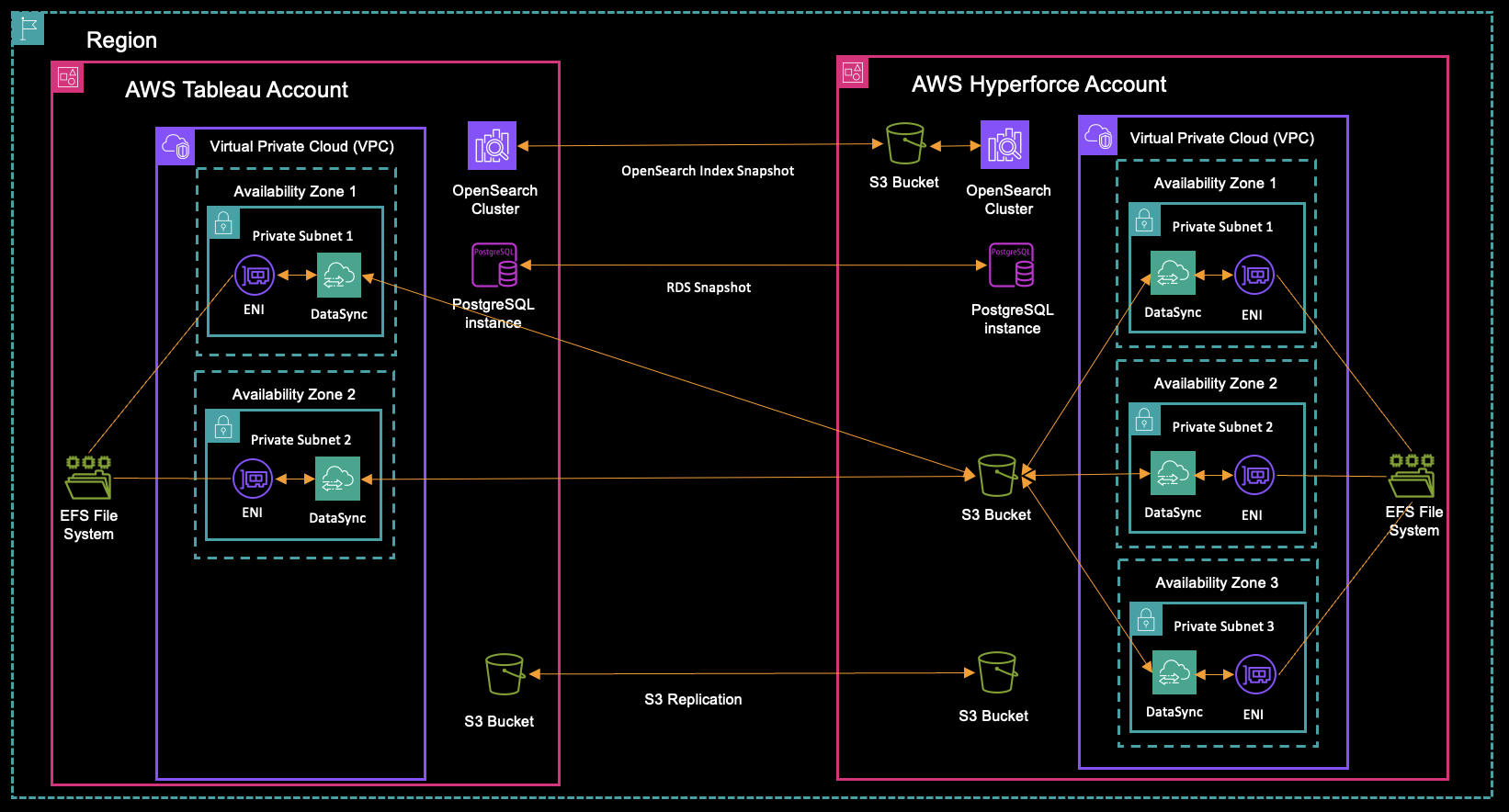
- Scope of Migration: 15 environments across seven AWS regions were migrated.
- Data Volume: Over 600 TB of data was transferred to the new Hyperforce infrastructure.
- Migration Window: Each environment was migrated within a 90-day timeline, from provisioning to final traffic switch.
- Customer Downtime: According to a Salesforce post co-authored with AWS, the migration incurred an average downtime of four hours per environment during scheduled maintenance.
By moving Tableau to Hyperforce, Salesforce is standardizing its technology stack, which should yield significant long-term operational efficiencies and security enhancements. This aligns the acquired Tableau asset more closely with the parent company’s infrastructure strategy. The move leverages AWS’s global footprint, enabling Tableau to pursue new compliance certifications, such as IRAP in Australia, and expand its regional availability. For customers, this promises improved scalability, data residency options, and resilience backed by a unified infrastructure model.
While the company reports a successful migration with managed downtime, any large-scale infrastructure shift carries inherent risks. The four-hour downtime per environment, though planned, still represents a significant service interruption. Furthermore, this deepens Tableau’s dependency on the AWS ecosystem, concentrating risk on a single cloud provider. The long-term performance and integration benefits are still prospective, and the true customer experience impact will only become clear over time.
The key forward-looking indicator is whether this migration model will be replicated for other major Salesforce acquisitions, such as Slack. Analysts should monitor Tableau’s expansion into new regions and its attainment of the new compliance certifications mentioned as proof of the migration’s strategic benefits.
Additionally, tracking customer-reported performance metrics and service reliability post-migration will be crucial to validating the project’s success. The process was supported by the AWS Countdown program, a model other enterprises may look to emulate.
- Standardizing acquired SaaS platforms onto a core infrastructure like Hyperforce is a key post-merger integration strategy.
- Large-scale cloud-to-cloud migrations (over 600 TB) can be executed with minimal, albeit non-zero, customer downtime.
- Leveraging native cloud services and formal support programs is critical for mitigating risks in complex migrations.
- The move enhances Tableau’s ability to meet specific regional data residency and compliance requirements.
Follow Hashlytics on Bluesky, LinkedIn , Telegram and X to Get Instant Updates