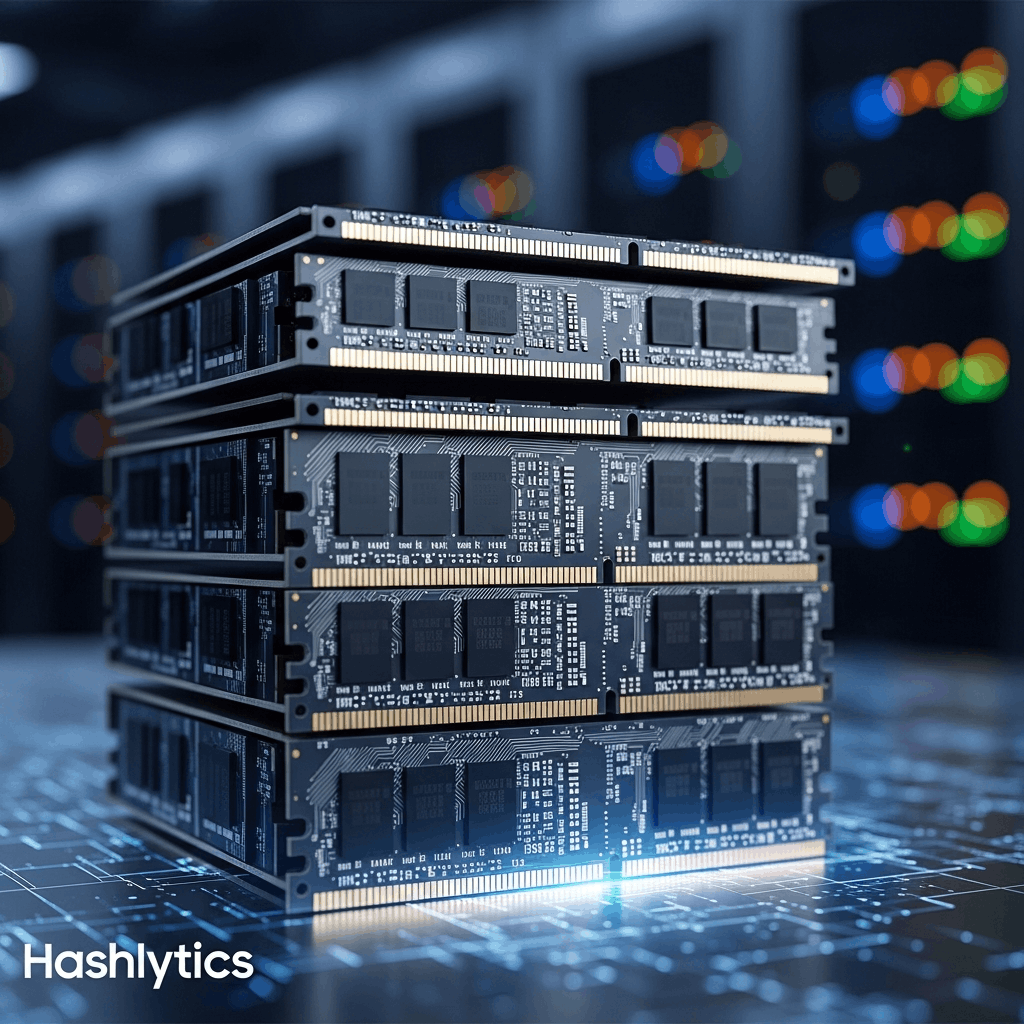
Samsung’s preliminary results for Q4 2025 exceeded market expectations, highlighting the strength of the rebound. The company reported operating profit of 20 trillion won ($13.81 billion), nearly triple year over year, alongside revenue of 93 trillion won, up 23% from the same period last year. For full-year 2025, operating profit is projected to reach 43.53 trillion won, a 33% increase from 2024, with revenue expected to climb 11% to 332.77 trillion won.
Key financial figures:
- Q4 2025 operating profit: 20 trillion won ($13.81 billion)
- Q4 2025 revenue: 93 trillion won
- Full-year 2025 operating profit (forecast): 43.53 trillion won
- Full-year 2025 revenue (forecast): 332.77 trillion won
Rising prices are now a central feature of the current memory cycle. According to market trackers, conventional DRAM contract prices are expected to rise between 55% and 60% in Q1 2026 compared with Q4 2025 levels, while NAND flash prices are forecast to increase by 33% to 38% over the same period. Citigroup projects even steeper gains in 2026, estimating average selling price increases of 88% for DRAM and 74% for NAND products.
| Metric | Details |
|---|---|
| Projected DRAM price increase (Q1 2026) | 55%–60% quarter-on-quarter |
| Projected NAND price increase (Q1 2026) | 33%–38% quarter-on-quarter |
| Citigroup 2026 DRAM ASP forecast | +88% |
| Citigroup 2026 NAND ASP forecast | +74% |
Analysts increasingly view this cycle as structurally different from past memory upturns. Unlike consumer-driven rebounds, the current surge is anchored in long-term capital spending on AI infrastructure. Nomura analysts expect the supercycle to extend through 2027, while HSBC analyst Ricky Seo forecasts an upward trend lasting four to five years. This outlook reflects sustained demand for AI servers, which require significantly higher memory bandwidth and density than traditional computing systems.
Samsung’s position as the world’s largest memory-chip manufacturer places it at the center of this shift. S&P Global Ratings notes that Samsung is likely to be one of the primary beneficiaries of elevated conventional memory prices, given its scale across both DRAM and NAND. At the same time, the company is expanding its HBM portfolio, including fifth-generation HBM3E products, as competition intensifies with rivals such as SK Hynix, which currently leads in HBM shipments to major AI chip designers like Nvidia.
The broader industry impact extends beyond chipmakers. As memory producers prioritize high-margin AI server products, supply constraints are emerging in conventional memory used by consumer electronics manufacturers. This dynamic raises the likelihood of higher component costs across smartphones, PCs, and other devices, potentially feeding through to end-user pricing. At the same time, the memory market’s historical cyclicality remains a risk factor, with S&P Global Ratings cautioning that periods of rapid expansion have previously been followed by sharp corrections.
Still, the current data suggests that the memory sector is entering a sustained expansion phase rather than a short-term rebound. Massive investment in AI infrastructure continues to reshape supply chains, pricing models, and production priorities across the semiconductor industry. Samsung’s Q4 2025 results underscore how deeply this transformation is already embedded in financial performance, offering a clear signal of where the memory market is heading through 2026 and beyond.
Follow us on Bluesky , LinkedIn , and X to Get Instant Updates