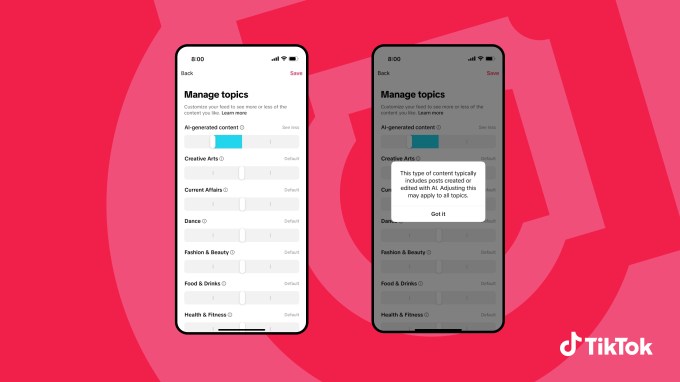
TikTok’s new AIGC control is nestled within the existing Manage Topics tool. Think of it as a content thermostat, letting you adjust the AI influence on your daily scroll. Already, users can tweak the frequency of topics like “Dance,” “Sports,” and “Food & Drinks“. Now, joins the party.
According to a recent blog post, TikTok emphasizes that this isn’t about censorship but about personalization: “Like those controls, the AIGC setting is intended to help people tailor the diverse range of content in their feed, rather than removing or replacing content in feeds entirely.”
Accessing this new capability is straightforward: navigate to Content Preferences, then Manage Topics. From there, you can adjust the slider for to your liking. The rollout is expected to occur over the coming weeks.
Beyond user controls, TikTok is bolstering its defenses against deceptive AI content with advanced labeling technologies. The company is testing “invisible watermarking” – a subtle, platform-readable marker that adds an extra layer of verification.
While TikTok already mandates labeling for realistic and utilizes Content Credentials from C2PA, these labels can be stripped during re-uploads or edits on other platforms. The invisible watermark aims to solve this problem.
TikTok will initially apply these watermarks to content created with its own AI tools, like AI Editor Pro, and to content uploaded with C2PA’s Content Credentials. This will enable more reliable identification of AI-generated material across the platform.
Recognizing the need for widespread understanding of AI, TikTok is launching a $2 million AI literacy fund. The initiative aims to empower experts, including organizations like Girls Who Code, to create educational content focused on AI literacy and online safety.
This investment underscores the company’s commitment to fostering a more informed and discerning user base, equipping individuals with the tools to navigate the complexities of the AI-driven digital world.
TikTok’s decision to offer AI content controls arrives as other tech giants, such as OpenAI and Meta, experiment with AI-only feeds. Meta, for example, recently launched Vibes, a new feed for sharing and creating short AI-generated videos. Similarly, OpenAI released Sora, a social media platform for creating and sharing AI-generated videos.
The contrasting approaches highlight a fundamental question: Should platforms curate our experiences with AI, or should we have the power to choose? TikTok is betting on the latter, placing the onus on users to shape their own digital realities. The success of this strategy will likely influence how other social media platforms navigate the evolving AI landscape, setting a precedent for user empowerment in the age of synthetic media.