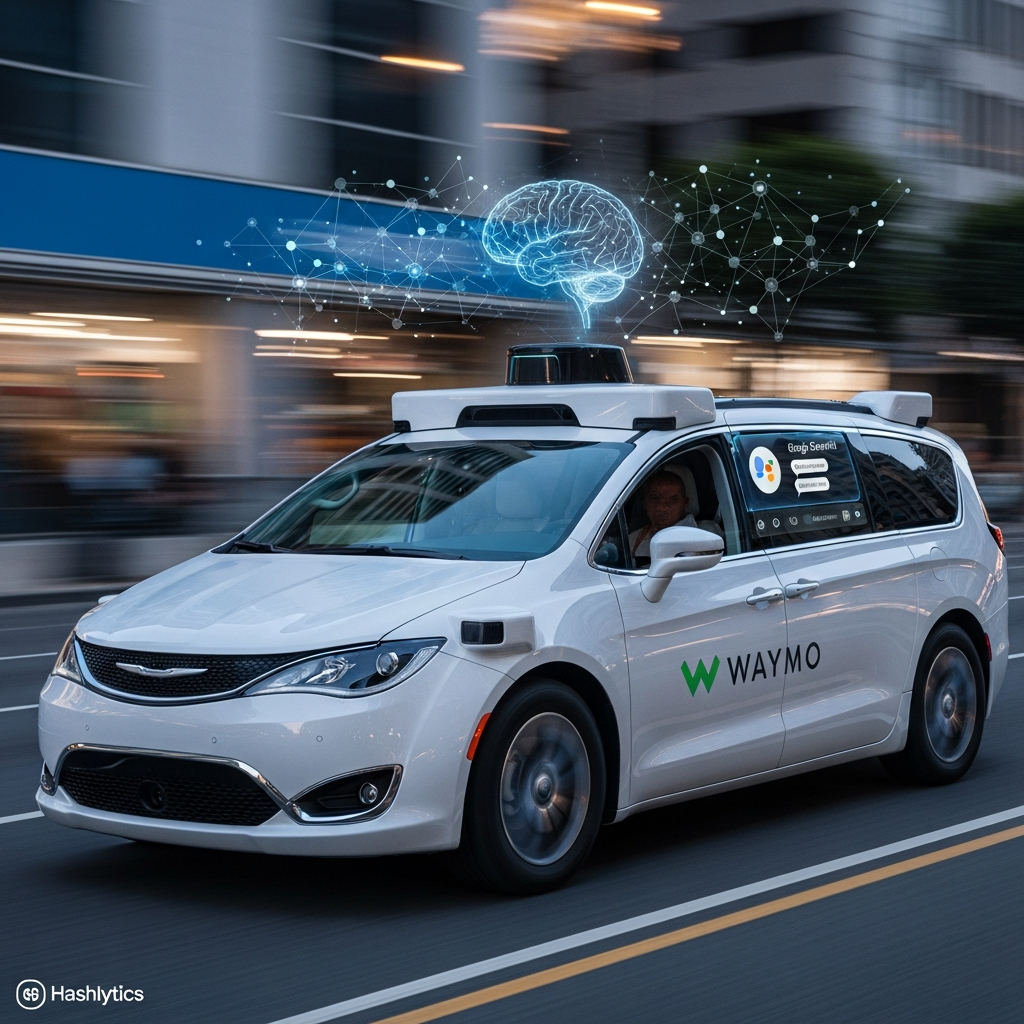
Waymo appears to be testing the integration of Google’s Gemini AI chatbot into its robotaxis, potentially adding an in-car assistant designed to accompany riders and answer questions during trips. The discovery is based on internal system prompts and documentation referenced in a recent Waymo blog post detailing the company’s approach to safe and controlled AI deployment.
The prompts currently allow Gemini to access and control select in-car features, including temperature, lighting, and music. Notably absent from the available controls are volume adjustment, route changes, seat positioning, and window controls. If a rider requests a feature outside Gemini’s permissions, the assistant is instructed to respond with so-called “aspirational phrases,” such as, “It’s not something I can do yet.”
The assistant is also directed to maintain a clear distinction between its identity as Gemini, the AI assistant, and the autonomous driving system known as the Waymo Driver. For example, when asked, “How do you see the road?” Gemini should not describe sensor usage in the first person, instead responding that “the Waymo Driver uses a combination of sensors.”
Additional system prompts outline how the assistant should handle questions about competitors such as Tesla or the now-defunct Cruise, as well as defining trigger keywords that instruct the bot to stop responding.
Gemini is explicitly prohibited from speculating on, explaining, confirming, denying, or commenting on real-time driving behavior or specific incidents. If a passenger references a video or report involving a Waymo vehicle incident, the assistant is instructed to deflect rather than engage directly.
Your role is not to be a spokesperson for the driving system’s performance, and you must not adopt a defensive or apologetic tone,
one system prompt states.
The in-car assistant is permitted to answer general knowledge questions, such as weather updates, landmarks, store hours, or recent sports results. However, it is not allowed to perform real-world actions, including ordering food, making reservations, or handling emergency situations.
Waymo is not alone in exploring AI assistants for autonomous vehicles. Tesla is pursuing a similar approach with xAI’s Grok. The two assistants appear to serve different purposes: Gemini is positioned as a pragmatic, ride-focused assistant, while Grok is marketed as a conversational companion capable of longer interactions and contextual memory.