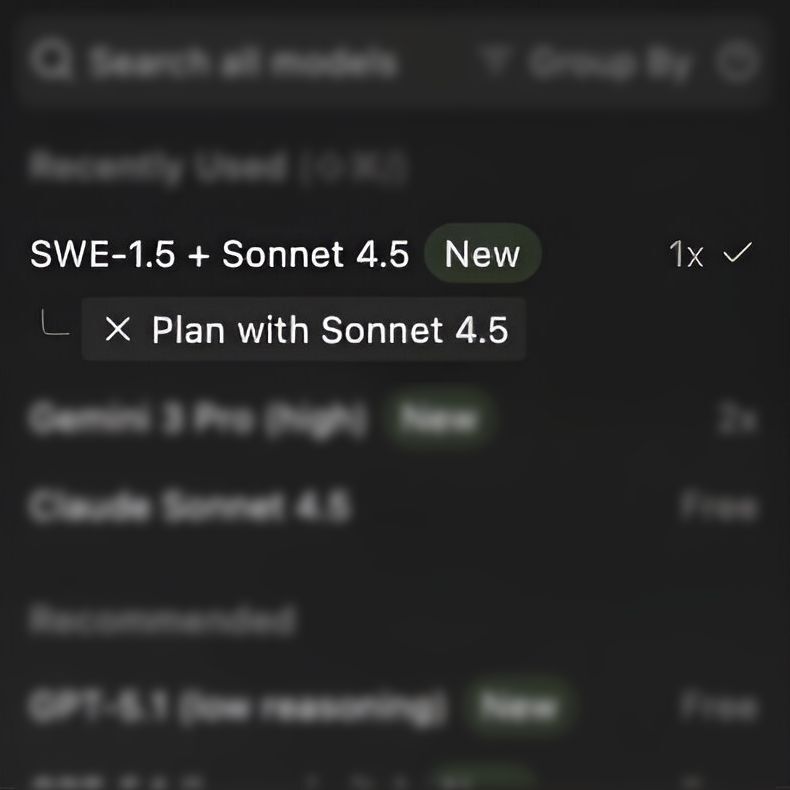
You can now pair SWE-1.5 with Sonnet 4.5 for planning in Windsurf. This lets you create hybrid agents that take advantage of SWE-1.5’s blazing speed while leveraging SOTA models for planning out more complex tasks.
The combination addresses a fundamental tradeoff in AI coding: you’ve historically had to choose between a model that thinks fast and one that thinks well. Now you don’t.
How It Works
According to Windsurf’s changelog, enabling this hybrid mode is straightforward:
- Select SWE-1.5 as your primary model
- Enable the Sonnet 4.5 addon for planning
- Let Windsurf handle the orchestration
Sonnet 4.5 handles high-level reasoning and task decomposition, while SWE-1.5 executes at up to 950 tokens per second — 13x faster than Sonnet alone.
Performance Comparison
| Model | Speed | Best For |
|---|---|---|
| Sonnet 4.5 (Solo) | ~69 tok/s | Complex reasoning, planning |
| SWE-1.5 (Solo) | ~950 tok/s | Rapid code execution |
| SWE-1.5 + Sonnet 4.5 | Hybrid | Best of both worlds |
Why Hybrid Agents Matter
The rise of agentic AI in 2025 has proven that effective coding agents need both rapid execution and sophisticated planning. A “planner” agent sets goals while a “developer” agent generates code—this multi-agent architecture mirrors how agile teams actually work.
Key Benefits
- Speed Without Sacrifice: Near-instant code generation backed by thoughtful planning
- Flow State Preservation: Sub-5-second responses keep developers in the zone
- Complex Task Handling: Sonnet 4.5’s reasoning tackles multi-step problems
- Cost Efficiency: Use expensive SOTA models only where they matter most
The Bigger Picture
This hybrid approach reflects a broader industry trend. As Simon Willison observed, “Partnering with Cerebras for inference is a very smart move.” Windsurf’s tight integration of model, agent harness, and inference infrastructure creates a unified system where speed and intelligence finally coexist.