
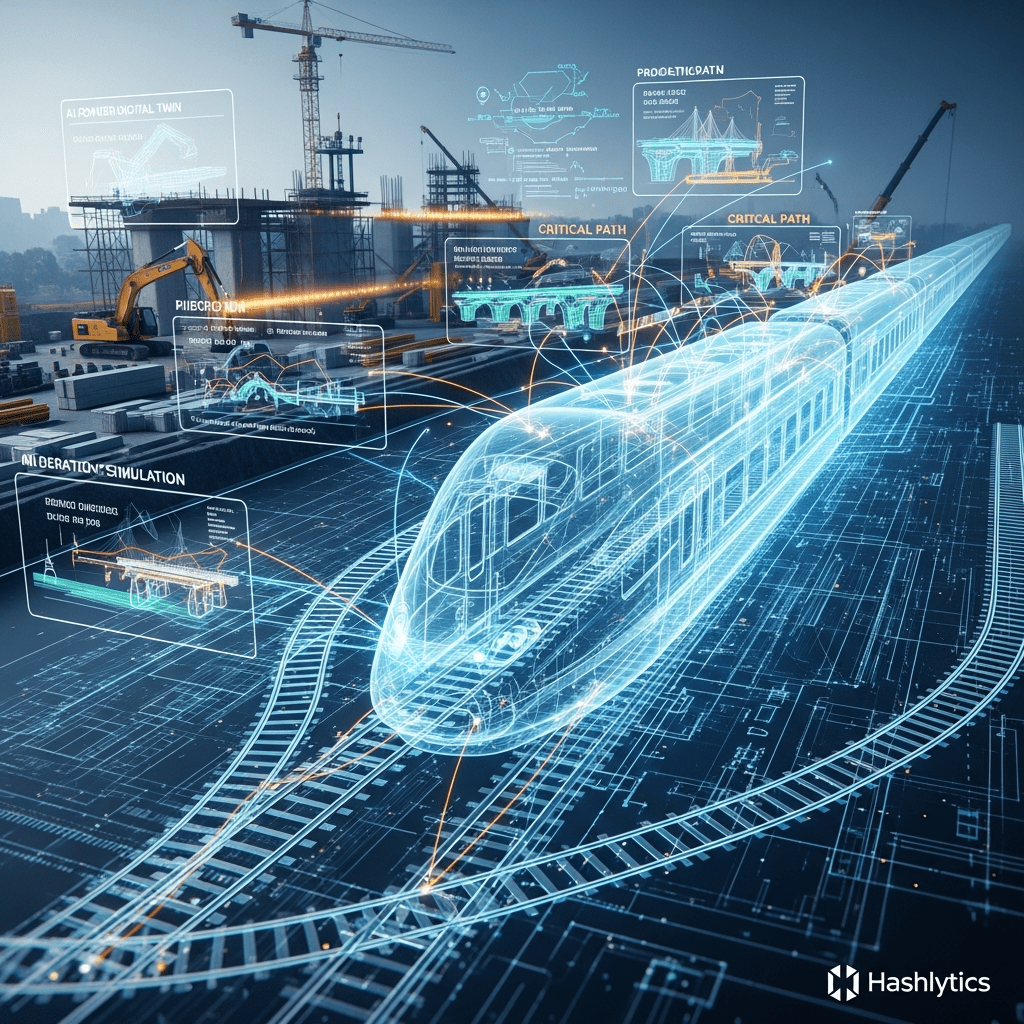
Imagine a virtual replica of a rail line, constantly learning and adapting based on real-time data. That’s the power of digital twins, and a recent study highlights how this technology, coupled with artificial intelligence, is transforming rail transit construction.
Researchers have designed and validated a closed-loop control platform that integrates multi-source data, enabling real-time prediction and AI-driven scheduling. Think of it as the central nervous system for building a rail line, with digital twins acting as the visual representation and testing ground for every decision.
The platform operates on a three-layer architecture:
- Edge Sensing: On-site devices collect real-time status updates.
- Cloud Computing: Middleware integrates and serves the collected data.
- Intelligent Interaction: A 3D digital twin validates strategies and dispatches execution.
This perception-fusion-prediction/optimization-execution/feedback loop ensures that the system is constantly learning and improving.
At the heart of this platform lies a sophisticated AI engine. Data modeling employs a Transformer-Encoder-based multimodal temporal fusion model, while graph attention networks handle heterogeneous structure modeling. This allows the system to understand complex relationships within the construction project.
Apache Kafka and Flink manage streaming data for high-frequency, low-latency processing, ensuring that the system responds quickly to changing conditions.
Specific AI algorithms include:
- Spatio-Temporal Graph Convolutional Network for passenger flow and construction period prediction.
- Shifted Window Transformer for image recognition.
- Proximal Policy Optimization (PPO) algorithm for task scheduling optimization.
Field tests in an urban rail construction project demonstrated the platform’s effectiveness. The system achieved 91.6% accuracy in passenger flow prediction under high-concurrency conditions and 98.2% accuracy in image recognition.
Perhaps most impressively, PPO-based scheduling reduced average task completion time by 27.4%. The system maintained an average response latency of 280 ms, with a peak throughput of 27,000 messages per second, and a closed-loop execution success rate exceeding 95%.
For those interested in diving deeper into the data behind this research, the datasets used are available from the corresponding author, Jianbo Guan, via email at [email protected], upon reasonable request.
This AI-powered digital twin platform isn’t just a technological achievement; it’s a blueprint for the future of urban infrastructure. By providing a foundation for informatization and intelligent upgrading in urban rail transit, this system promises to deliver safer, more efficient, and more responsive transportation networks for generations to come. As cities grow and demand for efficient transit increases, expect to see this technology become increasingly vital.