How Apple Intelligence Works
The core architecture relies on a hybrid model. Most processing happens on-device, keeping user data local. Only tasks requiring more computational power get routed to Apple’s Private Cloud Compute (PCC), a system designed so that even Apple itself cannot access the data being processed.
| Component | How It Works |
|---|---|
| On-Device Processing | Handles most requests locally using Apple Silicon |
| Private Cloud Compute | Handles complex tasks without storing or accessing user data |
| Personal Context | Siri reads emails, events, and photos on-device to inform responses |
| Developer APIs | WritingTools and ImagePlayground open Apple’s models to third-party apps |
What’s Actually New
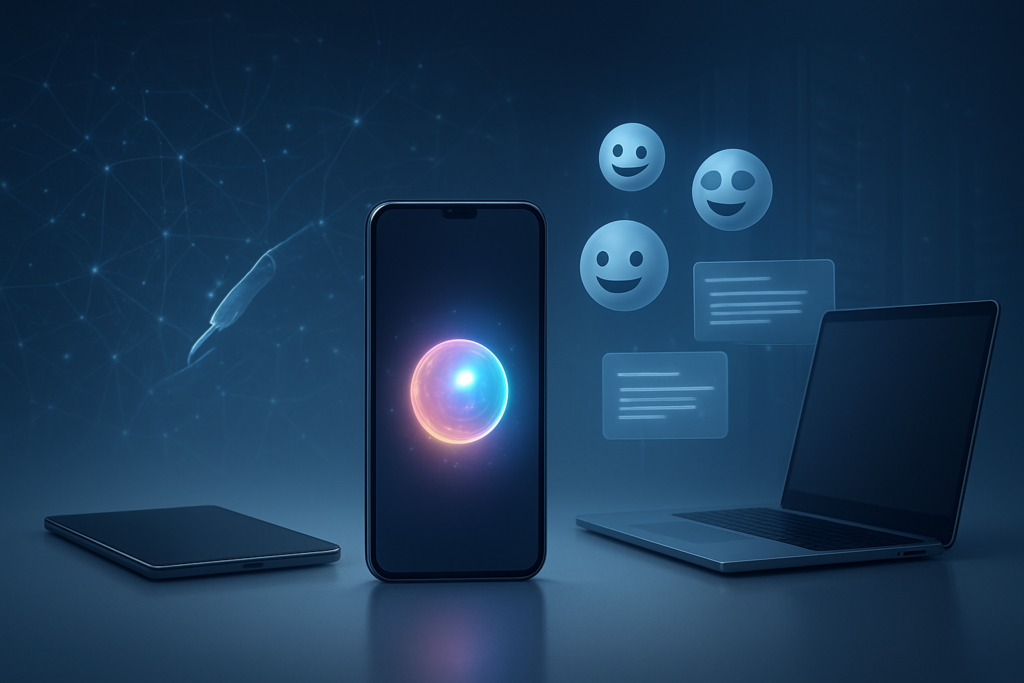
Apple Intelligence anticipates user needs and operates across apps rather than within a single interface. Key capabilities include a revamped, context-aware Siri that understands personal data on-device, system-wide writing tools for rewriting, proofreading, and summarizing text, and on-device image generation through Image Playground and Genmoji.
Visual Intelligence adds another layer, allowing the system to understand content within photos and on-screen. Deep OS integration means these tools function across native and third-party apps without requiring users to switch context.
Apple vs. Google: Two Very Different Philosophies
This is where the competitive analysis gets interesting. Google built Gemini around massive cloud infrastructure and broad data access. The result is powerful, knowledge-rich AI, but it operates more as a service layer on top of Android rather than woven into the OS itself.
Apple’s vertical integration flips this entirely. Because Apple controls the silicon, software, and cloud infrastructure, it can deliver a level of privacy and system-level fluidity that software-only solutions struggle to match. On-device processing means sensitive queries around emails, calendars, and photos never leave the device unless routed through PCC.
This forces a broader industry reckoning. Both Google and Microsoft, with its Copilot integration, now face pressure to reconsider how they balance AI utility with user data security, particularly in the high-end consumer segment where Apple dominates.
The Privacy Tradeoff in Practice
Apple’s privacy-first model comes with real limitations. On-device processing is inherently constrained by hardware capability compared to cloud-based models. Apple Intelligence is still susceptible to AI hallucinations, generating incorrect or fabricated information, a problem that persists across all current AI systems regardless of where processing happens.
The personal context engine also deepens Apple’s ecosystem lock-in. As Siri learns to understand a user’s emails, photos, and calendar events on-device, that accumulated context becomes a significant switching cost. Leaving the Apple ecosystem means losing that layer of personalization entirely.
Market Reception
The reaction has been less about dramatic capability leaps and more about practical appreciation. Users report the AI features working quietly in the background, handling tasks like summarizing documents or organizing photos without requiring deliberate interaction. The revamped Siri has drawn particular attention for handling context-specific requests that previous versions couldn’t process.
What This Means for the Industry
Apple Intelligence reframes the competitive conversation from raw AI capability to practical, privacy-respecting integration. Google’s advantage in knowledge breadth and cloud compute remains significant for enterprise and power-user scenarios. But for the consumer market, Apple has established a new benchmark: AI that operates invisibly, respects user data, and improves daily workflows without requiring users to actively seek it out.
Whether Google, Microsoft, and other competitors can match this level of OS-level integration while maintaining their own privacy commitments will define the next phase of the personal AI race.
Follow us on Bluesky , LinkedIn , and X to Get Instant Updates