+0.56%
+1.25%
-11.95%
-0.27%
-1.37%
-0.08%
Blockchain gaming is projected to reach $24.4 billion in revenue by 2025, driven by the convergence of entertainment and finance. This growth signifies a reshaping of the gaming landscape, creating new opportunities and challenges for developers, players, and investors.
Fueled by play-to-earn mechanics and digital ownership, blockchain gaming experienced rapid expansion with an estimated Compound Annual Growth Rate (CAGR) of 62.6% from 2020 to 2025.
User Activity & Market Performance
The blockchain gaming sector shows mixed signals in user engagement:
- Market share: Blockchain gaming accounts for 25% of all active wallets in the Web3 ecosystem
- Q3 2025 decline: Daily active wallets decreased 4.4%, suggesting a need for more sustainable models
- Funding drop: 60% year-on-year decline in late 2025, potentially indicating market correction
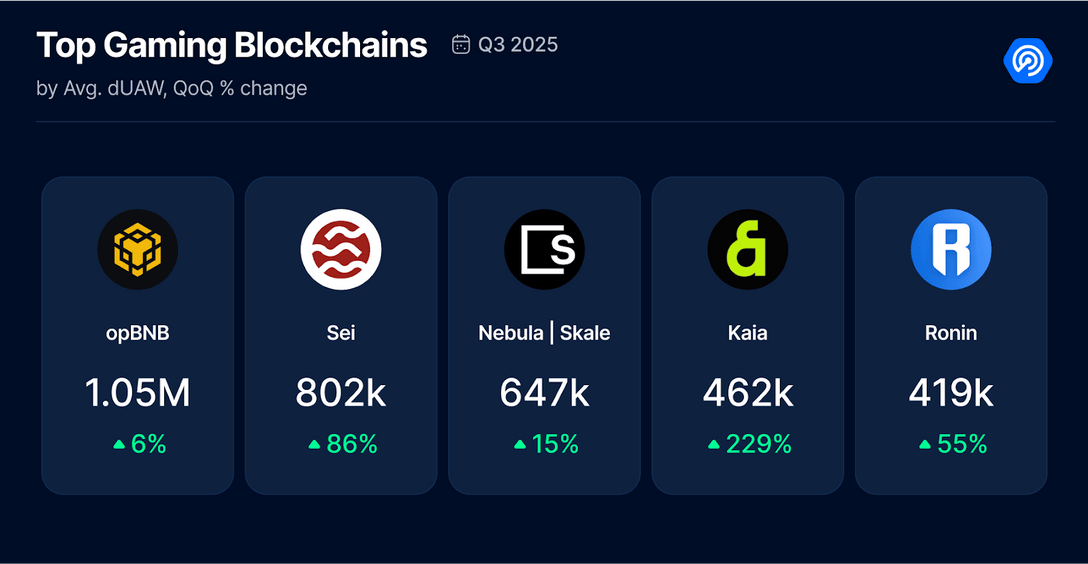
Platform Competition: Daily Active Users
| Platform | Average Daily Users | Q-o-Q Growth |
|---|---|---|
| opBNB | 1,050,000 | +6% |
| Sei | 802,000 | +86% |
| Nebula | Skale | 647,000 | +15% |
| Kaia | 462,000 | +229% |
| Ronin | 419,000 | +55% |
Geographic Market Distribution
| Region | 2024 Share | 2025 Projection | Notes |
|---|---|---|---|
| Asia-Pacific | 28.7% | 42.1% | Regional dominance solidifying |
| North America | — | 25.4% | Fastest-growing region |
| Southeast Asia & Latin America | — | — | Emerging markets, high mobile penetration, P2E adoption |
Play-to-Earn (P2E) Economics
P2E games remain the dominant revenue driver, but face sustainability challenges:
- Revenue share: Approximately 62% of blockchain gaming revenue in 2025
- Market size: $2.7 billion in 2024
- 2034 projection: $26.59 billion (CAGR ~25.7%)
- Key risks: Token-value volatility and regulatory uncertainty threaten long-term viability
- Growth concerns: Slowed user activity and funding indicate potential model challenges
Revenue Streams Breakdown
| Category | Key Metrics |
|---|---|
| Mobile Gaming | – $92.6 billion revenue in 2024 – 49% of total gaming market – 55.2% projected blockchain gaming share in 2025 |
| In-Game Asset Sales | – 76% of all online gaming revenue in 2025 – Growing demand for blockchain assets with resale rights – More stable revenue for developers |
| Asset Rentals & Leasing | – 35% increase in transaction volume during 2025 |
NFT Market Performance
Non-fungible tokens remain central to blockchain gaming economics:
- Transaction volume: Gaming NFTs represent 38% of total NFT transaction volume in 2025
- Secondary sales: Now constitute 52% of all NFT transactions
- Creator royalties: Ethereum-based creators earned over $920 million in NFT royalties in 2025
- Market size: Annualized trading volume expected between $5 billion and $6.5 billion in 2025
- Revenue potential: Secondary markets creating ongoing revenue generation opportunities
The blockchain gaming demographic is primarily young and tech-savvy. In 2025, the total population of blockchain gamers reached approximately 102 million, a 72% year-on-year increase. A significant 71% are aged between 18 and 34. Female participation is also on the rise, reaching 34% in 2025. Notably, 54% of blockchain gamers in the U.S. already own cryptocurrency, and 82% are interested in using it for in-game purchases. This highlights the strong synergy between crypto adoption and blockchain gaming.
While the long-term outlook for blockchain gaming remains positive, the sector has faced headwinds in terms of investment. In 2025, the blockchain gaming sector raised only $293 million in investment, a sharp drop from $1.8 billion in 2024. This decline reflects a shift in investor sentiment towards earlier-stage infrastructure rather than large consumer games. Regulatory uncertainty is also a major challenge, cited as a constraint by 28% of blockchain gaming companies in 2025. Regions with clearer regulations, like Singapore, are seeing tokenized gaming adoption grow 30-40% faster. The EU’s MiCA regulation enforcement from Q4 2025 is also increasing compliance costs for game developers.
The future of blockchain gaming hinges on building sustainable economies and creating truly engaging gameplay experiences. Developers need to move beyond speculative tokenomics and focus on durable game design. Integrating DeFi-style mechanics like staking and yield can also help stabilize in-game economies. Ultimately, the success of blockchain gaming will depend on its ability to attract and retain players. By focusing on playability, sustainability, and regulatory preparedness, developers can unlock the full potential of this rapidly evolving market.