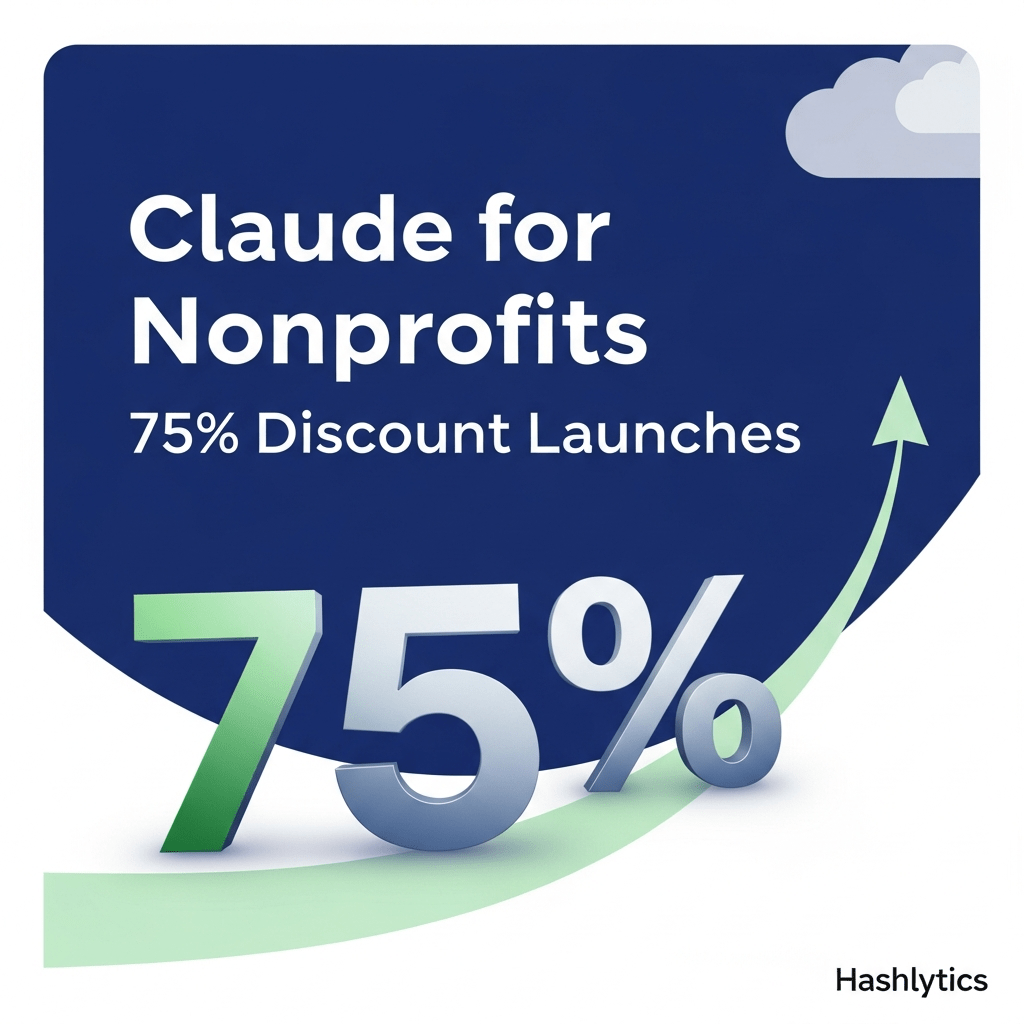
In partnership with GivingTuesday, Anthropic is launching Claude for Nonprofits, offering discounts of up to 75% on Team and Enterprise plans, new integrations with Blackbaud, Candid, and Benevity, and free AI training designed to help nonprofits spend less time on admin and more time on their missions.
Anthropic will offer nonprofit organizations discounts of 70% to 75% on its Claude tools for businesses, along with specific technical tools optimized for nonprofit groups’ operational needs.
As GivingTuesday CEO Asha Curran responded: Glad to partner with you on making helpful technology more accessible to nonprofits doing incredible work!
What’s Included
| Feature | Details |
|---|---|
| Discount | 70-75% off Team & Enterprise plans |
| Models (Default) | Claude Sonnet 4.5 + Claude Haiku 4.5 |
| Opus 4.5 | Available on request (Enterprise only) |
| Integrations | Blackbaud, Candid, Benevity connectors |
| Training | Free “AI Fluency for Nonprofits” course |
| Partners | Bridgespan Group, Idealist, Vera Solutions, Slalom |
Real-World Impact: Organizations Already Using Claude
According to Anthropic’s announcement, several nonprofits are already seeing dramatic results:
- Epilepsy Foundation: Providing 24/7 support to 3.4 million Americans living with epilepsy
- International Rescue Committee: Communicating with local partners and analyzing field data faster in time-sensitive humanitarian settings
- IDinsight: Reports working up to 16× faster with Claude
- SkillUp and Robin Hood: Using Claude for coding and administrative work that would otherwise require significantly more resources
The IRC Perspective
Jeannie Annan, chief research and innovation officer for the IRC, said:
“We have an organization of 12,000 staff in 40 different countries speaking many, many different languages. Claude has allowed teams to move a lot more quickly with a range of different knowledge. I think AI is one of the few tailwinds that we have in the humanitarian sector. Right now, we have a lot of headwinds, so we’re trying to use AI as much as possible.”
The Thoughtful Question: Why Does Opus 4.5 Require a Request?
One user posted a remarkably thoughtful question that deserves serious consideration. They wrote:
“I noticed that Opus 4.5 requires a separate request to the account team for nonprofit plans. What makes this particularly curious is that the regular Team plan with premium seats appears to include Opus 4.5 as the default model. So the restriction seems specific to the discounted nonprofit tier.”
They continued:
“From what I understand, Claude’s usage operates on a credit-like system, using more powerful models simply consumes credits faster, which naturally leads to hitting limits sooner. If that’s the case, wouldn’t the system self-regulate? Users who heavily rely on Opus would simply reach their limits earlier, while those who use Sonnet for most tasks would have longer runway.”
Possible Explanations (Informed Speculation)
While Anthropic hasn’t publicly explained the policy, several factors likely contribute:
1. Server Capacity and Computational Resource Management
- Opus 4.5 is significantly more expensive to run than Sonnet 4.5
- At 75% discount, nonprofits pay ~$6/user/month (vs. $25 regular Team pricing)
- If all 60+ pilot nonprofits defaulted to Opus, compute costs could quickly exceed revenue
- The request system lets Anthropic allocate Opus capacity strategically
2. Encouraging Thoughtful Model Selection
- Many tasks (donor emails, summaries, routine Q&A) don’t need Opus-level reasoning
- The request process prompts nonprofits to articulate why they need Opus
- This educational friction helps teams learn which model fits which use case
- Similar to how AWS requires justification for GPU instances—not gatekeeping, but guardrails
3. Cautious Rollout for New Program
- This is Anthropic’s first nonprofit program, they’re learning as they go
- Starting conservative (Sonnet default) reduces risk of abuse or unexpected costs
- If pilot proves successful, Opus access may expand automatically in 2026
4. Economic Reality of Deep Discounts
Let’s do the math:
| Plan Type | Regular Price | Nonprofit Price (75% off) | Anthropic’s Revenue |
|---|---|---|---|
| Team (per user/month) | $25 | ~$6.25 | $6.25/user |
| Enterprise (custom) | $50-100+ | ~$12.50-25 | $12.50-25/user |
At those rates, Opus usage could quickly become uneconomical. A nonprofit running Opus constantly might consume more compute than they’re paying for, especially at 75% discount.
The self-regulation argument (“they’ll just hit limits faster”) is valid if those limits are calibrated correctly. But Anthropic may not yet know the right balance for heavily discounted plans.
User Reactions: Excitement and Thoughtful Critique
“Opus 4.5 for Nonprofits is going to accelerate them so fast!”
One user celebrated the potential: when nonprofits do get Opus access, the performance gains could be transformative for complex tasks like grant writing, program evaluation, and strategic planning.
“Tools help, but the mission still needs kindness at the core”
Another grounded commenter observed: “Even with AI.” This is crucial, AI can automate admin work, but it can’t replace the human connection at the heart of nonprofit work.
“OpenAI should apply as they are non-profit”
This sarcastic jab references OpenAI’s complicated history: founded as a nonprofit, restructured as “capped-profit” in 2019, now raising at $150B+ valuation. Technically, OpenAI Inc. (the parent) is still nonprofit, but that’s increasingly a legal technicality rather than operational reality.
The Thoughtful Critique (Full Response)
The user who asked about Opus restrictions concluded their message beautifully:
“I ask this not as a criticism, but out of genuine curiosity. Understanding the philosophy behind these decisions helps me appreciate how Anthropic approaches AI accessibility and responsible deployment.”
This is the exact kind of user feedback product teams dream of: thoughtful, curious, solution-oriented, and demonstrating real-world use of the product.
The New Integrations Matter
According to Candid’s announcement, the nonprofit sector connectors are significant:
Candid Connector
- Access to data on 2.4 million nonprofits and foundations
- Look up real-time information on nonprofits and foundations
- Get latest news and expert guidance synthesized from Candid’s library
- Requires free Candid account (ensures data pulled only from publicly available sources)
Blackbaud Connector
- CRM and fundraising tools integration
- Pull donor data directly into Claude
- Generate reports without switching systems
Benevity Connector
- Access to over 2.4 million validated nonprofits
- Corporate giving and employee engagement platform integration
Catherine Williams, Chief Data Officer at Candid, explained: “Nonprofits are under immense pressure to do more with less. We’re meeting Claude users where they are to expand access to Candid’s data.”
The Tipping Point Pilot
According to SF Standard, Anthropic partnered with Daniel Lurie-founded nonprofit Tipping Point Community to give “up to 50” grantees free access to Claude Enterprise for six months, with Tipping Point providing an additional 12 months at deeply discounted pricing.
Sam Cobbs, Tipping Point CEO, warned: “Nonprofits run five to ten years behind the technological trends. If you get 5-10 years behind where AI is, you’re done.”
Real Use Cases From Pilot
- JVS (job training): Understanding AI’s threat to employment while using it to stretch resources amid federal funding cuts
- First Place for Youth: Draft grant proposals, organize data, develop training materials
- IRC: Design training guides, health care assessments, role-play scenarios—”dramatically reducing development time while maintaining quality”
What This Means for the Sector
As Jeannie Annan said: “AI is one of the few tailwinds we have in the humanitarian sector.” With global health funding shrinking and admin burdens rising, tools like Claude aren’t luxuries, they’re survival mechanisms.
The question isn’t whether nonprofits should use AI. It’s whether they can afford not to.