
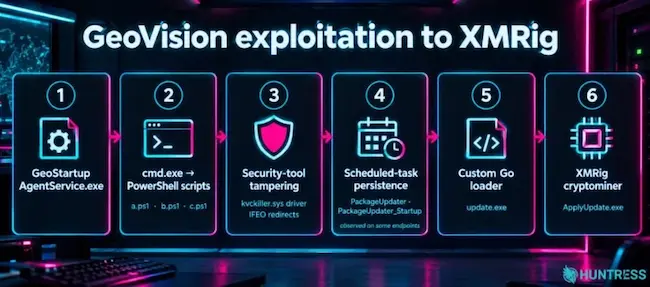
GeoVision is a Taiwanese surveillance and access control provider that operates in 110 countries. The attack activity started from services inside its software. Once in, the attackers ran scripts to detect and disable Microsoft Defender, downloading a kernel driver previously linked to BYOVD attacks to tamper with the antivirus tools already on the machine.
The Old Build Behind the Intrusions
The attackers went after GeoVision build GV-VMS 17.4.8.0, compiled on . That predates the fixed release, V17.4.8.58. Anthony Gibbs, a Security Operations Analyst at Huntress, confirmed the older version was running on a sample of the affected hosts. It is exposed to three unauthenticated remote code execution flaws in its WebCam Server component, as described in GeoVision’s advisory.
Huntress has not pinned down which flaw was used. Senior Security Operations Analyst Austin Worline said exploiting a known vulnerability is the most likely explanation, with CVE-2024-6047 and CVE-2024-11120 the candidates. Beyond turning off antivirus, the attackers set up three IFEO Debugger hijacks that redirect critical Windows security processes to systray.exe, which stops them from running.
A Loader Built to Outlast Its Servers
After the initial compromise, the attackers installed a custom loader. On some machines it was set to run every 15 minutes and at boot, and it pulled down XMRig, the widely used open-source cryptominer. The loader also carries a BitTorrent Mainline DHT client and a PKARR resolver, which let the operators find updated server addresses through a public key. If the command-and-control infrastructure is taken down or moved, the infected machines can still find their way back.
Gibbs called the loader “botnet-like” because of those discovery and payload delivery features. XMRig was the only payload Huntress saw, but the same mechanism could deliver other malware, including tools for reselling access to the infected machines. Huntress has found no evidence of that in these cases.
The company’s advice starts with removing public exposure that isn’t needed:
- Put GeoVision devices and management interfaces behind a VPN or restrict them to trusted IP addresses
- Watch for command shells or PowerShell sessions spawned by the GeoVision service
- If something looks suspicious, isolate the host right away and preserve forensic evidence before removing files or changing configurations
The researchers put it plainly: Organizations should treat camera management applications and software as part of the enterprise attack surface.
Hashlytics Take
The miner is the least interesting part of this story. A build compiled in April 2024 was still answering requests from the open internet in November 2026, and that gap, not any clever exploit, is what made 13 intrusions possible. Camera management servers are full Windows machines running services with deep privileges, yet they often sit with facilities or physical security teams rather than IT, which is how they end up outside the patch cycle. The loader matters more than the payload. A DHT and PKARR resolver means whoever controls it keeps access even if defenders burn the servers it currently uses, and XMRig is simply what they chose to run first. With Defender disabled and the IFEO hijacks in place, a quick “is antivirus running” check on these hosts would reassure no one. Treat any exposed GeoVision box as already compromised until proven otherwise.
Follow Hashlytics on Bluesky, Facebook, LinkedIn , Telegram and X to Get Instant Updates