+0.56%
+1.25%
+1.04%
+1.60%
+1.49%
+0.89%
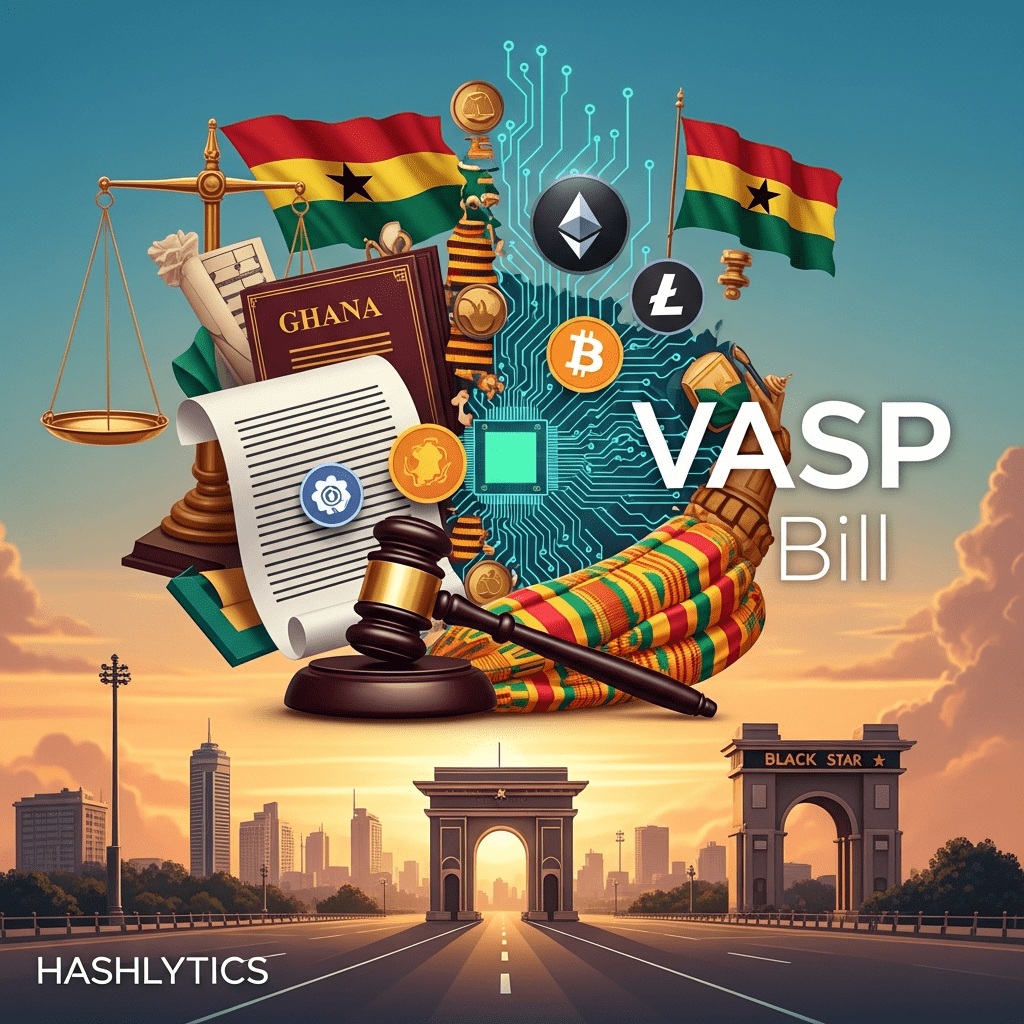
Ghana’s parliament has passed the Virtual Asset Service Providers (VASP) Bill 2025, officially legalizing cryptocurrency trading and establishing a comprehensive regulatory framework for digital assets. Bank of Ghana Governor Dr. Johnson Asiama announced the landmark legislation on December 19, 2025, declaring that virtual asset trading is now legal — no one will be arrested for engaging in crypto
while emphasizing the government’s intent to manage associated risks through proper oversight.
The new law ends years of regulatory uncertainty that left Ghana’s thriving crypto market operating in a legal gray area. With an estimated 3 million Ghanaians —roughly 17% of the adult population — already using digital assets, the legislation brings existing users and platforms under formal supervision while opening the door for international exchanges and fintech firms that previously avoided the market due to legal risks.
Transaction Scale and Regional Context
Ghana’s crypto market reached approximately $3 billion in transaction volume during the year ending June 2024, demonstrating significant grassroots adoption driven by remittances and peer-to-peer trading. However, this figure remains dwarfed by regional leader Nigeria, which recorded around $59 billion in crypto activity over a similar period. The regulatory move positions Ghana as part of a broader African trend toward structured oversight rather than outright prohibition, following recent examples from Kenya and South Africa.
| Country | Annual Crypto Volume (2024) | Regulatory Status |
|---|---|---|
| Nigeria | ~$59 billion | Regulated (Securities & Exchange Commission oversight) |
| Kenya | Not disclosed | Recently legalized with exchange guidelines |
| Ghana | ~$3 billion | Newly legalized (VASP Bill 2025) |
| South Africa | Significant market | Regulated under Financial Intelligence Centre Act |
Licensing Requirements and Enforcement Timeline
Under the VASP Bill, all cryptocurrency exchanges, wallet providers, and digital asset service platforms must obtain licenses from either the Bank of Ghana or the Securities and Exchange Commission (SEC), depending on their operational nature. The central bank will enforce compliance standards covering cybersecurity, capital requirements, anti-money laundering (AML) protocols, and alignment with Financial Action Task Force (FATF) guidelines.
The regulatory rollout will occur in phases throughout 2026, with existing operators required to register and comply to continue operating. The Bank of Ghana plans to establish a dedicated digital assets unit to monitor the sector and issue detailed directives in the coming months. Platforms failing to meet standards face sanctions or shutdown, reflecting the government’s commitment to eliminating fraud while fostering responsible innovation.
Consumer Protection and Financial Stability Measures
Governor Asiama emphasized that the framework prioritizes consumer protection and financial stability following Ghana’s 2022 banking crisis, which exposed regulatory weaknesses and resulted in significant depositor losses. The VASP Bill works in tandem with amendments to the Bank of Ghana Act designed to prevent systemic shocks while allowing controlled growth of the digital asset sector.
Key provisions include mandatory compliance reporting, transparency requirements for transactions, and mechanisms to reduce banking costs for small and medium-sized enterprises (SMEs). The law specifically targets fraud, money laundering, and misuse of customer funds—issues that plagued Ghana’s unregulated crypto market where hundreds of thousands of users traded through platforms operating without formal approval.
Economic Implications and Market Access
The legalization removes barriers that prevented international exchanges and institutional investors from entering Ghana’s market. Officials project that regulated crypto activity will generate tax revenue, create fintech jobs, and improve remittance efficiency—a critical economic driver for the West African nation. Youth-led entrepreneurship in blockchain payments and digital finance is a stated priority under the new framework.
However, analysts caution that regulation alone cannot eliminate volatility risks inherent to cryptocurrency markets or the technical complexity of blockchain technologies. Financial literacy and investor education remain essential complements to oversight, particularly given Ghana’s history of informal crypto adoption driven by currency devaluation and limited traditional banking access.
Comparison to Global Regulatory Approaches
Ghana’s “regulate rather than ban” philosophy aligns with emerging international best practices, contrasting sharply with nations that imposed outright crypto prohibitions. The approach mirrors recent regulatory developments in the United States, where proposed legislation aims to simplify tax rules for miners and establish clearer compliance frameworks.
Like Kenya’s recent Bitcoin legalization, Ghana’s framework defines clear operational guidelines for exchanges while maintaining central bank authority over monetary policy. This balanced approach aims to capture crypto’s benefits for financial inclusion and innovation while mitigating risks to consumers and the broader economy—a model that could influence regulatory decisions across West Africa.
What Happens Next
The Bank of Ghana and SEC will publish implementation guidelines and licensing application procedures in early 2026. Current crypto users can continue trading without legal concern, though platforms must prepare for compliance requirements. The transition period allows legacy operators to formalize their status, while new entrants can begin planning market entry strategies under Ghana’s newly clarified legal regime.
For traders and investors, the regulatory clarity provides both opportunities and obligations. Access to licensed, supervised platforms should reduce fraud risks, but compliance costs may affect fees and service structures. The government’s phased approach suggests authorities will monitor market development closely before expanding or tightening oversight based on observed outcomes.
Follow us on Bluesky, LinkedIn, and X to Get Instant Updates