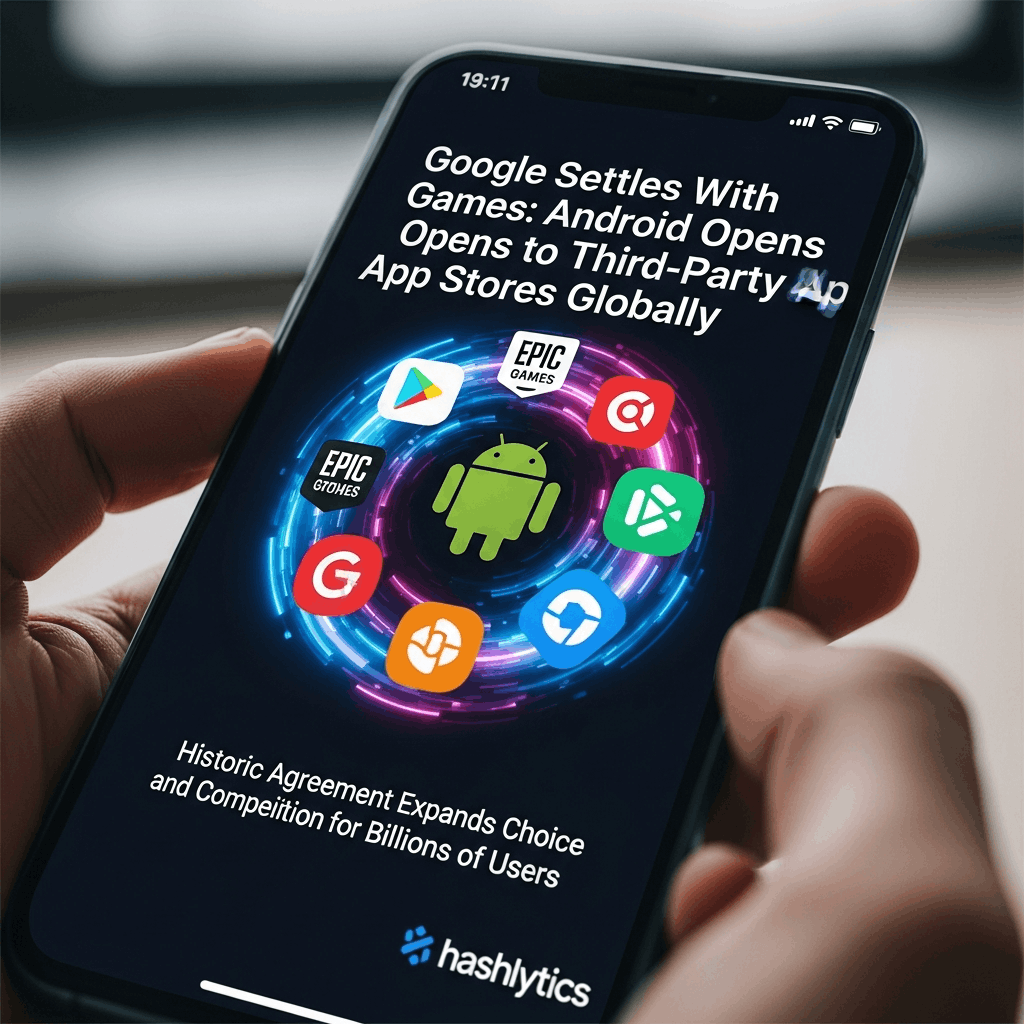
Google and Epic Games announced on March 4, 2026 a comprehensive settlement ending their five-year legal battle over Android app distribution and payment systems.
The agreement introduces a Registered App Store program making third-party store installation easier, reduces Google Play fees to 9-20% caps depending on transaction type, and allows developers to use alternative billing alongside Play Billing, changes that will roll out globally with Android’s next major update.
What Changed: The New Business Model
Google’s settlement establishes a fundamentally different economic model for Android app monetization. According to Sameer Samat, President of the Android Ecosystem at Google, the changes focus on expanding developer choice and flexibility, lowering fees, and encouraging more competition all while keeping users safe.
The new fee structure caps service fees at 9% for cosmetic items that don’t affect gameplay and 20% for items that materially impact gameplay like in-game currencies, power-ups, or new characters.
Developers can now display alternative payment options side-by-side with Google Play Billing inside their apps, with the ability to set different prices for each option. For example, a developer could show users a $9.99 price via their own payment processor versus $10.99 via Play Billing. Google explicitly cannot burden the use of in-app alternative payment options or external links by limiting their design, placement, formatting, or messaging,
according to court filings.
| Transaction Type | Previous Fee | New Fee Cap |
|---|---|---|
| First $1M annual revenue | 15% | 9-20% (item dependent) |
| Revenue above $1M | 30% | 9-20% (item dependent) |
| Play Billing processing fee | Included in above | Additional 5% (optional) |
Registered App Store Program: Streamlined Third-Party Access
The settlement creates infrastructure allowing alternative app stores to register with Google and become installable from websites with a single neutral prompt — eliminating the alarming security warnings that previously deterred users from downloading competing stores. According to The Verge, users will be able to download competing stores from websites with a single click starting with Android’s next major release, likely Android 17 in late 2026.
These Registered App Stores must meet Google’s security and safety standards but will otherwise face no technical barriers to distribution. The program applies globally, not just in the United States, providing consistent rules across all markets. Epic Games CEO Tim Sweeney called the proposal an awesome
solution that genuinely doubles down on Android’s original vision as an open platform.
The Legal Journey: From Lawsuit to Settlement
Epic filed suit against Google in August 2020 after introducing a direct-payment option in Fortnite that bypassed the Play Store’s 30% commission. Google removed Fortnite from the Play Store, triggering litigation that culminated in a December 2023 jury verdict finding Google guilty on all eleven counts of anti-competitive conduct. The jury determined that Google had illegally monopolized app distribution through deals like “Project Hug”—a program spending hundreds of millions to keep major publishers exclusively on Play—and “Project Banyan”—an agreement with Samsung to weaken the Galaxy Store’s competitiveness.
Judge James Donato issued a permanent injunction in October 2024 requiring Google to allow third-party app stores, alternative payment methods, and external links to developer websites. According to Wikipedia’s timeline, the Ninth Circuit upheld the verdict in July 2025, and the Supreme Court declined to hear Google’s appeal in October 2025. The settlement announced this week converts those court-mandated remedies into a negotiated agreement both parties support.
Why This Settlement Differs From Apple’s Outcome
Epic sued both Google and Apple over similar app store restrictions, but outcomes diverged dramatically. Apple largely won its case—the court found Apple’s App Store was not an illegal monopoly, though it ordered minor modifications allowing developers to include external payment links. According to TechCrunch, Apple’s Services business, which includes App Store revenue, reached $28.75 billion in its most recent quarter—up 15% year-over-year—demonstrating that Epic’s lawsuit barely impacted Apple’s business model.
Google, by contrast, faced evidence of explicit anti-competitive conduct including revenue-sharing deals with OEMs, carriers, and developers designed to exclude competing app stores. The jury found Google’s behavior fundamentally different from Apple’s vertically integrated ecosystem, making Google’s practices subject to antitrust liability while Apple’s were not.
Microsoft and FTC Opposition
Not everyone supports the settlement. Microsoft filed a friend-of-the-court brief opposing the proposed modifications to Judge Donato’s injunction, arguing that the settlement permits what the injunction prohibits: requiring developers to implement Google Play Billing as a condition of access to the Play Store.
According to Payments Dive, Microsoft claimed the settlement’s fee structure makes implementing alternative billing economically unviable because Google can charge a 9-20% service fee on any transaction made within 24 hours of an in-app clickthrough—including purchases on external websites.
The Federal Trade Commission also weighed in, noting that a deal Epic favors may not necessarily serve the public interest. Judge Donato expressed similar concerns during a January 22, 2026 hearing, remarking that Google has had yet another year of harvesting its ill-gotten gains from the predatory and anticompetitive conduct determined by a jury.
The court must still approve the settlement before it takes effect.
Implementation Timeline and Technical Requirements
Google indicated that changes requiring Android OS modifications will not arrive before the next major Android update—likely Android 17 in late 2026 or early 2027. The Registered App Store certification process must be built into the operating system, requiring significant engineering work. According to Ars Technica’s Ryan Whitwam, Google must certify external stores to maintain security standards, introducing new challenges around malware prevention and quality control if those stores aren’t properly vetted.
Immediate policy changes took effect on October 29, 2025 under the court’s existing injunction, including allowing developers to promote alternative payment methods, ending revenue-sharing exclusivity deals with OEMs and carriers, and stopping requirements that apps launch first or exclusively on Play. The settlement extends these policies globally and adds the Registered App Store infrastructure.
What This Means for Developers
For developers, the settlement provides financial certainty that the previous court injunction lacked. The capped service fees—9% for cosmetics, 20% for gameplay-affecting items—allow finance teams to build accurate ROI models for implementing their own payment processors. Apps like Spotify or Netflix can now direct users to their websites for lower-priced subscriptions without Play Billing’s 30% cut, though Google may still assess a 9-20% fee on those transactions if they occur within 24 hours of an in-app link.
Gaming apps gain flexibility to create sophisticated monetization strategies with side-by-side pricing options for different payment methods. According to Neon Blog’s analysis, developers can now calculate the precise financial benefit of building their own payment infrastructure versus accepting Google’s 25% maximum combined fee (20% service + 5% billing).
However, device storage constraints may limit how many alternative stores users install, creating winner-take-most dynamics where only the largest third-party stores gain meaningful adoption.
Security and Safety Concerns
Opening Android to easier third-party store installation introduces malware risks if Google’s certification process proves inadequate. Google previously argued that Judge Donato’s injunction posed security threats by forcing the company to distribute unvetted app stores. The settlement attempts to balance openness with safety through the Registered App Store program requiring stores to meet Google’s security standards before certification.
Critics worry that certification could become a gatekeeping mechanism allowing Google to exclude competitors under the guise of security concerns. The settlement includes oversight mechanisms to prevent this, but implementation details remain unclear pending court approval.
Global Impact and Competitive Dynamics
Unlike many antitrust settlements limited to specific jurisdictions, this agreement applies worldwide. Developers will face consistent rules across all markets rather than fragmenting compliance strategies by region. The Epic Games Store for Android—announced for Play Store distribution following Epic’s legal victory—will now reach billions of Android users globally without installation friction.
The settlement runs through 2032, providing seven years of stability for developers building alternative monetization and distribution strategies. According to Developer-Tech, this timeline allows businesses to make long-term platform investments with regulatory certainty rather than navigating constantly shifting policies.
What Comes Next
Judge Donato scheduled additional hearings to evaluate the settlement’s impact on the original injunction and state-level antitrust cases like Utah v. Google. If approved, Google will implement the Registered App Store program and revised fee structure in the next Android version. If rejected, the October 2024 injunction remains in force, potentially creating the “implementation disputes” both parties sought to avoid through settlement.
For users, these changes will manifest as more options for app stores, payment methods, and pricing—assuming developers invest in building alternative infrastructure and users overcome inertia favoring the default Play Store experience. The settlement transforms Android from a platform with de facto app store exclusivity into a genuinely multi-store ecosystem, fulfilling the “open platform” vision that Google originally marketed but struggled to maintain once Play Store revenue exceeded billions annually.
As Google stated in its announcement, the changes will make for a stronger Android ecosystem with more choice for users and even more successful developers who can further invest in higher quality experiences on mobile and beyond.
Whether this vision becomes reality depends on court approval, successful technical implementation, and whether consumers and developers embrace newly available alternatives over the established Play Store status quo.
Follow us on Bluesky, LinkedIn, and X to Get Instant Updates