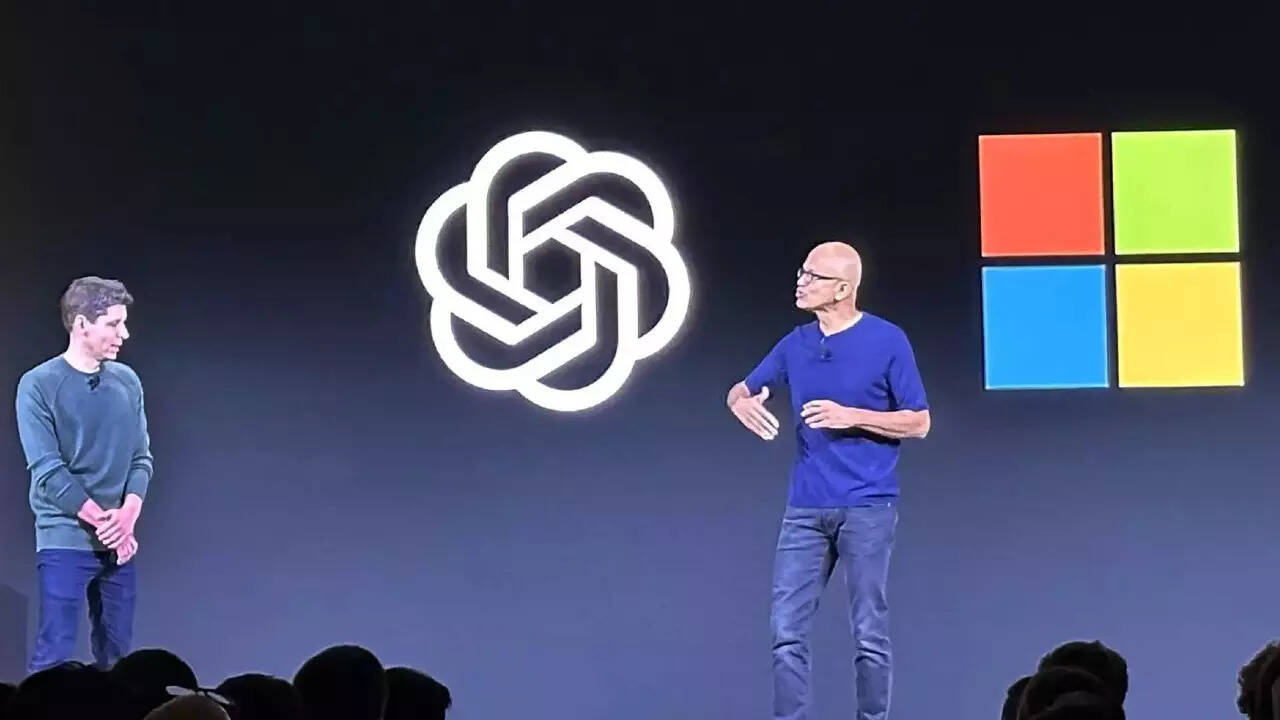
The partnership between OpenAI and Microsoft, a relationship that has significantly impacted the AI landscape, reached a critical juncture in late 2025, culminating in a comprehensive agreement designed to address existing tensions and solidify the future direction of artificial general intelligence (AGI). The OpenAI-Microsoft Deal was more than just a technological arrangement; it was a strategic corporate maneuver with the future of AI at stake.
The foundation for this agreement was laid during the turbulent events of late 2023, when Sam Altman was briefly ousted from OpenAI, only to be swiftly recruited by Microsoft CEO Satya Nadella. This event exposed vulnerabilities within the partnership and triggered a series of strategic realignments.
A Near-Death Experience for OpenAI
Altman’s sudden dismissal sent shockwaves throughout the tech industry. Nadella’s quick action to recruit Altman and Greg Brockman to lead a new AI research unit within Microsoft signaled that Microsoft was not merely an investor, but a crucial lifeline. This move was strategically astute, ensuring that key talent would remain within the Microsoft ecosystem should OpenAI falter.
The internal unrest at OpenAI, with over 700 employees threatening to move to Microsoft, triggered a significant power shift. The board was restructured, and Microsoft gained a non-voting observer seat, providing valuable insight into OpenAI’s operations.
Cracks in the Foundation
Despite Altman’s reinstatement, the partnership began to show signs of strain. By 2024, strategic differences became increasingly apparent. Microsoft’s subsequent actions indicated a growing desire for independence from OpenAI’s technological dominance.
A key moment occurred in March 2024 when Nadella hired Mustafa Suleyman, a co-founder of Google DeepMind and Inflection AI, to lead a new “Microsoft AI” division. Suleyman’s objective was to develop consumer AI products that were not solely dependent on OpenAI’s technology. As Nadella stated in a blog post, this new organization was focused on “advancing Copilot and our other consumer AI products and research.”
Concurrently, Microsoft intensified its internal AI development efforts, focusing on its “Phi” family of small language models (SLMs) and training large models in-house. This strategy indicated Microsoft’s preparation for a future where it would not be entirely reliant on OpenAI for AI innovation.
Defining the Future of AI
Beyond technological independence, revenue streams and the definition of AGI became significant points of contention. Both OpenAI, with its “ChatGPT Enterprise,” and Microsoft, with its “Azure OpenAI Service,” competed for the same enterprise clients, causing friction and market confusion.
The most critical issue, however, was AGI. Under the original agreements, Microsoft’s license to OpenAI’s technology applied only to pre-AGI models. Upon OpenAI achieving AGI, the license would expire, and the technology would revert to the non-profit’s control. The OpenAI board had the sole authority to declare when AGI had been reached, a situation that threatened to cut Microsoft off from technology it had invested billions in.
A New Era Dawns
By 2025, the relationship required a formal reset. The resulting agreement addressed ownership concerns and secured long-term IP access for Microsoft, while also allowing both companies to pursue independent innovation and growth.
Key changes included:
- A verified process for declaring AGI.
- Extended IP rights for Microsoft, including post-AGI models until 2032, with safety guardrails.
- Clarified definitions of “research IP,” granting Microsoft rights to confidential methods until either AGI verification or 2030.
- Exclusion of OpenAI’s consumer hardware from Microsoft’s IP rights.
- Authorization for OpenAI to jointly develop some products with third parties.
- Empowerment for Microsoft to independently pursue AGI, even with third-party partners.
- Compute thresholds for Microsoft’s use of OpenAI’s IP in AGI development before AGI is declared.
- A continued revenue share agreement until AGI verification, with payments extended over a longer timeframe.
- OpenAI’s commitment to purchase an additional $250 billion of Azure services.
- Permission for OpenAI to provide API access to US government national security customers, regardless of cloud provider.
- Authorization for OpenAI to release open weight models meeting capability criteria.
According to the official announcement, Excluding the impact of OpenAI’s recent funding rounds, Microsoft held a 32.5 percent stake on an as-converted basis in the OpenAI for-profit. The agreement preserves key elements that have fueled this successful partnership — meaning OpenAI remains Microsoft’s frontier model partner and Microsoft continues to have exclusive IP rights and Azure API exclusivity until Artificial General Intelligence (AGI).
Corporate Normalization and a Future Defined
The October 2025 deal represents a “corporate normalization” of the OpenAI-Microsoft relationship. It resolves the identity crisis that fueled the 2023 boardroom drama and mitigates the competitive tensions of 2024. Microsoft emerges as a major shareholder with secured technology rights, while OpenAI transitions from a research lab to a more commercially oriented entity.
This agreement not only redefines a partnership but also reshapes the landscape of AI development and deployment. It sets the stage for a future where both companies can pursue their individual visions of AGI, while still leveraging the strengths of their collaboration. The implications for the future of AI, and the world it will shape, are profound.
Follow us on Bluesky , LinkedIn , and X to Get Instant Updates