
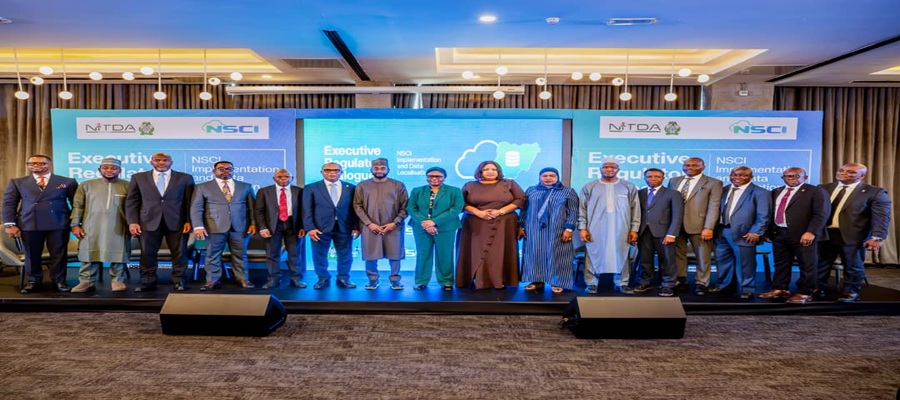
NITDA Director General Kashifu Inuwa confirmed the partnership at an Executive Regulatory Dialogue in Lekki, Lagos, which brought together stakeholders from finance, telecom, data centers, and technology. He framed the issue as one of national economic security. Imagine what will happen to our economy if tomorrow a major disruption or geopolitical crisis prevents our banks from accessing critical digital infrastructure hosted outside our country,
Inuwa said.
Sovereignty, he clarified, does not mean isolation. It means building the national capacity to make informed technology decisions, and Nigeria must choose its own infrastructure and standards.
Banks Go First, and the Clock Is Short
Finance is the natural starting point. The CBN’s cashless policy pushed institutions to upgrade their technology, which opened the door for fintech companies and helped Nigeria build one of Africa’s leading fintech ecosystems. NITDA and the CBN now want the financial sector to comply with the sovereign cloud framework before anyone else.
The division of labor is simple. NITDA supplies the policy framework, and sector-specific regulators then use it to advance digital transformation in their own industries. CBN Deputy Governor Lamido Abubakar Yuguda reaffirmed the bank’s commitment to financial stability and cybersecurity, and confirmed the January 2027 timeline for critical payment transaction data.
What Local Providers Told the Survey
Inuwa said the ecosystem is building on what already exists rather than starting from scratch. A pre-event survey by Dr. Muhammad Aminu Lawal, Special Assistant to the NITDA DG, was offered as evidence:
- 79 percent of 42 surveyed providers said they are ready to take on additional financial-sector workloads
- 74 percent said they can onboard new financial customers within three months
The same survey flagged regulatory clarity, migration timelines, and local infrastructure capacity as the critical open issues. Financing costs, power supply, and foreign exchange remain the main constraints on planned infrastructure expansion in 2027. Making the transition smooth, the survey concluded, will take coordinated action from NITDA, the CBN, and industry players.
Hashlytics Take
The readiness numbers deserve a careful read. They come from 42 providers answering a survey run out of the NITDA DG’s own office, and providers have every reason to say yes to a mandate that sends financial workloads their way. Being ready to onboard a customer within three months is a statement of intent, not proof of capacity. The constraints listed alongside it, financing, power, and foreign exchange, are the ones that decide whether capacity actually gets built, and none of them is something a regulator can order away. With the deadline roughly two months out and migration timelines still named as an open issue, the real test is not whether providers say they are ready. It is whether banks can move payment data onto local infrastructure without a service interruption that undermines the case for sovereignty in the first place.
Follow Hashlytics on Bluesky, Facebook, LinkedIn , Telegram and X to Get Instant Updates