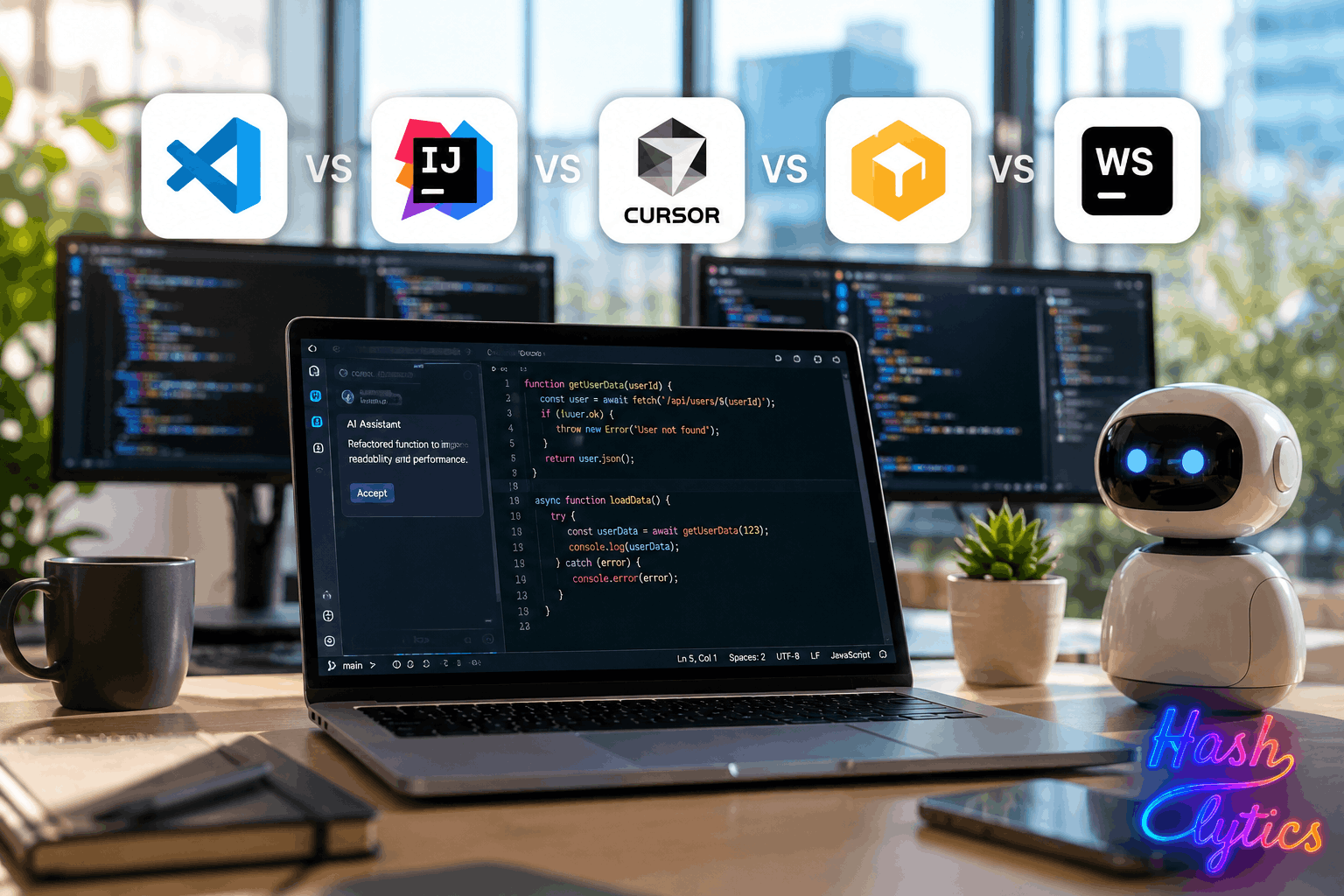
The real question now is which tool handles which layer of your stack, because most serious developers use two. One factual correction before we start: Cursor is an independent company, not an xAI product. xAI has no standalone IDE. Cursor routes through Claude, GPT, Gemini, and Grok models but is built and priced separately.
The Five Tools, Head to Head
| Tool | Made By | Interface | Entry Price | Model | SDK/Mobile | Beginner Friendly |
|---|---|---|---|---|---|---|
| Claude Code | Anthropic | Terminal, VS Code, JetBrains, Desktop, Web | $20/month (Pro) | Fable 5.1 / Sonnet 5 | MCP plugins, no native mobile SDK | Medium (terminal-first) |
| OpenAI Codex | OpenAI | Web, CLI, VS Code, iOS | $20/month (Plus) | GPT-5.4 / GPT-5.5 | API key access, GitHub integration | High (GitHub-native) |
| Google Antigravity | Desktop, CLI, VS Code, IntelliJ, Xcode, Zed | Free (preview) | Gemini 3.1 Pro + Claude/GPT-OSS | Native Android, iOS via Xcode extension | High (visual IDE) | |
| Cursor | Cursor (independent) | Standalone IDE, CLI (Jan 2026) | $20/month (Pro) | Multi-model: Claude, GPT, Gemini, Grok | BugBot, Design Mode, Security Agents | Very High (autocomplete-first) |
| Meta Muse Code | Meta | Terminal (beta) | Pay-as-you-go: $1.25/$4.25 per MTok | Muse Spark 1.2 | MCP support, no native mobile SDK | Low (CLI only, beta) |
Where Each Tool Actually Wins
Claude Code leads on deep, long-horizon engineering. Fable 5.1’s 54% cost reduction per completed task and zero-data-retention support finally made it viable for enterprise teams that previously could not send sensitive code to Anthropic’s infrastructure. The CLAUDE.md project memory system is the best context management of the five tools. At 88.6% SWE-bench, it sets the capability ceiling. Weakness: terminal-first workflow alienates beginners, and $100-$200/month for heavy use is steep.
OpenAI Codex is the strongest tool for asynchronous delegation. The GitHub-native architecture (automatic PR review, Slack integration, event-driven Triggers) means you assign a task and come back to a pull request. The April 2026 shift to token-credit billing makes costs less predictable: OpenAI’s own estimate is $100-$200 per developer per month for active use. Best for teams with established GitHub workflows. Weakness: locked into GitHub, no direct support for GitLab or Bitbucket projects.
Google Antigravity is the only tool with genuine native mobile SDK support. The Gemini model family underneath it is shipping faster than any competitor, with three releases in six weeks as of August. The Android CLI 1.0 gives agents access to SDK management, Compose preview rendering, and UI test execution. The new Xcode extension (available from Xcode 27 beta 6) extends this to iOS and macOS without leaving Apple’s own IDE. Free during preview with a $100/month AI Ultra tier for heavy usage. Weakness: free tier rate limits have frustrated developers; three major model releases in six weeks signals instability as much as pace.
Cursor wins on daily developer experience. Tab autocomplete, visual diff approval, Design Mode for frontend work, and multi-model routing (switch between Claude, GPT-5.6, Gemini, or Grok per task) make it the most flexible IDE of the five. Cursor Pro at $20/month is the “developer meta stack” baseline that most senior engineers combine with one agent tool. BugBot security scanning and automated PR review are the enterprise differentiators. Weakness: $40/user Teams pricing against Claude Code Premium’s $125/user creates a real budget gap at scale; no native terminal agent depth comparable to Claude Code or Muse Code for long-horizon work.
Meta Muse Code is the price disruptor. At $1.25/$4.25 per million tokens with git worktree isolation, crash-proof event logging, and persistent background execution, it costs a fraction of the competition for high-volume agentic workloads. Still terminal-only and in beta as of August 2026. No mobile SDK, no VS Code extension, no beginner surface. For cost-sensitive teams comfortable in the terminal running long parallel tasks, it is the challenger nobody has fully stress-tested yet.
Our Editorial Take
The consensus developer meta in 2026 is Cursor Pro ($20) plus one agent tool, either Claude Code Pro ($20) for complex work or Muse Code pay-as-you-go for cost-sensitive volume. OpenAI’s GPT-6 Astra announcement will reshape the Codex tier later this year, but right now Codex is the strongest tool specifically for teams that live inside GitHub and want asynchronous, review-first automation rather than interactive sessions.
For beginners in Nigeria and across Africa where internet costs and dollar-denominated subscriptions bite hard: Antigravity’s free preview tier is the only serious free option that delivers full desktop IDE quality with genuine Android native support. Use it while it lasts. The rate limits will not stay as generous once Google moves out of preview pricing. Muse Code’s pay-as-you-go model could be the most accessible long-term option for low-volume users who do not want a $20 monthly commitment, but it requires terminal comfort and has no safety net for mistakes in production environments.
Follow us on Bluesky, LinkedIn, X, and Telegram to Get Instant Updates