+0.67%
+0.03%
-0.14%
+1.10%
+4.54%
-0.31%
Unregistered Crypto Services Face Prison Time and Heavy Fines
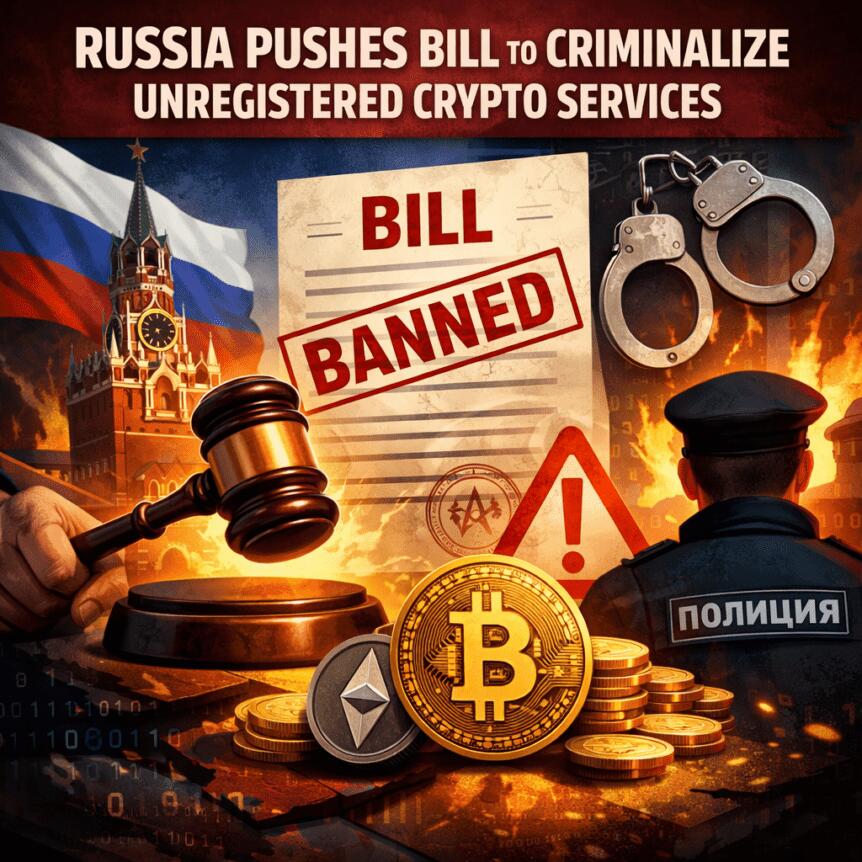
The draft legislation would attach criminal liability to individuals and organizations that provide crypto-related services without central bank registration. According to Crypto Breaking News, individuals operating without proper licensing could face fines up to 4,000 USD and up to four years in prison. Penalties intensify significantly for organized groups or cases involving substantial profits or damages, with compulsory labor for up to five years or imprisonment extending to seven years. Additional provisions allow fines of up to 1 million rubles (approximately 13,100 USD) or profit-linked penalties spanning five years, depending on case specifics.
Timing Creates Tension Between Lawmakers and Courts
The bill arrives as Russia prepares to implement its broader Digital Currency and Digital Rights framework in July. However, Russia’s Supreme Court has expressed reservations about the measure, questioning whether criminal penalties are justified before the comprehensive regulatory architecture takes effect. The court suggested that criminal enforcement lacks proper statutory foundation and could be premature without clarifying how digital assets will be treated under the new framework.
Multi-Pronged Regulatory Strategy Takes Shape
This draft represents part of a larger regulatory push that extends beyond exchange oversight. In March, Russian lawmakers proposed penalties for illegal crypto mining, signaling a unified approach targeting both trading platforms and mining operations. The legislation centers on a licensing regime controlled by the Bank of Russia, requiring entities to obtain approval before organizing digital currency circulation.
The Grinex exchange hack underscores why regulators are moving aggressively. The platform suffered losses exceeding 1 billion rubles (roughly 13.7 million USD) in a suspected state-sponsored attack, highlighting operational vulnerabilities in the largely unregulated sector. Such incidents strengthen the political case for tighter enforcement.
What Compliance Could Mean for Market Participants
If the Digital Currency and Digital Rights law passes as scheduled, it could provide the statutory foundation for criminal penalties outlined in the draft. Market observers expect rapid consolidation around compliant, licensed operators as gray-market activity faces genuine legal jeopardy. However, compliance costs may increase significantly, potentially creating barriers for smaller platforms and raising questions about how authorities will interpret enforcement thresholds.
The coming months will clarify whether Russia’s regulatory framework balances innovation with investor protection or tilts heavily toward restriction. July’s implementation of the broader digital-currency law remains the critical milestone for understanding how criminal penalties will be applied in practice.
Follow Hashlytics on Bluesky, LinkedIn , Telegram and X to Get Instant Updates